Skip to content
Animals Top
Home>Animals>Birds>Landfowl
Animal Profile IUCN: LC

Penelope jacquacu

Penelope jacquacu,Spix's Guan

Spix crested pheasant (scientific name: Penelope jacquacu) There are 4 subspecies of S. Guan.Spex Crested pheasants like to live in groups. Most of the time they live in pairs or in groups of 6-12. They walk on branches, looking for fruits and leaves to eat. It feeds mainly on the fruits of the uppe

Landfowl 533 views
Scientific Name Penelope jacquacu,Spix's Guan
Length 66-76cm
Weight 1.142-1.78kg
Lifespan No textual research information is available
IUCN Status LC
Advertisement

Table of Contents

    Spix crested pheasant (scientific name: Penelope jacquacu) There are 4 subspecies of S. Guan.
    1 b4c510fd9f9d72a89407890dd2a2834349bbb13_ nine ray image converter. JPG

    Spex Crested pheasants like to live in groups. Most of the time they live in pairs or in groups of 6-12. They walk on branches, looking for fruits and leaves to eat. It feeds mainly on the fruits of the upper layers of the rainforest. Its call is typical of an Amazonian dawn chorus. A bird's nest is built on a tree or stump with branches and leaves. The female will lay two to three eggs at a time, which are rough and white in surface. The female will dish the eggs alone.

    Listed on the International Union for Conservation of Nature (IUCN) 2016 Red List of Threatened Species ver 3.1 - Not Threatened (LC).


    Protect wild animals and eliminate wild meat.

    Maintaining ecological balance is everyone's responsibility!

    At a glance

    Profile Details

    Key characteristics, appearance, and habitat information.

    Traits & Behavior

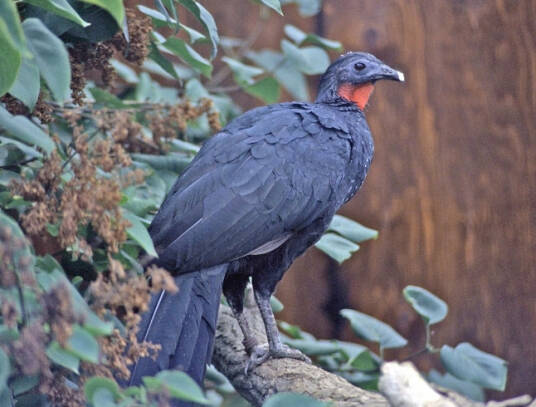
    It is mainly dark gray, with blue-gray skin and a red dewlap on the throat

    Appearance

    The Spex Crested pheasant is a large bird with a general length of 66-76 cm and a weight of 1142-1780 g. They resemble turkeys in appearance, with small, crowned heads, long, powerful feet, and a broad, long tail. They are mainly dark gray in color, with radiating white spots on the neck and chest. Slightly lighter plumage on the rump and abdomen. The eye sockets are featherless, the skin is bluish-gray, and the throat has a red dewlap. Female and male chickens are similar, but the chicks have ochre spots.

    Distribution & Habitat

    It is distributed in Bolivia, Brazil, Colombia, Ecuador, Guyana, Peru, and the Bolivarian Republic of Venezuela.
    It lives in forests and is the most arboreal of the galliniformes.
    Advertisement

    Visual guide

    Browse available images of this species.

    Quick answers

    Penelope jacquacu FAQs