Skip to content
Animals Top
Home>Animals>Birds>Landfowl
Animal Profile IUCN: LC

Pternistis atrifrons

Pternistis atrifrons,Black-fronted Francolin

The Black-fronted colored partridge (Pternistis atrifrons) is known as black-fronted Francolin and has no subspecies.The black-fronted partridge feeds on plant seeds, as well as insects such as termites (isoptera). A bird that can occasionally fly short distances. When in danger, he prefers running

Landfowl 505 views
Scientific Name Pternistis atrifrons,Black-fronted Francolin
Length About 40 cm
Weight 340-600g
Lifespan No textual research information is available
IUCN Status LC
Advertisement

Table of Contents

    The Black-fronted colored partridge (Pternistis atrifrons) is known as black-fronted Francolin and has no subspecies.
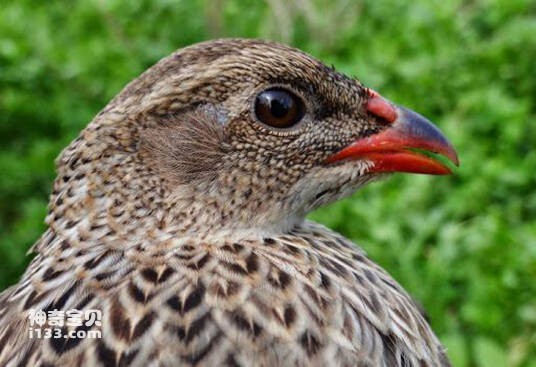
    472309 f79052982209d2bbfddbca7bcb0a46d42f_ nine ray image converter. JPG

    The black-fronted partridge feeds on plant seeds, as well as insects such as termites (isoptera). A bird that can occasionally fly short distances. When in danger, he prefers running to escape danger rather than flying. With the exception of sub-adult bird activity that has been observed in mid-March and mid-May, no information is known as to whether this species mainly breeds during the onset of the rainy season.

    Listed on the International Union for Conservation of Nature (IUCN) 2016 Red List of Threatened Species ver 3.1 - Not Threatened (LC).


    Protect wild animals and eliminate wild meat.

    Maintaining ecological balance is everyone's responsibility!


    At a glance

    Profile Details

    Key characteristics, appearance, and habitat information.

    Traits & Behavior

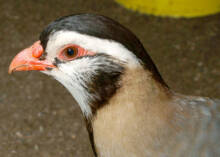
    The throat feathers have black and white radial plumage

    Appearance

    The black-fronted partridge is about 40 cm long. The forehead has black feathers, this color extends to the ciliary area and the chest, the throat is white, the neck and chest are light brown with some black stripes, and the upper body is grayish-yellow. It's a little different from the chestnut pillow partridge. The beak and legs are red.

    Distribution & Habitat

    It is found in Ethiopia. The jungle inhabits forest edges and semi-open forest lands, with wide areas of low undergrowth.
    Advertisement

    Visual guide

    Browse available images of this species.

    Quick answers

    Pternistis atrifrons FAQs