Skip to content
Animals Top
Home>Animals>Birds>Landfowl
Animal Profile IUCN: LC

Pternistis bicalcaratus

Pternistis bicalcaratus,Double-spurred Francolin

The Double-spurred Francolin (Pternistis bicalcaratus) has three subspecies.The partridge is an opportunist living in west Africa. Its diet is closely related to the habitat environment and seasonal changes. It mainly eats dry rhizoids and tubers, and also eats plant seeds and insects. When in dange

Landfowl 557 views
Scientific Name Pternistis bicalcaratus,Double-spurred Francolin
Length 30-34cm
Weight 381-507g
Lifespan No textual research information is available
IUCN Status LC
Advertisement

Table of Contents

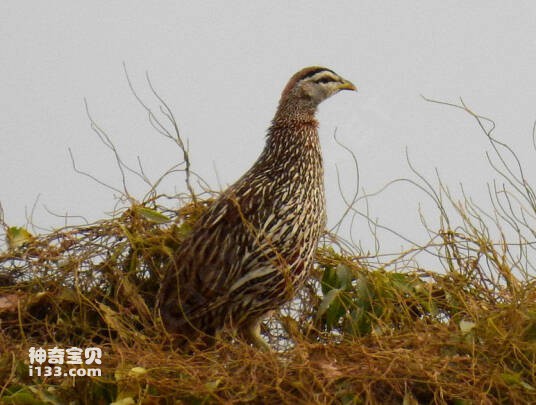
    The Double-spurred Francolin (Pternistis bicalcaratus) has three subspecies.
    a08b87d6277f9e2fc56d61281330e924b899f3b2_ nine ray image converter. JPG

    The partridge is an opportunist living in west Africa. Its diet is closely related to the habitat environment and seasonal changes. It mainly eats dry rhizoids and tubers, and also eats plant seeds and insects. When in danger, he prefers running to escape danger rather than flying.

    Listed on the International Union for Conservation of Nature (IUCN) 2016 Red List of Threatened Species ver 3.1 - Not Threatened (LC).


    Protect wild animals and eliminate wild meat.

    Maintaining ecological balance is everyone's responsibility!


    At a glance

    Profile Details

    Key characteristics, appearance, and habitat information.

    Traits & Behavior

    The forehead has black striped feathers, with broad white brow lines and radiating spots below the neck

    Appearance

    The average body length of partridge is 30-34 cm; The male weighs 507 g and the female 381 g. Wingspan 45-50 cm. The forehead has black striped feathers, with broad white brow lines, radiating spots below the neck, and brown-gray wings. The beak and legs are yellow.

    Distribution & Habitat

    It is found in Benin, Burkina Faso, Cameroon, Chad, Cote d 'Ivoire, Gambia, Ghana, Guinea, Guinea-Bissau, Liberia, Mauritania, Morocco, Niger, Nigeria, Senegal, and Sierra Leone.
    It lives widely in sub-Saharan Africa, with habitats ranging from moist savannas to arid savannas, from wastelands to vast areas with low shrubs. Active early in the morning and late in the evening, it moves to the shade to rest during the hottest part of the day.
    Advertisement

    Visual guide

    Browse available images of this species.

    Quick answers

    Pternistis bicalcaratus FAQs