Skip to content
Animals Top
Home>Animals>Birds>Landfowl
Animal Profile IUCN: LC

Scleroptila whytei

Scleroptila whytei,Whyte's Francolin

White ring neck Partridge (scientific name: Scleroptila whytei) foreign name Whyte' s Francolin, no subspecies.White-necked partridges are land birds that usually gather in pairs or family groups. Flies fast when in danger, but usually runs around in panic. It feeds mainly on the roots and bulbs

Landfowl
Scientific Name
Scleroptila whytei,Whyte's Francolin
Length
About 33 cm
Weight
392-480g
Lifespan
No textual research information is available
IUCN Status
LC
Advertisement

Table of Contents

    White ring neck Partridge (scientific name: Scleroptila whytei) foreign name Whyte' s Francolin, no subspecies.

    78310 a55b319ebc4706a6a848e26cffc1e171698_ nine ray image converter. JPG


    White-necked partridges are land birds that usually gather in pairs or family groups. Flies fast when in danger, but usually runs around in panic. It feeds mainly on the roots and bulbs of plants, searches for insects and plant seeds on the ground, eats weeds, roots, seeds, young leaves and crops, and also eats insects and invertebrates.
    The White Partridge is monogamous and the breeding season in Zambia is from February to December, almost all year round. The nest is built on the ground hidden in dense grass. Each clutch lays 3-8 eggs.

    Listed on the International Union for Conservation of Nature (IUCN) 2016 Red List of Threatened Species ver 3.1 - Not Threatened (LC).


    Protect wild animals and eliminate wild meat.

    Maintaining ecological balance is everyone's responsibility!


    At a glance

    Profile Details

    Key characteristics, appearance, and habitat information.

    Traits & Behavior

    A medium tan ringnecked partridge

    Appearance

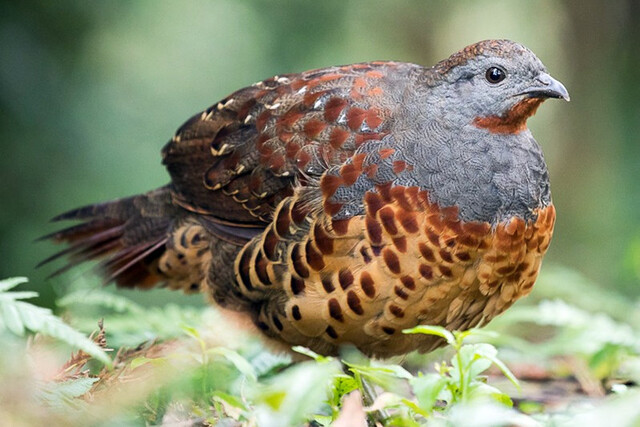
    White's Partridge is 33 cm long and weighs 392-480 grams. It is a medium-sized brown-colored ringnecked partridge with reddish square markings on the brown-colored feathers on the sides of its neck. The lower body has black and white horizontal streaks of water. The throat is stained white. The beak is black and the legs are yellow.

    Distribution & Habitat

    It is found in the Democratic Republic of the Congo, Malawi and Zambia.
    It inhabits the mountains, hilly grasslands and open woodlands of Africa. It inhabits at an altitude of 600-1800 m, reaching up to 2000 m on the Nyika Plateau.

    Quick answers

    Scleroptila whytei FAQs

    Follow your curiosity

    Keep Exploring Animals

    Read more about animal biology, compare similar-looking species, or browse the animal encyclopedia.