Skip to content
Animals Top
Home>Animals>Fish>Medium Fish
Animal Profile IUCN: LC

Luciobramamacrocephalus

Luciobramamacrocephalus,longspiky-head carp,Blowgun, pointed-headed catfish, horse-headed catfish, duck-billed catfish, trumpet fish, catfish, catfish

The Latin name of the carp is Luciobramamacrocephalus, and the English name is longspiky-head carp. It is a large predatory fish and a species endemic to my country.The carp is a large economic fish, fierce in nature, and likes to live alone. Individuals under 30 cm are generally active in the middl

Medium Fish 681 views
Scientific Name Luciobramamacrocephalus,longspiky-head carp,Blowgun, pointed-headed catfish, horse-headed catfish, duck-billed catfish, trumpet fish, catfish, catfish
Length 30-200cm
Weight 5-50kg
Lifespan No verification information
IUCN Status LC
Advertisement

Table of Contents

    The Latin name of the carp is Luciobramamacrocephalus, and the English name is longspiky-head carp. It is a large predatory fish and a species endemic to my country.
    a9399ec466cd2d2e19458b8980d403c2_九雷图片转化为_九雷图片转化为.jpg

    The carp is a large economic fish, fierce in nature, and likes to live alone. Individuals under 30 cm are generally active in the middle and upper layers of the water body, while larger individuals mostly live in the middle and lower layers. They have semi-migratory habits in rivers and lakes. Males reach sexual maturity at 4 winters and females at 5 winters. The reproductive period is from April to July, and mature broodstock migrate upstream to places with fast currents in rivers to reproduce and lay floating eggs. They are ferocious, and fatten in lakes during the juvenile stage. They eat cladocerans and fry during the fry stage; adult fish turn to fish, often using their long tubular snouts to forage for small fish in cracks between rocks or in waterweeds. The maximum weight can reach more than 50 kg, and the natural yield is not high.

    Overfishing is one of the main reasons for the decline in the resources of the black carp; coupled with the barrier of rivers and lakes, it is difficult for its young fish to enter lakes to live and fatten; in addition, the overall decline in the amount of fish resources in major rivers has a greater impact on large and medium-sized carnivorous fish, so food shortage is also the reason for the significant reduction of this species.

    Listed in the "Red List of Chinese Species": Vulnerable (VU)

    Listed in the "Red Book of Endangered Animals in China - Fish": Vulnerable.

    Listed in the second level of China's "National Key Protected Wildlife List" (February 5, 2021).


    Protect wild animals and eliminate game.

    Maintaining ecological balance is everyone's responsibility!


    At a glance

    Profile Details

    Key characteristics, appearance, and habitat information.

    Traits & Behavior

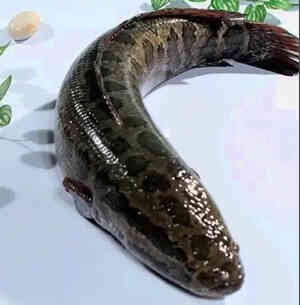
    It has a pointed head, a long beak, and a slender body. It is commonly known as a blowpipe.

    Appearance

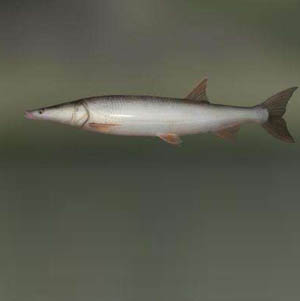
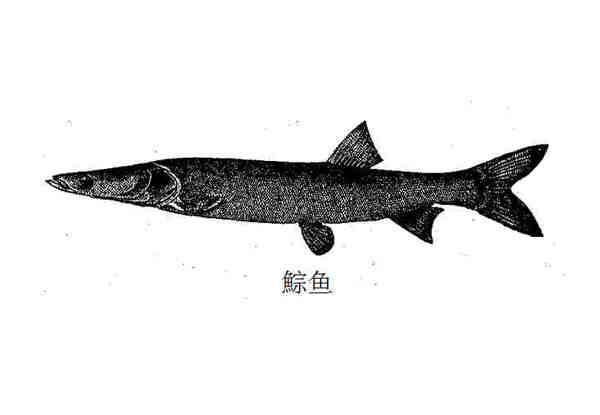
    The body is slender and slightly cylindrical, with a thick caudal peduncle. The dorsal margin is straight and the abdomen is round. The head is long and pointed, slightly tubular in the front and flattened in the back. The snout is long and duck-like, and the snout length is 2.2~2.8 times the diameter of the eye. The mouth is terminal and obliquely cleft. The maxilla extends to the lower edge of the eye or slightly behind. The eyes are relatively small. The space between the eyes is wide and flat, about 2 times the diameter of the eye, and there is a transparent fat body behind the eyes. The operculum is connected at the isthmus. The scales are small and thin. The lateral line is slightly arc-shaped and extends backward to the base of the caudal fin.
    The dorsal fin is short and located very posteriorly; the starting point of the anal fin is opposite to the end of the dorsal fin; the pectoral and pelvic fins are short; the caudal fin is deeply forked, and the lower lobe is long. The

    Distribution & Habitat

    Lives in open water bodies such as rivers or lakes.
    Advertisement

    Visual guide

    Browse available images of this species.

    Quick answers

    Luciobramamacrocephalus FAQs