Quick answer: Animals with true crests include cockatoos, hoopoes, peafowl, crested penguins, elegant quail, Palawan peacock-pheasants, crested auklets, crested geckos, Fiji crested iguanas, and crested porcupines. A crest is a raised structure on the head, neck, or back that may be made of feathers, skin, scales, spines, or modified hairs. Crests can be used for courtship, communication, species recognition, defense, or visual display.
Not every structure on an animal's head is a crest. A rooster's fleshy comb, a cassowary's helmet-like casque, and a cow's horn are different anatomical structures. This guide focuses on animals whose crest is a genuine feathered, dermal, scaled, spiny, or hair-based raised structure.
10 Animals With Crests at a Glance
| Animal | Scientific name | Type of crest | Main role |
|---|---|---|---|
| Sulphur-Crested Cockatoo | Cacatua galerita | Erectile feather crest | Communication and display |
| Hoopoe | Upupa epops | Fan-shaped feather crest | Display and signaling |
| Indian Peafowl | Pavo cristatus | Feather crest | Visual ornamentation |
| Crested Penguins | Eudyptes spp. | Yellow ornamental feathers | Species recognition and courtship |
| Elegant Quail | Callipepla douglasii | Long feather topknot | Sexual ornamentation |
| Palawan Peacock-Pheasant | Polyplectron napoleonis | Head feathers forming a crest | Display and sexual dimorphism |
| Crested Auklet | Aethia cristatella | Forward-curving feather crest | Social and sexual signaling |
| Crested Gecko | Correlophus ciliatus | Raised scale-like crest | Protection and possible signaling |
| Fiji Crested Iguana | Brachylophus vitiensis | Dermal spine crest | Body display and species appearance |
| North African Crested Porcupine | Hystrix cristata | Erectable quill crest | Defense and intimidation |
What Is a Crest in Animals?
In zoology, the word crest is used for a raised ridge, tuft, plume, or series of projections that stands above the normal body outline. It is especially common on the head, neck, or back.
A crest is not made from one universal tissue. Different animals evolved crest-like structures independently:
Birds usually have crests made of specialized feathers.
Lizards may have raised scales or dermal spines along the head and back.
Porcupines can raise modified hairs or quills into a defensive crest.
Because these structures evolved independently, the word describes their appearance rather than implying that a cockatoo crest, gecko crest, and porcupine crest are anatomically identical.
Crest vs Comb vs Casque vs Horn
| Structure | What it is | Example |
|---|---|---|
| Crest | Raised feathers, scales, spines, hairs, or similar structures | Cockatoo, hoopoe, crested gecko |
| Comb | Fleshy tissue on top of the head | Rooster |
| Casque | Helmet-like head structure | Cassowary |
| Horn | Usually a keratin-covered or keratinous projecting structure associated with the skull | Cattle, antelope |
| Caruncle | Fleshy external growth or patch | Turkey facial and neck tissue |
A rooster's red comb is therefore not simply another word for a feather crest. Likewise, the cassowary's tall structure is more accurately called a casque. For more examples of true horns, see 20 Horned Animals and Their Horn Types.
Sulphur-Crested Cockatoo
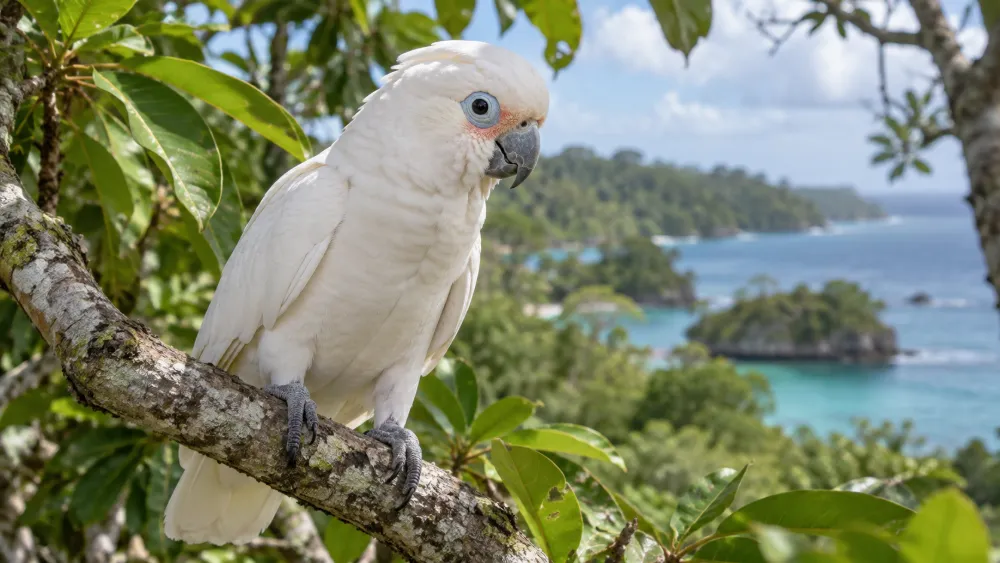
The sulphur-crested cockatoo (Cacatua galerita) has one of the most recognizable movable crests in the animal world.
The long yellow feathers lie flatter when the bird is relaxed and can be raised dramatically during excitement, alarm, social interaction, or display. Cockatoos as a group are distinguished from many other parrots by their prominent erectile crests.
San Diego Zoo notes that cockatoos can raise the crest when needed. That mobility makes the crest an important visual communication structure rather than a fixed decoration.
Different body postures must be interpreted together. A raised crest can accompany curiosity or excitement, but in another context it may occur during alarm or defensive behavior.
For more on advanced parrot behavior, see 10 Smartest Parrots in the World.
Hoopoe
The hoopoe (Upupa epops) has a spectacular fan-shaped crest made from long orange feathers tipped with black.
When folded, the crest points backward along the head. When fully raised, it forms a broad crown that can make the bird look much larger and more conspicuous.
Hoopoes occur across large parts of Europe, Asia, and Africa and use open woodland, grassland, farmland, and savanna-like habitats.
Audubon describes the orange crest as one of the species' most distinctive features. The bird can raise it during display, excitement, landing, and other behavioral contexts.
Indian Peafowl
Indian peafowl (Pavo cristatus) are famous for the male's enormous train, but the smaller crest on the top of the head is a completely separate ornament.
The crest consists of upright feathers with expanded tips, creating a delicate crown-like shape. Both sexes possess a crest, although males and females differ strongly in overall plumage.
The male's train receives most of the attention during courtship, but the head crest contributes to the bird's overall visual ornamentation and can also move slightly with the head during social interactions.
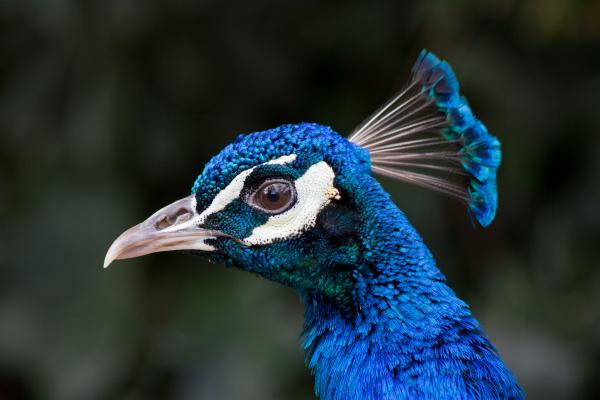
The Indian peafowl's head crest is distinct from the much larger train displayed by adult males.
Crested Penguins
Crested penguins in the genus Eudyptes are recognizable by yellow or golden ornamental feathers above and around the eyes.
The group includes species such as macaroni, royal, erect-crested, Fiordland, Snares, and rockhopper penguins, although taxonomy and species boundaries have been revised over time.
The yellow crest feathers differ in shape and arrangement among species, helping make each species visually distinctive during social and breeding interactions.
Unlike the flexible crest of a cockatoo, these ornaments are part of the penguin's breeding plumage rather than a fan that can be dramatically raised and lowered.
Elegant Quail
The elegant quail (Callipepla douglasii) is a ground-dwelling quail endemic to northwestern Mexico.
Its common English name is elegant quail. “Golden-crested quail” sometimes appears as a translated regional name, but it is not the most widely used English species name.
Adult males have a long, straight golden-buff crest, while females have a smaller, duller crest. This makes the head ornament a clear example of sexual dimorphism.
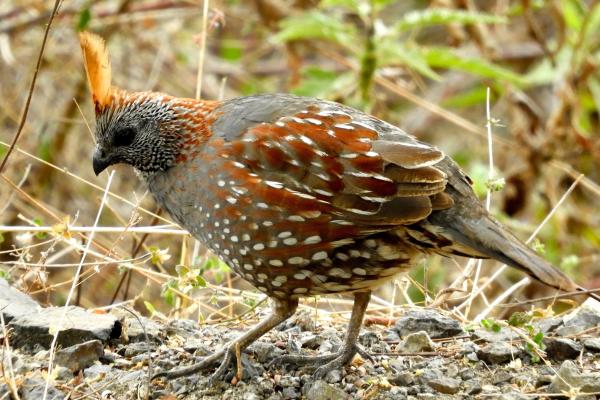
Male elegant quail have a conspicuous elongated crest, while females have a smaller and less colorful version.
Palawan Peacock-Pheasant
The Palawan peacock-pheasant (Polyplectron napoleonis) is endemic to Palawan in the Philippines.
Adult males have dark plumage with brilliant blue-green iridescent markings and ornamental feathers on the top of the head. Females are much browner and less conspicuous.
Tokyo Zoo describes the male as having long ornamental feathers on the top of the head, while the Oregon Zoo highlights the species' dramatic sexual differences and elaborate courtship behavior.
The species' display combines more than one visual feature: the crest contributes to the head profile while the male also fans patterned tail feathers during courtship.
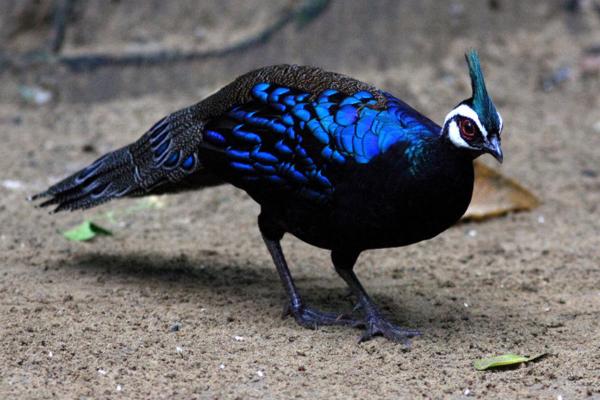
The male Palawan peacock-pheasant combines an ornamental head crest with brilliant blue-green plumage and patterned tail feathers.
Crested Auklet
The crested auklet (Aethia cristatella) is a small seabird of the North Pacific and Bering Sea region.
Adults develop a distinctive forward-curving crest of feathers above the bill. Both males and females have ornamental crests, although males generally have longer crest feathers.
Research summarized by Animal Diversity Web indicates that crest size varies with factors such as age and body condition. The species also has unusual facial ornaments and a characteristic citrus-like plumage odor involved in social and reproductive behavior.
This makes the crested auklet especially interesting because its crest is part of a larger package of visual and chemical social signals.
Crested Gecko
The crested gecko (Correlophus ciliatus) shows that crests are not limited to birds.
This New Caledonian lizard has raised scale-like projections extending above the eyes and along the sides of the head and body. The projections above the eyes create the “eyelash” appearance that inspired its alternative name, eyelash gecko.
Animal Diversity Web describes the crest as a continuous raised structure running above the eyes and along the back. The crest above the eyes may help keep debris away from the eye area, while other portions may also play a role in visual recognition or signaling.
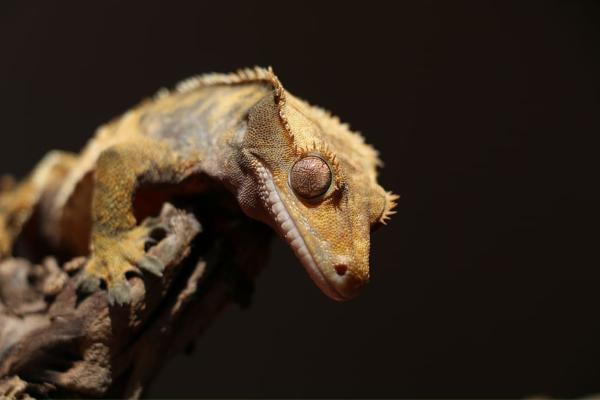
The crested gecko's “eyelashes” are actually part of a raised crest of scales rather than true eyelashes.
Fiji Crested Iguana
The Fiji crested iguana (Brachylophus vitiensis) is a striking green lizard native to islands in western Fiji.
Raised spines create a crest along the neck and back. In adult males, the combination of crest, bright green coloration, and pale body bands produces a highly distinctive appearance.
The species is currently considered Critically Endangered and faces threats including habitat loss, fire, invasive predators, weeds, and other changes to its dry-forest habitat.
Unlike a bird's feather crest, the iguana's crest is formed from dermal and scaled structures that remain part of the animal's body outline rather than being raised and folded like cockatoo feathers.
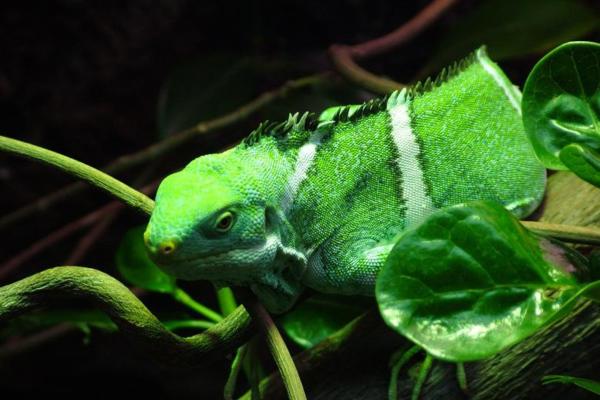
The Fiji crested iguana has a prominent spiny crest and is restricted to a small part of the Fijian archipelago.
North African Crested Porcupine
The North African crested porcupine (Hystrix cristata) provides a mammalian example of a true external crest.
Long quills along the head, neck, and shoulders can be raised into a conspicuous crest when the porcupine is disturbed.
San Diego Zoo compares the erect crest to a Mohawk. Raising the quills increases the animal's apparent size and exposes its defensive armament to a potential predator.
This crest therefore has a very different function from the courtship-oriented feather ornaments of many birds: it is primarily a defensive visual warning.
Why Do Animals Have Crests?
Crests evolved independently many times, so there is no single universal function.
Communication
Movable crests can communicate an animal's state. Cockatoos can raise or lower their head feathers, changing their appearance immediately during social interactions.
Courtship and Sexual Selection
Many bird crests are ornamental. Differences between males and females in species such as elegant quail and Palawan peacock-pheasants suggest a role in sexual display and mate choice.
Species Recognition
A crest can make closely related species easier to distinguish. Crested penguins provide a good example because the pattern and shape of yellow head feathers differ among species.
Defense
For crested porcupines, erecting quills makes the body appear larger and more threatening while displaying a real defensive weapon.
Protection
In crested geckos, the raised structures above the eyes may help protect the eye area from particles and debris.
Are All Crests Used for Mating?
No.
Many prominent bird crests have a social or reproductive role, but that does not apply to every crested animal. A porcupine's erectable crest is strongly defensive, while a gecko's raised scales may combine protective and signaling functions.
Even within birds, a crest may be used in more than one context. Cockatoos raise their crests during excitement, alarm, social display, and other emotionally intense situations.
Do Female Animals Have Crests?
Yes. Crests are not exclusive to males.
Both sexes of Indian peafowl have head crests. Male and female crested auklets also possess ornamental crests, though the average size may differ. Female elegant quail have a crest too, but it is smaller and less colorful than the male's.
The degree of sexual dimorphism depends on the species.
Can Animals Move Their Crests?
Some can.
Cockatoos and hoopoes can actively raise and lower feather crests. Porcupines can erect their quills. Other crests, such as the raised structures of crested geckos and iguanas, are essentially fixed parts of the body.
So a crest can be either dynamic or fixed.
Is a Rooster's Comb a Crest?
Not in the strict anatomical sense used here.
A rooster has a fleshy comb on top of the head, along with wattles beneath the bill. The comb can be involved in signaling and heat exchange, but it is structurally different from a feather crest.
This distinction is why roosters are often described casually as “crested” in translated material even though “combed” is more anatomically accurate for the familiar red structure.
Is a Cassowary's Casque a Crest?
The cassowary's head structure is more accurately called a casque, not a feather crest.
Smithsonian describes the southern cassowary's casque as a hollow, keratin-covered structure. Research suggests it can function as a thermal window that helps release heat.
Because a casque and a feather crest develop from different tissues and have different structures, they should not be treated as interchangeable terms.
Is the Mary River Turtle's “Green Hair” a Crest?
No. The famous green “hair” seen on some Mary River turtles is algae growing on the animal's body.
The algae may help with camouflage, but it is not an anatomical crest produced by the turtle itself.
This is an important distinction when building a list of animals with genuine crest structures.
Frequently Asked Questions
What animals have crests?
Examples include cockatoos, hoopoes, peafowl, crested penguins, elegant quail, Palawan peacock-pheasants, crested auklets, crested geckos, Fiji crested iguanas, and crested porcupines.
What is a crest on an animal?
A crest is a raised ridge, tuft, plume, or row of projections on an animal's head, neck, or back. It may be made from feathers, scales, spines, hairs, or other body tissues.
Which birds have crests?
Many birds have crests, including cockatoos, cockatiels, hoopoes, peafowl, crested penguins, quail, crowned pigeons, crested auklets, cardinals, and several woodpeckers.
Are crests only found in birds?
No. Crested geckos and iguanas have raised scaled or spiny crests, while crested porcupines can erect long modified hairs and quills into a crest.
Why do birds raise their crests?
Depending on the species, raised crests can signal excitement, alarm, aggression, courtship interest, curiosity, or other social states.
Does a peacock have a crest?
Yes. Indian peafowl have a small upright feather crest on the head. It is separate from the male's enormous display train.
Does a rooster have a crest?
The red structure on a rooster's head is more accurately called a comb. It is fleshy tissue rather than a feather crest.
Does a cassowary have a crest?
Cassowaries have a casque, a helmet-like keratin-covered structure. It is anatomically different from the feather crest of a cockatoo or hoopoe.
Do reptiles have crests?
Yes. Crested geckos, Fiji crested iguanas, green iguanas, and several other lizards have raised scales or dermal spines forming crests.
What mammal has a crest?
The North African crested porcupine is a clear example. Long quills on its head, neck, and shoulders can be raised into a prominent defensive crest.
Scientific and Reference Sources
Final Takeaway
Animal crests are not one single anatomical feature. They evolved independently as feather plumes in birds, raised scales and dermal spines in reptiles, and erectable quills in porcupines.
The most useful way to identify a true crest is to ask what the structure is made from and how it functions. A cockatoo's movable feather crest, a crested gecko's raised scales, and a porcupine's defensive quill crest all qualify, while a rooster's comb, a cassowary's casque, and algae growing on a turtle are different structures that should be named separately.