If “hair” means the natural body coat of a wild mammal, the musk ox is one of the strongest candidates for the animal with the longest fur. Its coarse outer guard hairs can reach about 60 cm (24 in) long and may hang almost to the ground. However, there is no universal scientific record comparing every type of animal hair, because body fur, manes, tails and continuously growing domestic-animal hair are measured differently. What makes the musk ox exceptional is its naturally enormous two-layer Arctic coat.
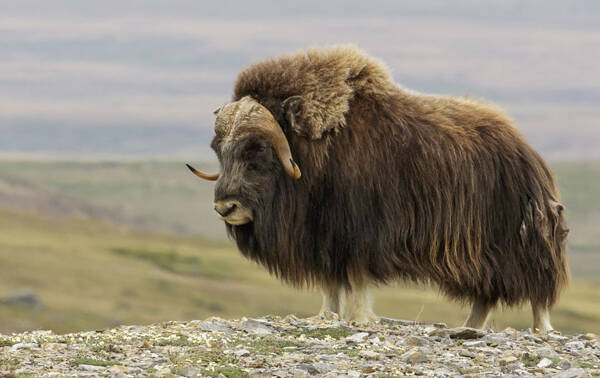
A musk ox's coarse outer guard hairs can reach about 60 cm long, creating the shaggy coat that hangs around its body like a skirt.
What Animal Has the Longest Hair?
The musk ox, Ovibos moschatus, is frequently cited as having some of the longest natural body fur of any wild mammal.
Scientific studies report that individual guard hairs can reach approximately:
60 cm, or about 24 inches.
The longest hairs occur particularly around the rump and lower sides of the body, producing the characteristic shaggy “skirt” seen on adult musk oxen.
These guard hairs are very different from the fine wool underneath them.
However, saying that the musk ox has the absolute “longest hair of any animal on Earth” requires an important qualification.
There is no single scientific competition comparing:
ordinary body fur;
manes;
tail hair;
domestic breeds selectively bred for long coats;
individual hairs allowed to grow for many years.
For natural body fur on a wild mammal, though, the musk ox is an exceptional record-holder.
How Long Is Musk Ox Hair?
| Coat Feature | Typical or Maximum Size | Function |
|---|---|---|
| Longest guard hairs | Up to about 60 cm (24 in) | Protection from wind, snow and moisture |
| Average guard hairs in one scientific study | About 10–15 cm | Outer protective coat |
| Qiviut undercoat fibers | About 3.5–7 cm | Thermal insulation |
| Qiviut fiber diameter | About 12–14 microns | Very fine insulating fiber |
The 60 cm figure refers to the longest coarse guard hairs rather than every hair covering the animal.
Most individual guard hairs are considerably shorter.
Why Do Musk Oxen Have Such Long Hair?
Musk oxen evolved in one of the coldest environments occupied by large grazing mammals.
They live in Arctic landscapes exposed to:
extreme winter cold;
high winds;
blowing snow;
long periods with little vegetation available;
very limited shelter.
Their enormous coat creates a barrier between the animal's body and the Arctic environment.
The long outer hairs help shield the softer insulating layer from wind, snow and physical wear.
Underneath is an extremely fine layer of wool called qiviut, which traps insulating air close to the skin.
Does a Musk Ox Have Fur or Hair?
Both words can be used.
Biologically, fur is hair.
“Fur” normally describes a dense body covering consisting of many hairs, while “hair” may refer either to the entire coat or to an individual fiber.
A musk ox has a highly specialized coat containing different types of hair.
The two most important are:
long coarse guard hairs on the outside;
fine qiviut underneath.
These two layers have very different textures and functions.
What Is Qiviut?
Qiviut is the extraordinarily fine undercoat produced by musk oxen.
It sits beneath the long guard hairs and acts as the main insulating layer next to the body.
Unlike the outer guard hairs, qiviut is:
shorter;
much finer;
very soft;
lightweight;
naturally shed seasonally.
The Musk Ox Farm in Alaska reports an average qiviut fiber diameter of only about 12–14 microns.
For comparison, fine textile fibers are valued partly because smaller fiber diameter generally feels softer against human skin.
Is Qiviut Really Eight Times Warmer Than Wool?
Several official Alaskan wildlife sources describe qiviut as approximately eight times warmer than sheep's wool by weight.
That comparison is widely used to communicate just how effective the material is as lightweight insulation.
It should not be interpreted as meaning that every qiviut garment is automatically exactly eight times warmer than every wool garment.
Actual warmth also depends on:
fiber thickness;
how tightly the material is knitted;
garment thickness;
air trapped within the fabric;
wind and moisture;
the type of sheep wool used for comparison.
What is clear is that qiviut is an exceptionally fine and effective natural insulating fiber.
Do Musk Oxen Shed Their Hair?
The two coat layers behave differently.
Musk oxen shed much of their qiviut during spring and early summer as temperatures rise.
Loose qiviut often hangs from the coat in ragged sheets before falling away or becoming caught on shrubs and other tundra vegetation.
Captive musk oxen can also be gently combed during the natural shedding season to collect the valuable fiber.
The long outer guard hairs do not undergo the same dramatic annual molt.
Research indicates that guard hairs continue growing over several years and may take approximately three to four years to reach full length.
Why Are the Guard Hairs So Much Longer Than Qiviut?
The two layers perform different jobs.
| Guard Hair | Qiviut |
|---|---|
| Coarse | Very fine |
| Can reach around 60 cm | Usually only a few centimeters long |
| Forms the visible shaggy coat | Hidden close to the skin |
| Protects against weather and abrasion | Provides much of the thermal insulation |
| Persists for years | Shed seasonally |
The result is effectively a layered clothing system built into the animal.
Why Does Musk Ox Hair Almost Touch the Ground?
The longest guard hairs grow around the sides and rump, forming the shaggy lower “skirt.”
Because musk oxen also have relatively short legs and stocky bodies, this hair can appear to reach nearly to the ground.
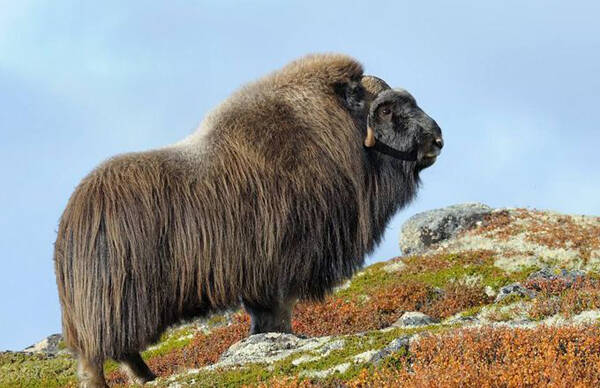
The longest guard hairs around the sides and rump form the musk ox's characteristic skirt and can nearly reach the ground.
This is why photographs sometimes make a musk ox look as though it is wearing a floor-length coat.
Is the Musk Ox Actually an Ox?
Not in the same sense as domestic cattle.
The scientific name Ovibos moschatus combines roots referring to sheep and ox-like characteristics, and the animal certainly looks somewhat cattle-like.
But appearance can be misleading.
Musk oxen belong to the family Bovidae and the subfamily Caprinae, the broader group that also includes sheep, goats and their relatives.
Modern evolutionary research places their closest living relatives among animals such as gorals and serows.
A musk ox is therefore not a “transitional animal between cows and sheep,” nor is it a hybrid of the two.
Are Musk Oxen Related to Sheep and Goats?
Yes.
Taxonomically, musk oxen are more closely associated with the caprine branch of bovids than with true cattle in the genus Bos.
This is one of the reasons judging animal relationships by appearance alone can be misleading.
The musk ox's stocky body and horns look cattle-like, while its evolutionary relationships point toward sheep-and-goat relatives.
Where Do Musk Oxen Live?
Musk oxen are Arctic mammals.
Native surviving populations persisted in Arctic Canada and Greenland, while conservation programs later reintroduced or introduced musk oxen to several other northern regions.
Today populations occur in areas including:
Greenland;
Arctic Canada;
Alaska;
parts of Norway;
parts of Russia.
Not every modern population represents an uninterrupted native population.
For example, musk oxen disappeared from Alaska and were restored using animals brought from East Greenland during the twentieth century.
What Happened to Alaska's Original Musk Oxen?
Musk oxen once occurred naturally in Alaska but disappeared there by the late nineteenth or early twentieth century.
In 1930, 34 animals captured in East Greenland were brought to Alaska.
They ultimately formed the basis of restored Alaskan herds.
Alaska Department of Fish and Game reports that today's Alaskan musk oxen descend from those Greenland animals.
This is one of the better-known large-mammal restoration stories in the Arctic.
Can Musk Oxen Survive -40°C?
Yes.
Musk oxen are exceptionally well adapted to severe Arctic winters.
The U.S. National Park Service describes them enduring temperatures of -40°C or colder, along with strong winds and blowing snow.
The thick coat is only one part of this adaptation.
The animals also have:
compact, heavily built bodies;
short extremities compared with many warmer-climate ungulates;
substantial fat reserves;
seasonal behavior that reduces energy expenditure.
All of these traits help limit heat loss.
Are Musk Oxen Afraid of Heat?
Musk oxen are much better adapted to cold than to high temperatures.
The same dense insulation that protects them in winter can make dumping excess body heat more difficult during warm conditions.
This is why their seasonal shedding of qiviut is important.
Calling them simply “afraid of heat” is not biologically precise; the better description is that they are Arctic specialists with limited adaptations for sustained high temperatures.
Do Musk Oxen Have Different-Sized Left and Right Hooves?
No.
An older internet claim says the left and right hooves of musk oxen are unequal or asymmetrical.
Alaska Department of Fish and Game describes musk oxen as having cloven hooves and specifically notes that all four hooves are the same size.
The hooves are well suited for moving across tundra, snow and rocky ground.
Do Both Male and Female Musk Oxen Have Horns?
Yes.
Both sexes grow horns.
Adult males, however, develop much heavier horn bases that meet across much of the forehead to form a thick structure known as a boss.
During the rut, males charge and collide head-on while competing for access to females.
The thick horn bosses and skull help absorb the forces generated during these clashes.
Why Are They Called Musk Oxen?
The English name comes partly from the odor produced by males during the breeding season.
The “ox” part reflects their heavy, cattle-like appearance rather than close membership in the true cattle genus.
The plural forms musk oxen and muskoxen are both commonly encountered, while many wildlife agencies write the animal's common name as one word: muskox.
Is the Musk Ox the Hairiest Animal?
That depends on what “hairiest” means.
If it means the longest natural body hairs, musk oxen are outstanding, with guard hairs reaching roughly 60 cm.
If it means the greatest number of hairs per unit of skin, other animals may be far denser.
Sea otters, for example, are famous for extraordinarily dense fur rather than extremely long individual hairs.
Hair length and hair density are therefore completely different records.
Does the Musk Ox Have the Longest Hair of Any Mammal?
It is safer to describe the musk ox as having some of the longest natural body hair among wild mammals.
The U.S. National Park Service specifically describes its outer coat as the longest fur of any North American animal.
Scientific studies independently confirm guard hairs reaching around 60 cm.
However, no universal zoological database ranks every mammal by every type of hair.
Domestic horses, cattle, dogs and other selectively bred animals can also grow extraordinary manes, tails or coats, especially when the hair is protected from normal wear and allowed to grow for years.
What About Yaks?
Domestic and wild yaks also have extremely long shaggy coats adapted to cold environments.
Long hair hangs from the chest, belly and flanks and can create a skirt-like appearance similar to that of musk oxen.
However, the musk ox remains particularly well documented for guard hairs reaching about 60 cm and for the extraordinary combination of those guard hairs with a very fine qiviut undercoat.
Musk Ox vs Yak: Are They Related?
Both are bovids and both have evolved heavy cold-weather coats, but they belong to different branches of the family.
Yaks are true cattle in the genus Bos.
Musk oxen belong to Ovibos within the caprine branch.
Their superficially similar shaggy appearance is therefore an example of different related lineages evolving adaptations to cold environments.
Frequently Asked Questions
What animal has the longest hair?
For natural body fur on a wild mammal, the musk ox is one of the strongest candidates. Its longest outer guard hairs can reach approximately 60 cm, or about 24 inches. There is no universal record comparing every form of animal hair, mane and tail hair.
How long is musk ox hair?
The longest guard hairs can reach about 60 cm. A scientific study reported average guard-hair lengths of roughly 10–15 cm, with the longest hairs forming the characteristic rump and body skirt.
What animal has the longest fur?
The U.S. National Park Service describes the musk ox as having the longest fur of any North American animal. Globally, the answer becomes less precise because different kinds of body hair, manes and tails are measured differently.
What is musk ox wool called?
The fine insulating undercoat is called qiviut. It lies beneath the much longer coarse guard hairs.
How long is qiviut?
Qiviut fibers are generally only a few centimeters long. The Musk Ox Farm reports typical staple lengths of approximately 3.5–7 cm.
Is qiviut warmer than sheep's wool?
Official Alaska wildlife sources commonly describe qiviut as approximately eight times warmer than sheep's wool by weight, although the warmth of a finished garment also depends on its construction and thickness.
Do musk oxen shed their fur?
They shed the fine qiviut undercoat seasonally, usually as temperatures rise in spring and early summer. The long guard hairs persist much longer and may continue growing for several years.
Are musk oxen cows?
No. They belong to the cattle family Bovidae, but they are in the caprine branch and are more closely associated evolutionarily with sheep-and-goat relatives than with true cattle.
Can musk oxen survive extreme cold?
Yes. Their two-layered coat and compact body allow them to survive severe Arctic winters, including temperatures around -40°C and below.
Where do musk oxen live?
Wild populations occur across parts of the Arctic, including Greenland and northern Canada, with restored or introduced populations in Alaska and several other northern regions.
Do male and female musk oxen have horns?
Yes. Both sexes grow horns, but adult males develop much larger horn bases and a heavy forehead boss used during breeding-season contests.
Is a musk ox related to a yak?
They are both members of Bovidae, but yaks belong to the true cattle genus Bos, while musk oxen belong to Ovibos within the caprine branch.
Scientific and Official Sources
U.S. National Park Service — musk ox Arctic adaptations, coat structure and evolutionary relationships.
Alaska Department of Fish and Game — musk ox anatomy, distribution, restoration history and qiviut.
PLOS ONE — measurements and growth patterns of musk ox guard hairs, including hairs reaching approximately 60 cm.
Government of Northwest Territories, Canada — musk ox coat structure and approximately half-meter outer hair.
The Musk Ox Farm, Alaska — qiviut fiber diameter, staple length and seasonal collection.