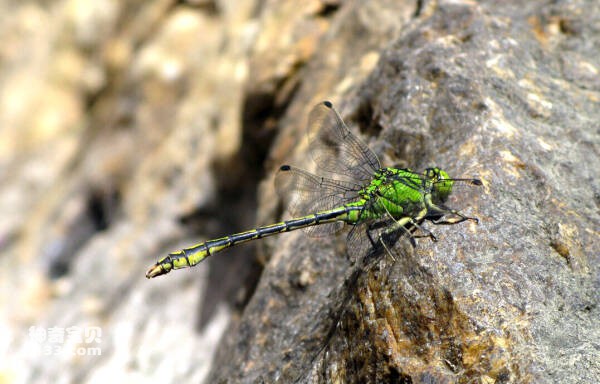
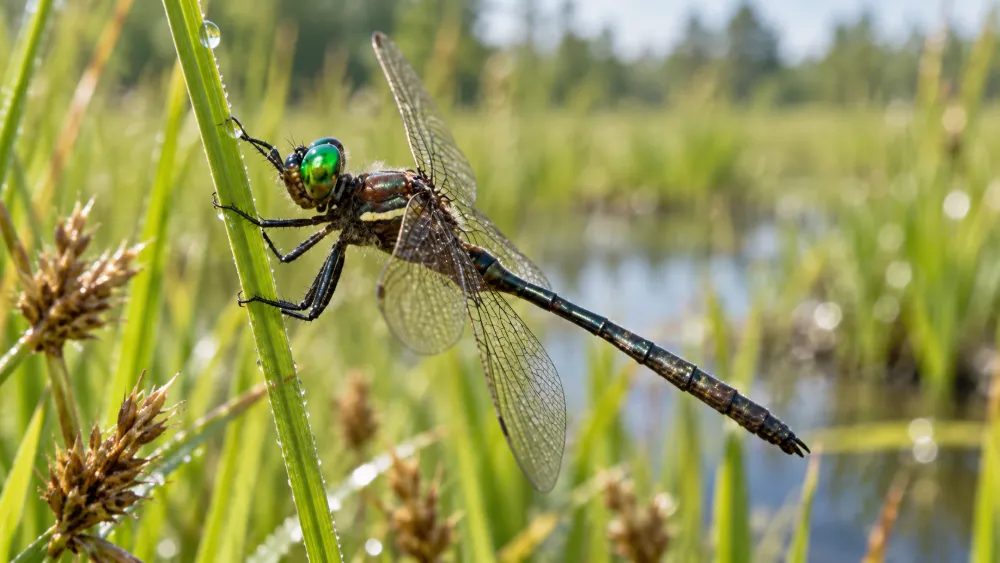
There is no scientifically accepted single “rarest dragonfly in the world,” because rarity can mean a tiny range, very few known sites, a small population, or a high extinction risk. Strong candidates include the Hine’s emerald dragonfly in North America, the Critically Endangered bekko tombo of East Asia, and Adam’s emerald dragonfly in Australia, which is known from only a handful of sites and has been collected extremely rarely.
This list compares 10 rare and threatened true dragonflies using documented conservation status, restricted distribution, habitat specialization, and evidence of decline. It does not mix in damselflies, which belong to a different suborder of Odonata.
10 Rarest Dragonflies in the World at a Glance
| # | Dragonfly | Scientific name | Region | Conservation evidence |
|---|---|---|---|---|
| 1 | Hine’s Emerald | Somatochlora hineana | United States | Federally Endangered; isolated populations in specialized calcareous wetlands |
| 2 | Bekko Tombo | Libellula angelina | East Asia | Critically Endangered on the IUCN Red List; major wetland losses |
| 3 | Adam’s Emerald Dragonfly | Archaeophya adamsi | Australia | Endangered in New South Wales; known from very few sites |
| 4 | Sydney Hawk Dragonfly | Austrocordulia leonardi | Australia | Endangered in New South Wales; extremely restricted river habitat |
| 5 | Giant Dragonfly | Petalura gigantea | Australia | Endangered in New South Wales; specialized swamp habitat |
| 6 | Coastal Petaltail | Petalura litorea | Australia | Endangered in New South Wales; narrow coastal range |
| 7 | Greek Goldenring | Cordulegaster helladica | Greece | Endangered in global and European assessments |
| 8 | Splendid Cruiser | Macromia splendens | Southwestern Europe | Vulnerable in Europe and the EU; declining river specialist |
| 9 | Yellow-Veined Skimmer | Orthetrum nitidinerve | Mediterranean region | Vulnerable in Europe and the EU; declining European populations |
| 10 | Zygonyx torridus | Zygonyx torridus | Southern Europe, Africa and Asia | Vulnerable in Europe and the EU despite a broader global range |
How This “Rarest Dragonfly” List Was Chosen
There is no global database that ranks every dragonfly from “rarest” to “most common.” A species can be rare in several different ways:
extremely small geographic range
very few known breeding sites
small or fragmented populations
strong dependence on a specialized wetland or stream habitat
legal Endangered status
IUCN Critically Endangered, Endangered, or Vulnerable status
documented long-term decline
For that reason, the order below is an evidence-based guide rather than an official scientific ranking.
Dragonflies vs Damselflies
Dragonflies and damselflies both belong to the order Odonata, but they are not the same group.
True dragonflies belong to the suborder Anisoptera. Damselflies belong to Zygoptera. Dragonflies are usually more robust-bodied and generally hold their wings open or partly open while resting, while most damselflies are more slender and commonly fold their wings closer to the body.
The older version of many “rare dragonfly” lists on the internet mixes the two groups. This guide intentionally keeps the Top 10 to true dragonflies.
Hine’s Emerald Dragonfly — One of North America’s Rarest Dragonflies
The Hine’s emerald dragonfly (Somatochlora hineana) is one of the strongest answers to “What is the rarest dragonfly?” in North America.
The U.S. Fish & Wildlife Service listed it as Endangered in 1995. Historically it occurred more widely, but modern populations survive in isolated areas of Illinois, Michigan, Missouri and Wisconsin.
This species is highly dependent on unusual groundwater-fed wetlands, sedge meadows and small calcareous streams. Habitat destruction, altered groundwater and pollution have driven much of its decline.
Recent 2026 research still describes the remaining populations as isolated and emphasizes the difficulty of conserving the specialized wetlands they require.
Bekko Tombo — Critically Endangered in East Asia
The bekko tombo (Libellula angelina) is a rare East Asian dragonfly associated with old, stable ponds and other freshwater wetlands.
It is classified as Critically Endangered on the IUCN Red List. Research from China, Korea and Japan has documented severe population decline linked especially to habitat loss and wetland urbanization.
The species is visually distinctive, with a yellow-brown to rusty body and dark markings on the wings.
Its decline shows why small ponds can be as important for dragonfly conservation as large rivers or lakes.
Adam’s Emerald Dragonfly — Known From Only a Few Sites
Adam’s emerald dragonfly (Archaeophya adamsi) is one of Australia’s rarest dragonflies.
New South Wales government sources describe it as Endangered and note that it has been collected from only a very small number of sites in the Greater Sydney region.
The larvae live in narrow shaded riffles of clean creeks, especially where rocks, moss and intact streamside vegetation remain.
Threats include:
sedimentation
stream-bank vegetation removal
water pollution
urban development
drought and severe fire events
Its naturally slow recruitment and restricted habitat make local population losses particularly serious.
Sydney Hawk Dragonfly — An Extremely Rare River Specialist
The Sydney hawk dragonfly (Austrocordulia leonardi) is another highly restricted Australian species.
The New South Wales government lists it as Endangered and describes it as an extremely rare dragonfly. Historically it was known from only a small number of river systems south of Sydney, although more recent records have extended the known range northward.
Its larvae require permanent, cool, flowing river habitat and are often found beneath rocks in deeper pools.
A wider known distribution does not automatically mean the species is secure. It remains highly dependent on specific freshwater conditions.
Giant Dragonfly — Rare Wetland Giant
The giant dragonfly (Petalura gigantea) is one of Australia’s largest dragonflies and one of the few surviving members of the ancient family Petaluridae.
New South Wales lists the species as Endangered. It is strongly associated with permanent swamps, peatlands and other wetland habitats, many of which have been drained, altered or fragmented.
Unlike typical aquatic dragonfly larvae, giant dragonfly larvae spend much of their life in wet burrows and saturated wetland soils.
This specialized life cycle makes the species particularly vulnerable when wetlands dry out or are physically disturbed.
Coastal Petaltail — A Narrow-Ranged Australian Dragonfly
The coastal petaltail (Petalura litorea) is closely related to the giant dragonfly and is also listed as Endangered in New South Wales.
It has a narrow coastal distribution in southeastern Queensland and northeastern New South Wales and depends on permanent swamp and bog habitat.
Its orange petal-shaped terminal appendages give the group its “petaltail” name.
Because its habitat is geographically limited and wetlands are vulnerable to drainage, development and fire, even relatively small habitat losses can affect a large share of the species’ available range.
Greek Goldenring — Endangered Mediterranean Stream Dragonfly
Cordulegaster helladica is a dragonfly endemic to Greece and is assessed as Endangered in European conservation databases.
It is associated with freshwater springs, streams and river habitats. Endemic species with small ranges are inherently vulnerable because a local drought, water diversion, wildfire or development project can affect a meaningful part of the total population.
This species is a good example of a rare dragonfly that may never become famous globally but still deserves conservation attention because its entire natural distribution is limited.
Splendid Cruiser — A Vulnerable River Specialist
The splendid cruiser or shining macromia (Macromia splendens) is one of Europe’s most distinctive threatened dragonflies.
The European Red List classifies it as Vulnerable in Europe and the European Union, with a decreasing population trend.
It occurs mainly in parts of the Iberian Peninsula and southern France and is associated with suitable river systems.
River regulation, water extraction, pollution and habitat modification can be especially damaging to species whose larvae depend on specific flowing-water conditions.
Yellow-Veined Skimmer — Rare in Europe
The yellow-veined skimmer (Orthetrum nitidinerve) has a broader distribution around parts of North Africa and the Mediterranean, but its European populations are much more restricted.
The European Red List classifies it as Vulnerable in Europe and the EU and records a decreasing trend.
Males are often blue-bodied, while distinctive yellowish wing veins help separate the species from many other Orthetrum skimmers.
This species demonstrates why global abundance and regional rarity can tell different stories.
Zygonyx torridus — Globally Widespread, Regionally Threatened
Zygonyx torridus is not globally among the most restricted dragonflies, but it is a useful example of regional rarity.
European conservation assessments classify it as Vulnerable in Europe and the EU, even though its wider global assessment is less threatened.
This distinction matters. A dragonfly can remain relatively secure across a large global range while disappearing from part of that range because local river habitats are degraded or fragmented.
What Is the Rarest Dragonfly in the World?
There is no universally accepted single answer.
Hine’s emerald is one of the rarest and best-documented endangered dragonflies in North America. Bekko tombo is globally Critically Endangered. Adam’s emerald dragonfly is remarkable because so few specimens and localities have been documented.
The answer changes depending on whether “rarest” means smallest population, smallest range, fewest known sites or highest extinction-risk category.
What Is the Rarest Dragonfly Color?
There is no scientifically recognized “rarest dragonfly color.”
Dragonflies can appear:
blue
green
red
yellow
brown
black
metallic bronze or emerald
multi-colored or patterned
Color varies by species, sex, age, temperature, lighting and maturation. Rarity is determined by population and distribution—not by whether a dragonfly is blue, red or green.
For example, the Hine’s emerald is famous for brilliant green eyes, while the bekko tombo has amber-brown coloration and dark wing patches. Neither species is rare because of its color.
Why Are Rare Dragonflies Disappearing?
Dragonflies spend much of their life as aquatic larvae, so freshwater habitat quality is critical.
Major threats include:
wetland drainage
river modification and dams
groundwater alteration
water pollution
urban development
invasive fish and other introduced predators
drought and climate change
loss of streamside vegetation
A major 2025 global freshwater assessment led by IUCN found that roughly one quarter of assessed freshwater animal species across several groups—including dragonflies and damselflies—are at high risk of extinction. That makes freshwater conservation central to protecting rare Odonata.
Why Dragonflies Are Good Indicators of Freshwater Health
Dragonfly larvae can spend months or years underwater. Because different species require different water quality, flow, vegetation and substrate conditions, changes in dragonfly communities can reveal changes in freshwater ecosystems.
Protecting a rare dragonfly often means protecting:
clean water
natural stream flow
groundwater systems
wetlands
riparian vegetation
many other freshwater animals
That is why a tiny insect can become the focus of much larger habitat-conservation programs.
Frequently Asked Questions
What is the rarest dragonfly?
There is no official single winner. Hine’s emerald, bekko tombo and Adam’s emerald dragonfly are strong examples because of their endangered status, highly restricted distributions and documented population decline.
What is the rarest dragonfly in the world?
No global scientific ranking identifies one species as the rarest. Bekko tombo is Critically Endangered, while species such as Hine’s emerald and Adam’s emerald are known from highly restricted and fragmented populations.
What are some rare dragonfly species?
Examples include Hine’s emerald, bekko tombo, Adam’s emerald dragonfly, Sydney hawk dragonfly, giant dragonfly, coastal petaltail, Greek goldenring and splendid cruiser.
Are dragonflies endangered?
Many are not endangered, but numerous species are threatened because their larvae depend on wetlands, streams, springs and other freshwater habitats that are being altered or lost.
Is the Hine’s emerald dragonfly endangered?
Yes. It is federally listed as Endangered in the United States and survives in isolated populations associated with specialized wetlands.
Is the bekko tombo rare?
Yes. Libellula angelina is classified as Critically Endangered and has undergone severe declines in East Asia because of habitat loss.
What is the rarest dragonfly color?
There is no scientifically recognized rarest color. Dragonfly rarity is based on population size, distribution and conservation status rather than body color.
Are blue dragonflies rare?
Not as a group. Many common dragonfly species are blue. A blue dragonfly can be common or rare depending on the species and region.
Why are some dragonflies so rare?
Many rare species depend on very specific freshwater habitats. Wetland drainage, pollution, river modification, invasive species, groundwater changes and climate stress can rapidly reduce suitable breeding sites.
Are damselflies the same as dragonflies?
No. Both belong to Odonata, but dragonflies are Anisoptera and damselflies are Zygoptera. This list includes true dragonflies only.
Scientific and Official Sources
Journal of Insect Conservation — Hine’s Emerald Dragonfly Conservation, 2026
Worldwide Dragonfly Association — Bekko Tombo Conservation Genetics
European Red List of Dragonflies — Macromia splendens, Orthetrum nitidinerve and Zygonyx torridus
Final Answer
There is no official single rarest dragonfly, but Hine’s emerald, bekko tombo and Adam’s emerald are among the strongest examples of extreme rarity and conservation concern. The most important pattern is not color or size: rare dragonflies usually become rare because specialized wetlands, streams and groundwater habitats disappear or degrade. Protecting those habitats protects far more than dragonflies alone.