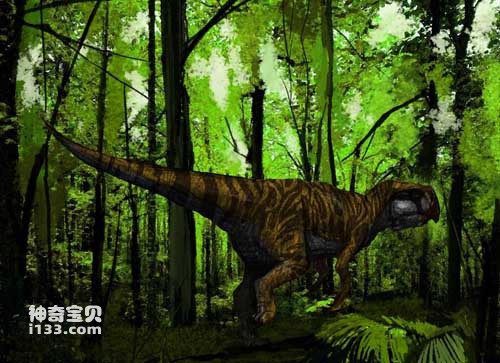
Scientific name of Tyrannosaurus rex: Tyrannosaurus rex
Similar species:
Tarbosaurus

Tyrannosaurus rex is one of the most popular and enduring dinosaurs, starring in movies and children's shows and finding a place in pop culture memorabilia.
introduce
Pronounced Ty-ran-oh-sore-us rex
Tyrannosaurus rex means "tyrant lizard" in Greek, and Rex means "king" in Latin.
Tyrannosaurus rex, commonly known as Tyrannosaurus rex, is the largest Tyrannosaurus rex and the last member of the family. It is one of the best-studied Tyrannosaurus rex due to the large number of specimens found. As of 2020, over 42 specimens (5-80% complete by number of bones) have been discovered, including several nearly complete skeletons.
In 1874, Arthur Lakes near Golden, Colorado discovered the teeth of what is now recorded as a Tyrannosaurus rex.
The famous fossil hunter Barnum Brown discovered the first partial skeleton of Tyrannosaurus rex in eastern Wyoming in 1900; in 1902, he found another partial skeleton in Hell Creek, Montana. The species was named in 1905 by Henry Fairfield Osborn, then director of the American Museum of Natural History.
The 1960s saw a renewed interest in Tyrannosaurus rex.
The 1990s brought a deluge of discoveries, nearly twice as many as in previous years, including two of the most complete skeletons ever discovered: Sue and Stan.
In 2000, workers from the Jack Horner Organization discovered five Tyrannosaurus rex skeletons near the Fort Peck Reservoir.