Skip to content
Animals Top
Home>Animals>Mammal>Primates
Animal Profile IUCN: LC

Perodicticus edwardsi

Perodicticus edwardsi,Milne-Edwards's Potto、 Central Potto

Central African Potto (scientific name: Perodicticus edwardsi), also known as Milne-Edwards's Potto and Central Potto in foreign languages, is a nocturnal animal that sleeps in the leaves during the day. It lives in trees and rarely moves on the ground. It is secretive, slow-moving, usually soli

Primates 583 views
Scientific Name Perodicticus edwardsi,Milne-Edwards's Potto、 Central Potto
Length About 38 cm
Weight About 600g
Lifespan No verification information
IUCN Status LC
Advertisement

Table of Contents

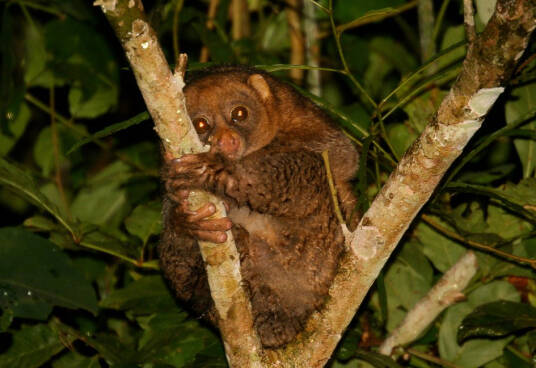
    Central African Potto (scientific name: Perodicticus edwardsi), also known as Milne-Edwards's Potto and Central Potto in foreign languages, is a nocturnal animal that sleeps in the leaves during the day. It lives in trees and rarely moves on the ground. It is secretive, slow-moving, usually solitary, and has a low sense of territory. Its diet consists of 65% fruit, 21% sap, and 10% insects, and it occasionally catches bats and small birds. It lives from sea level to 1,500 meters above sea level.
    0b7b02087bf40ad162d95da90b6606dfa9ec8a13606c_九雷图片转化为.jpg

    Listed in the "Red List of Threatened Species of the World Conservation Union" (IUCN) 2016 ver3.1-Least Concern (LC).


    Protect wild animals and stop eating game.

    Maintaining ecological balance is everyone's responsibility!


    Tags

    At a glance

    Profile Details

    Key characteristics, appearance, and habitat information.

    Traits & Behavior

    Night vision is strong, and the germs carried in saliva

    Appearance

    The Central African koala is about 38 cm long, with large eyes and strong night vision. There are protruding spines on the vertebrae from the neck to the shoulder blade for defense. It has hands suitable for grasping, with the thumb and other fingers opposite, which can hold branches of various shapes tightly. Koalas cannot escape, so there is a protrusion on their shoulder blades. When attacked, they arch their bodies so that the enemy can only bite their shoulders, and their long and sharp bones protrude to protect themselves from harm. They crawl on the trees as carefully and slowly as walking on a tightrope, and they are out at night and hide during the day. Koalas have curly gray-brown hair. The body emits a pungent smell similar to curry, which is used to mark the territory. The bacteria carried in the saliva of koalas can cause inflammation of wounds.

    Distribution & Habitat

    The Central African koala monkey is found in Angola, Cameroon, the Central African Republic, the Democratic Republic of the Congo, Congo-Brazzaville, Equatorial Guinea, Gabon and Nigeria. It lives in the rainforests of tropical Africa.
    Advertisement

    Visual guide

    Browse available images of this species.

    Quick answers

    Perodicticus edwardsi FAQs