This is a world where squids eat each other. A remote-controlled submarine filmed two deep-sea squid species devouring their own species.
Several species of squid, including the giant squid, can devour their own species.
For a long time, people have mainly judged this by the food in their stomachs. It is not clear whether this is normal behavior or whether it occurs after they are caught in the net. According to the GEOMAR Helmholtz Center for Marine Research in Kiel, Germany, Henk-Jan Hoving said. “When animals are caught in a net and the pressure builds up, they may begin to undergo what’s known as ‘net predation’, where they eat any nearby food.”
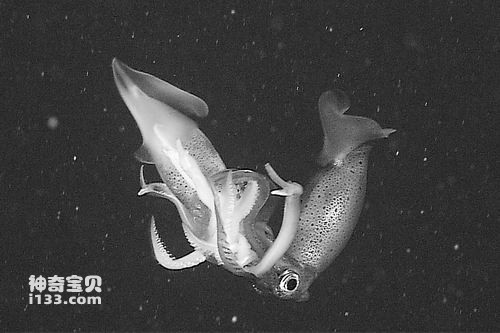
Hoving and colleagues sent a remotely operated submarine into an underwater canyon in Monterey Bay, off the coast of California, to observe two species of cuttlefish that live in water from the phreatic layer to 2,000 meters below the surface.
Remotely controlled submarines often see two species cannibalizing each other and cannibalizing the same kind, especially the clawed squid of the genus Sepia. "Forty percent of these animals were found to be feeding on their own species," Hoving said. "That's quite a high proportion, it's very shocking."
Hoving said that these squids grow very fast and only reproduce once, requiring a large amount of food to drive their metabolism. Feeding on similar species becomes a good way to obtain food when other food is scarce. This has other benefits as well. "It will eliminate food competitors," he said.
"It's important to have a clear understanding of cannibalism," says Brad Seibel of the University of South Florida in St. Petersburg. "They may be engaging in this behavior at a semi-regular level, otherwise it would be difficult to see it from a submarine."