Skip to content
Animals Top
Home>Animals>Invertebrates>Arthropoda
Animal Profile IUCN: LC

Grylloblattella cheni

Grylloblattella cheni

Chen's western cockroach has an ancient origin, which can be traced back to the Upper Lime Period about 300 million years ago. It can be called a "living fossil" of the class Insecta. As an extremely rare insect that ordinary people rarely see, there are only a few museums in the world

Arthropoda 601 views
Scientific Name Grylloblattella cheni
Length 14mm
Weight
Lifespan
IUCN Status LC
Advertisement

Table of Contents

    Chen's western cockroach has an ancient origin, which can be traced back to the Upper Lime Period about 300 million years ago. It can be called a "living fossil" of the class Insecta. As an extremely rare insect that ordinary people rarely see, there are only a few museums in the world that have preserved cockroach specimens, and the number is counted in units or tens.
    1_九雷图片转化为.jpg

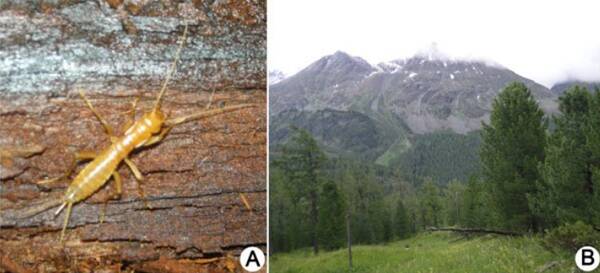
    The picture shows a female Chen's western cockroach and its living environment 


          Chen's western cockroach has a very small distribution area, limited to the cold regions between 33 and 60 degrees north latitude (North America and Asia). The cockroach is an omnivorous animal that feeds on corpses on the ice and vegetation under the ice. It develops very slowly and takes at least 7 to 8 years to complete a generation.  


    Listed as the first level of the "National Key Protected Wildlife List".
    Tags

    At a glance

    Profile Details

    Key characteristics, appearance, and habitat information.

    Traits & Behavior

    Appearance

    Yellow. The posterior edge of the pronotum is weakly concave, the outer edge of the nuchal plate has five long hairs, the inner edge has three long hairs, and the tarsal pad is short.

    Distribution & Habitat

    Individuals are rare and extremely rare. Its distribution area is narrow. It is found in the fir forest at an altitude of 1750m on the north side of Kanas Lake in Xinjiang.
    Advertisement

    Visual guide

    Browse available images of this species.

    Quick answers

    Grylloblattella cheni FAQs