Skip to content
Animals Top
Home>Animals>Mammal>Cetacea
Animal Profile IUCN: LC

Caperea marginata

Small right whale, dwarf whale, dwarf whale, small right whale, pygmy right whale, new right whale

The scientific name of the pygmy right whale is Caperea marginata, and its foreign name is Pygmy right whale. It feeds on small plankton. It likes to live in shallow waters and dives for a long time. It swims very slowly and is easily confused with small whales. The largest group seen is 8.Listed in

Cetacea 656 views
Scientific Name Small right whale, dwarf whale, dwarf whale, small right whale, pygmy right whale, new right whale
Length 6.09-6.45m
Weight No verification information
Lifespan No verification information
IUCN Status LC
Advertisement

Table of Contents

    The scientific name of the pygmy right whale is Caperea marginata, and its foreign name is Pygmy right whale. It feeds on small plankton. It likes to live in shallow waters and dives for a long time. It swims very slowly and is easily confused with small whales. The largest group seen is 8.
    d326b9d2abd25e860c8561e1ac8f0376_九雷图片转化为.jpeg

    Listed in the "Red List of Threatened Species of the World Conservation Union" (IUCN) 2018 ver 3.1 - Endangered (LC).

    Listed in Appendix I, Appendix II and Appendix III of the Convention on International Trade in Endangered Species of Wild Fauna and Flora (CITES) 2019 Edition.


    Protect wild animals and eliminate game.

    Maintaining ecological balance is everyone's responsibility!


    Tags

    At a glance

    Profile Details

    Key characteristics, appearance, and habitat information.

    Traits & Behavior

    Appearance

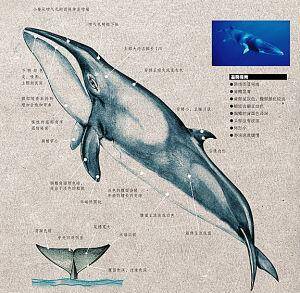
    The maximum body length of females is 6.45m, and that of males is 6.09m. It is the smallest of all baleen whales. The back is slightly protruding. The upper jaw is arched and pointed at the front, and the lower jaw is curved and slightly protruding in front of the upper jaw. The mouth extends backward to below the eye. The flippers are narrow and slightly rounded at the end. The dorsal fin is small, triangular, and sickle-shaped at the rear edge, located less than 1/3 of the back of the body. The caudal fin is wide, with a notch in the middle of the rear edge. When viewed from above, the head suddenly narrows in front of the eye, and the snout gradually tapers. The blowhole is V-shaped. There are no folds. The back of the body is black or gray, the sides of the body are light gray, and the belly is white. The baleen is light yellow with brown edging on the outer edge. The eyes are black. The baleen plates are slender, with 230 on each side. There is a pair of longitudinal shallow groov

    Distribution & Habitat

    It is only distributed between 310 and 520 degrees south latitude in the southern hemisphere, and is mostly found in waters with water temperatures of 5-200°C in southern New Zealand, southeast and southwest Australia, Tasmania, southern Africa, Argentina, Chile, the Falkland Islands, etc., and can reach the subtropical waters of the South Atlantic to the north.
    Advertisement

    Visual guide

    Browse available images of this species.

    Quick answers

    Caperea marginata FAQs