Skip to content
Animals Top
Home>Animals>Fish>Small fish
Animal Profile IUCN: LC

Hippocampus abdominalis

Hippocampus abdominalis

The Latin name of the big-bellied seahorse is c (Lesson, 1827), also known as the puffy-bellied seahorse, which is one of the species of the genus Hippocampus in the order Acanthopterygii of the class Actinopterygii and the family Syngnathidae. It is the largest of all known seahorses.The big-bellie

Small fish 939 views
Scientific Name Hippocampus abdominalis
Length About 35 cm
Weight About 250-350g
Lifespan 5-9years
IUCN Status LC
Advertisement

Table of Contents

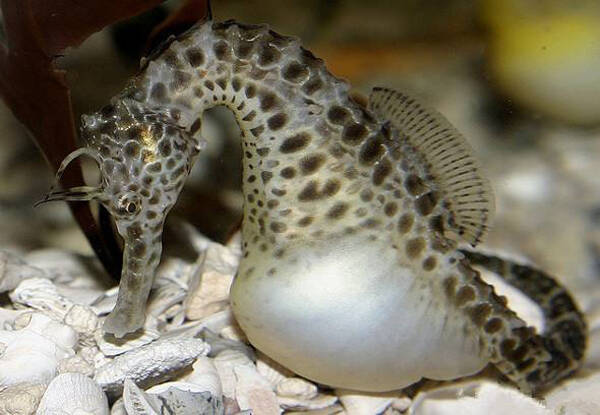
    The Latin name of the big-bellied seahorse is c (Lesson, 1827), also known as the puffy-bellied seahorse, which is one of the species of the genus Hippocampus in the order Acanthopterygii of the class Actinopterygii and the family Syngnathidae. It is the largest of all known seahorses.
    e410b15a27b379c5740073131531aaab_九雷图片转化为.jpeg

    The big-bellied seahorse is nocturnal and carnivorous, feeding on small crustaceans.

    The big-bellied seahorse can be found in shallow waters, around seaweed, seagrass and reefs. They mostly live in deeper waters attached to sponges. Unlike most seahorses, the big-bellied seahorse is a good swimmer and can swim hundreds of meters a day.

    6869c5af58dc5f36926d23c1536d20ab_九雷图片转化为.jpeg

    Male big-bellied seahorses have pouches but do not reproduce. Females lay eggs in the pouches, and males fertilize and enter the pregnancy period. 1,100 pups are hatched in about 30 days, and then the pups leave the pouches to live.

    The IUCN Red List lists it as Data Deficient (DD)


    Protect wildlife and stop eating game.

    Maintaining ecological balance is everyone's responsibility!

    At a glance

    Profile Details

    Key characteristics, appearance, and habitat information.

    Traits & Behavior

    With a round belly, it is the largest of all known seahorses.

    Appearance

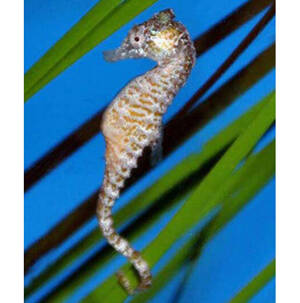
    Characterized by a rounded belly. Up to 35 cm long. 12 to 13 rings, 27-28 dorsal fin rays; 15-17 pectoral fin rays; no caudal fin, with a prominent round eye spine. Body is off-white with dark spots and stains on the head and trunk; alternating dark and light stripes on the tail; males have more black spots than females.

    Distribution & Habitat

    The seahorse is found mostly in the southwestern Pacific Ocean around Australia and New Zealand.
    The seahorse inhabits harbors and sheltered coastal bays. It can live at depths up to 109 meters. It inhabits reef areas and swims along seagrasses.
    Advertisement

    Visual guide

    Browse available images of this species.

    Quick answers

    Hippocampus abdominalis FAQs