Skip to content
Animals Top
Home>Animals>Reptilia>Squamata
Animal Profile IUCN: LC

Acalyptophis peronii

Acalyptophis peronii,Horned sea snake, Spiny sea snake

Acalyptophis peronii is a venomous sea snake.Spiny-canthus sea snakes often move in caves and crevices in the sea. Night is the most active period for Spiny-canthus sea snakes. They mainly eat shrimp gobies and other small fish.The sea snake is a viviparous snake. The female gestation period is 6-7

Squamata 649 views
Scientific Name Acalyptophis peronii,Horned sea snake, Spiny sea snake
Length About 130 cm
Weight No verification information
Lifespan About 20 years
IUCN Status LC
Advertisement

Table of Contents

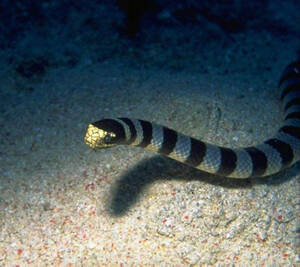
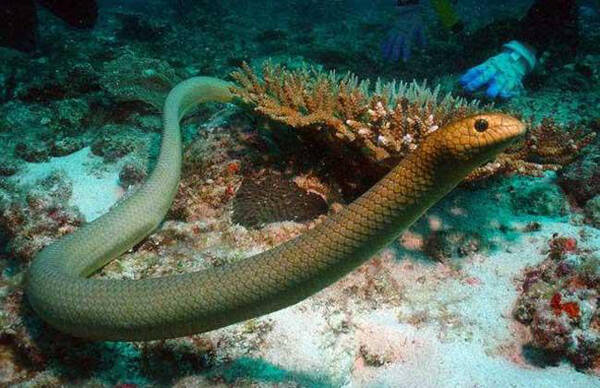
    Acalyptophis peronii is a venomous sea snake.
    7f939bdffcc62a6ca00ada43d812da8b_九雷图片转化为.jpeg


    Spiny-canthus sea snakes often move in caves and crevices in the sea. Night is the most active period for Spiny-canthus sea snakes. They mainly eat shrimp gobies and other small fish.

    The sea snake is a viviparous snake. The female gestation period is 6-7 months, and each snake gives birth to about 10 young snakes. It belongs to the front groove venomous snake. A venomous snake with shorter front grooves. The venom is a colorless or light yellow viscous liquid, similar to the venom of terrestrial snakes, but the toxicity is much stronger than that of ordinary terrestrial snake venom, and it is the strongest animal venom. Toxicity LD50 value: 0.079. Unit toxicity intensity ranking: 14. Note: The lower the LD, the higher the toxicity. Half a dose can kill instantly.


    It is included in the "List of Terrestrial Wildlife with Important Economic and Scientific Research Value under State Protection" issued by the State Forestry Administration of China on August 1, 2000. [2] 

    Listed in the 2012 IUCN Red List: Least Concern (LC).

    Listed in the second level of the "List of Nationally Protected Wildlife in China".


    Protect wildlife and stop eating game.

    Maintaining ecological balance is everyone's responsibility!


    Tags

    At a glance

    Profile Details

    Key characteristics, appearance, and habitat information.

    Traits & Behavior

    The tail is not as slender as a whip like a land snake, but is flattened like a paddle.

    Appearance

    The head is relatively short, with a blunt snout, dorsal nostrils, and a stout body. There are 6 (2-2-2) scales on the upper lip; there are no internasal scales, and the nasal scales are tangent to each other; the posterior margins of the supraorbital scales and several adjacent scales are pointed and spinous (hence the name), there are 1 (2) preorbital scales, and 3 (4) postorbital scales; the frontal scales and parietal scales are split into small scales, and the posterior margins of some frontal scales and labial scales are also pointed and spinous; there are 2 pairs of chin plates, which are tangent to each other and to the 4 pairs of lower lip scales. There are 19 rows of dorsal scales on the neck and 23 rows on the thickest part of the body, arranged in a slightly shingled manner. The dorsal scales on the posterior part of the body are wider than long and have a short ridge; there are 157 ventral scales, which are equal to or slightly narrower than the adjacent dorsal scales. The

    Distribution & Habitat

    Overseas, it is distributed in the tropical waters of the Indian Ocean, Australia and Papua New Guinea.
    In China, it is distributed along the coast of Taiwan and Guangdong.
    Advertisement

    Visual guide

    Browse available images of this species.

    Quick answers

    Acalyptophis peronii FAQs