 LC
LC
Rattlesnake
Crotalus: rattlesnakes (often including Sistrurus: pygmy rattlesnakes)
Rattlesnakes are among the most iconic venomous snakes of the Americas, best known for the distinctive rattle at the end of the ta···
Explore reptiles including turtles, snakes, lizards, and crocodilians, with species profiles covering size, habitat, lifespan, traits, and IUCN status.
Use these shortcuts to move into more specific animal groups.
Squamata is the largest order of reptiles, with about 6,000 species, accounting for more than 90% of existing reptiles. It is divided into two orders, including the lizards and snakes. The body surface is covered with keratinous scales, generally without bony plates, and the body is mostly long. The front and rear limbs are well developed or degenerate.
Taxonomic Placement
Squamata is the largest order of Reptilia (reptiles), comprising all lizards (in a broad sense), snakes, and amphisbaenians (worm lizards). With over 10,000 described species, they inhabit a range of environments (deserts, rainforests, grasslands, coastlines, etc.) worldwide, excluding the polar regions.
Morphological and Physiological Traits
Scaled Skin: Squamates have keratinized scales that reduce water loss and provide protection. Many species shed these scales periodically during growth.
Flexible Jaws: Most squamates have a relatively kinetic skull and jaw articulation; notably, snakes can disarticulate their jaws extensively to swallow large prey.
Locomotion Variations: Lizards typically have four limbs (though some groups like glass lizards have reduced limbs). Snakes have lost limbs entirely and move by lateral undulation or other specialized methods. Amphisbaenians (worm lizards) also lack visible limbs, with segmented bodies adapted to burrowing.
Lifestyle Diversity
Diet: Ranges from strict herbivory (e.g., iguanas) and insectivory to carnivory (e.g., large constrictors, venomous snakes) or specialized feeding.
Reproduction: Most are oviparous (egg-laying), though some exhibit ovoviviparity or viviparity (e.g., some vipers and skinks).
Role in Food Webs
Many lizards and snakes act as medium-level predators, controlling insect or rodent populations, and serving as prey for birds or larger carnivores. Herbivorous lizards may help in seed dispersal and plant community dynamics.
Economic and Cultural Value
Pest Control and Balance: Snakes can significantly reduce rodent populations in agricultural areas.
Medicinal and Ornamental: Some snakes (e.g., cobras, pit vipers) are used in traditional medicine, while various lizards (e.g., green iguana) and snakes (e.g., ball pythons, kingsnakes) are popular in the pet trade.
Negative Impacts: A few venomous species pose safety risks; some introduced lizards (e.g., green iguanas) can become invasive in non-native regions.
Origins and Early Evolution
Squamates trace back to Jurassic–Cretaceous ancestors (~150–100 million years ago). They derived from older diapsid reptiles, diversifying widely through the Mesozoic era.
Snakes (Serpentes) evolved from a particular lineage of limbless or limb-reduced lizards, though whether this occurred primarily in a burrowing terrestrial environment or a marine environment was long debated. Current evidence favors a terrestrial or fossorial (burrowing) origin.
Modern Diversification and Global Spread
Geological and climatic changes (e.g., continental drifts, sea-level changes) from the Cretaceous onward allowed lizards and snakes to expand nearly worldwide, except the coldest polar areas.
Different groups have successfully adapted to terrestrial, arboreal, fossorial, freshwater, or even marine environments (such as marine iguanas or sea snakes).
Traditionally, lizards (Lacertilia / Sauria), snakes (Serpentes), and amphisbaenians (Amphisbaenia) are recognized as three major lineages. Below is a concise list of prominent families and representative genera. Please note that molecular research continues to refine family-level boundaries.
| Family | Representative Genera | Example Species | Distribution & Notes |
|---|---|---|---|
| Gekkonidae (Geckos) | Gekko (Tokay gecko), Hemidactylus (House gecko), etc. | Tokay gecko (Gekko gecko), Common house gecko (Hemidactylus frenatus), etc. | Typically small, nocturnal lizards with adhesive toe pads for climbing walls and ceilings. |
| Scincidae (Skinks) | Eumeces (Skinks), Scincus (Sand skinks), etc. | Blue-tailed skink (Plestiodon/ Eumeces laticeps), etc. | Many have cylindrical bodies and smooth scales; some exhibit limb reduction or viviparity. |
| Agamidae (Agamas) | Pogona (Bearded dragons), Draco (Flying dragons), etc. | Central bearded dragon (Pogona vitticeps), Flying lizard (Draco volans), etc. | Found in Africa, Asia, and Australia; popular as pets (bearded dragons); Draco can glide among trees. |
| Chamaeleonidae (Chameleons) | Chamaeleo, Furcifer, Calumma, etc. | Panther chameleon (Furcifer pardalis), Veiled chameleon (Chamaeleo calyptratus), etc. | Africa & Madagascar primarily; famous for projectile tongues, independently rotating eyes, vivid coloration. |
| Iguanidae (Iguanas) | Iguana, Amblyrhynchus (Marine iguana), etc. | Green iguana (Iguana iguana), Galápagos marine iguana (Amblyrhynchus cristatus), etc. | Mostly New World; some species herbivorous (e.g., green iguana), others specialized (marine iguana dives for algae). |
| Helodermatidae (Beaded lizards) | Heloderma (Gila monster, Beaded lizard) | Gila monster (Heloderma suspectum), Mexican beaded lizard (H. horridum) | North American desert dwellers; possess venomous glands, injecting toxin via grooved teeth. |
| Varanidae (Monitor lizards) | Varanus (Monitors) | Komodo dragon (Varanus komodoensis), Asian water monitor (Varanus salvator), etc. | Africa, Asia, Oceania distribution; often large-bodied; Komodo dragon is among the world’s largest lizards. |
| Family | Representative Genera | Example Species | Distribution & Notes |
|---|---|---|---|
| Pythonidae (Pythons) | Python, Morelia, Liasis, etc. | Burmese python (Python bivittatus), Reticulated python (Malayopython reticulatus), etc. | Old World distribution, typically large constrictors; some can exceed 6 meters in length. |
| Boidae (Boas & Anacondas) | Boa, Eunectes, etc. | Boa constrictor (Boa constrictor), Green anaconda (Eunectes murinus), etc. | New World distribution, parallel to pythons in function (constrictors); anacondas among the heaviest snakes. |
| Colubridae (Typical snakes) | Natrix (Grass/Water snakes), Elaphe (Ratsnakes), Pantherophis, etc. | Grass snake (Natrix natrix), King ratsnake (Elaphe carinata), etc. | The largest snake family worldwide; most are non-venomous or only mildly venomous; highly diverse ecologically. |
| Elapidae (Cobras, Kraits, Mambas, Coral snakes, etc.) | Naja (Cobra), Ophiophagus (King cobra), Micrurus (Coral snakes), etc. | King cobra (Ophiophagus hannah), Indian cobra (Naja naja), etc. | Possess potent neurotoxic venom, found in Africa, Asia, Australia, and the Americas (e.g., coral snakes). |
| Viperidae (Vipers & Pit vipers) | Vipera, Crotalus (Rattlesnakes), Bothrops (Lanceheads), etc. | Timber rattlesnake (Crotalus horridus), Gaboon viper (Bitis gabonica), etc. | Venomous snakes with cytotoxic or hemotoxic venom; common morphological traits include triangular heads and vertical pupils. |
| (Sea Snakes: Subfamily Hydrophiinae under Elapidae) | Hydrophis, Laticauda, etc. | Banded sea krait (Laticauda colubrina), Short-headed sea snake (Hydrophis curtus), etc. | Fully or partially marine, primarily in Indo-Pacific warm seas; often highly venomous. |
| Family | Representative Genera | Example Species | Distribution & Notes |
|---|---|---|---|
| Amphisbaenidae | Amphisbaena, Zygaspis, etc. | Various “worm lizards” (Amphisbaena alba, etc.) | Africa and the Americas; elongate and limbless, adapted for fossorial (burrowing) life with a reinforced skull. |
| Trogonophidae | Trogonophis, Parea, etc. | Moroccan worm lizard (Trogonophis wiegmanni), etc. | Found in North Africa/Middle East; ringed body segments, head-tail similarity for burrowing. |
| Bipedidae | Bipes (Two-legged worm lizards) | Mexican mole lizard (Bipes biporus), etc. | Endemic to arid regions of Mexico, unique among amphisbaenians in retaining forelimbs but no hind limbs. |
(Note: The amphisbaenian suborder is less commonly encountered but evolutionarily significant.)
Multiple Adaptations and Global Distribution
Squamata represents over 95% of extant reptile species. Fossil and molecular data indicate they underwent major diversification from the Late Jurassic to the Cretaceous, dispersing via land bridges and sea-level changes to inhabit most warm regions worldwide.
Ecological and Human Interactions
Squamates often occupy mid-level trophic positions, helping maintain ecological balance (e.g., snakes controlling rodents).
Some species are harvested for food or traditional medicine, while others are valuable in the pet trade. However, invasive species introductions, potential venomous risks, and habitat encroachment are ongoing concerns.
Conservation Challenges
Habitat loss, pollution, overharvesting, and climate change imperil many squamate species (e.g., island-endemic lizards, rare vipers).
Legislation, education, regulated pet trade, and habitat conservation are crucial for preserving squamate diversity and ecological stability.
This overview provides a brief introduction to the history of the order Squamata, its major classifications, and its role in ecology and human society. For more in-depth species-level or regional information, refer to professional herpetology books, field manuals, and the latest molecular systematics papers. I hope that this "Squamata Classification" will provide you with detailed and easy-to-understand scientific information to help readers understand the fascinating world of the three major groups of reptiles: lizards, snakes, and caecilians.
Search the animals shown on this page or narrow them by IUCN conservation code.
LC
Crotalus: rattlesnakes (often including Sistrurus: pygmy rattlesnakes)
Rattlesnakes are among the most iconic venomous snakes of the Americas, best known for the distinctive rattle at the end of the ta···
 LC
LC
Python regius
The Ball Python, also called the Royal Python (Python regius), is a non-venomous python native to West and Central Africa. It is b···
 LC
LC
Agkistrodon contortrix
The Copperhead (Agkistrodon contortrix) is a common pit viper in parts of North America. It is best known for a coppery head tone ···
 LC
LC
Pantherophis guttatus
The Corn Snake (Pantherophis guttatus) is one of the best-known snakes in North America. Slender, adaptable and generally non-dang···
 LC
LC
Thamnophis
Garter snakes are among the most familiar and frequently encountered snakes in North America. The name usually refers to multiple ···
 LC
LC
Eunectes: anacondas (e.g. Eunectes murinus, E. notaeus, E. deschauenseei, E. beniensis)
Anacondas are iconic giant snakes of South America, placed in the boa family (Boidae) within the genus Eunectes. They are best kno···
 LC
LC
Crotalinae: pit vipers (e.g. Trimeresurus spp., Bothrops spp., Crotalus spp.)
Pit vipers are a major and widely known lineage within the viper family (Viperidae), commonly treated as the subfamily Crotalinae.···
 LC
LC
Demansia psammophis
The Yellow-faced Whip Snake (Demansia psammophis) is a slender, fast-moving elapid native to Australia and a member of the genus D···
 LC
LC
Hydrophis platurus
The Yellow-bellied Sea Snake (Hydrophis platurus, formerly Pelamis platurus) is a medium-sized, highly venomous sea snake of the f···
 LC
LC
Pseudonaja nuchalis
The Western Brown Snake (Pseudonaja nuchalis, in the broad sense) is a medium-sized, highly venomous elapid native to inland and w···
 LC
LC
Notechis scutatus
The Tiger Snake (Notechis scutatus) is a large, highly venomous elapid native to southern Australia, including Tasmania and many c···
 LC
LC
Antaresia stimsoni
Stimson's Python (Antaresia stimsoni) is a small, non-venomous python native to Australia and a member of the genus Antaresia,···
 LC
LC
Phyllurus platurus
The Southern Leaf-tailed Gecko (Phyllurus platurus) is a medium-sized, highly camouflaged gecko of the family Carphodactylidae, en···
 LC
LC
Cryptophis nigrescens
The Small-eyed Snake (Cryptophis nigrescens) is a medium-sized, highly secretive elapid snake endemic to eastern Australia. As its···
 LC
LC
Tiliqua rugosa
The Shingleback Lizard (Tiliqua rugosa) is a stout, highly distinctive skink endemic to Australia and a member of the blue-tongued···
 LC
LC
Tropidechis carinatus
The Rough-scaled Snake (Tropidechis carinatus) is a medium-sized, highly venomous elapid endemic to eastern Australia. It is the s···
 LC
LC
Pseudechis porphyriacus
The Red-bellied Black Snake (Pseudechis porphyriacus) is one of the most familiar large venomous snakes in eastern and south-easte···
 LC
LC
Hoplocephalus bitorquatus
The Pale-headed Snake (Hoplocephalus bitorquatus) is a medium-sized, highly venomous elapid endemic to eastern Australia. It is on···
 LC
LC
Pseudechis australis
The Mulga Snake (Pseudechis australis), widely known as the King Brown Snake, is one of Australia’s largest terrestrial venomous ···
 LC
LC
Oxyuranus microlepidotus
The Inland Taipan (Oxyuranus microlepidotus) is a highly venomous elapid snake endemic to the semi-arid interior of eastern Austra···
 LC
LC
Cacophis squamulosus
The Golden-crowned Snake (Cacophis squamulosus) is a small, secretive elapid snake native to eastern Australia. Belonging to the f···
 LC
LC
Egernia stokesii
The Gidgee Skink (Egernia stokesii), also known as Stokes’s Skink, is a robust, heavily armoured skink in the family Scincidae an···
 LC
LC
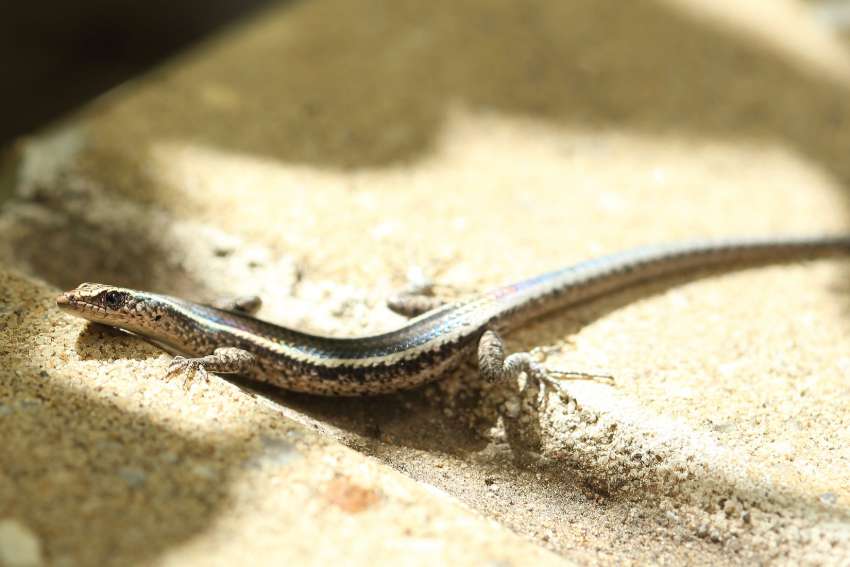
Cryptoblepharus virgatus
The Fence Skink (commonly referring to species such as Cryptoblepharus virgatus) is a small, fast-moving skink in the family Scinc···
 LC
LC
Eulamprus quoyii
The Eastern Water Skink (Eulamprus quoyii) is a medium-sized, semi-aquatic skink native to eastern Australia. As a member of the f···