Some animals can look surprisingly human when viewed from the front. The strongest resemblance is usually seen in other primates, especially apes, because humans share a relatively recent common ancestry with them. In other animals, the effect is often more subjective: rounded eyes, a short muzzle, visible lips, or a face framed by fur can trigger the impression of a familiar human expression.
There is no scientific category called a “human-faced animal,” so this list is based on visible resemblance rather than taxonomy. The effect is also influenced by face pareidolia—the tendency of the brain to detect familiar face patterns even when the resemblance is incomplete.
10 Animals That Can Look Like Human Faces
| Animal | Why the face can look human-like | How strong is the resemblance? |
|---|---|---|
| Bonobo | Forward-facing eyes, mobile lips, expressive brow and close evolutionary relationship | Very strong |
| Chimpanzee | Forward-facing eyes, expressive mouth, ears and facial musculature | Very strong |
| Gorilla | Bare face, visible nose and lips, expressive eyes | Very strong |
| Orangutan | Forward-facing eyes, visible lips, expressive facial movements | Very strong |
| Gibbon | Round face, forward-facing eyes and relatively flat facial profile | Strong |
| Baboon | Expressive eyes, brows and lips, despite a much longer muzzle | Moderate |
| Capuchin monkey | Large forward-facing eyes and highly expressive face | Moderate to strong |
| Sloth | Round head, short muzzle and dark eye markings that resemble facial expressions | Moderate |
| Red fox | Forward-looking gaze and changing mouth shape can appear expressive | Subjective |
| Giant panda | Round face and dark eye patches exaggerate a familiar face pattern | Subjective |
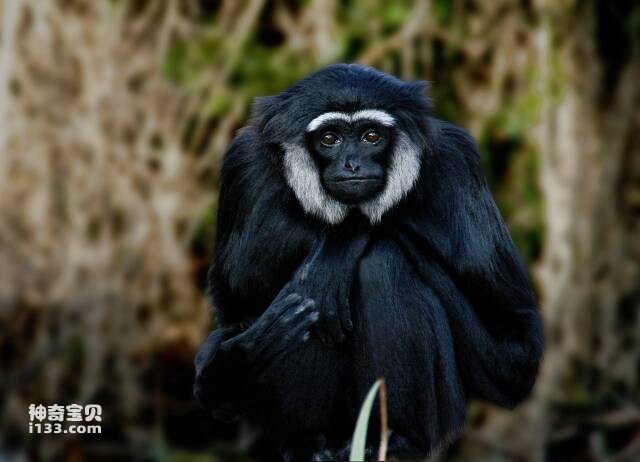
Gibbons are apes, not monkeys, and their round faces and forward-facing eyes can create a strong human-like impression.
Why Do Some Animals Look Human to Us?
There are two main reasons. The first is real biological similarity. Humans are primates, and we share important features with other primates, including forward-facing eyes, mobile lips, expressive facial muscles, and broadly similar arrangements of the eyes, nose, and mouth. The resemblance is strongest in apes because humans and other apes share common ancestry.
The second reason is perception. Human brains are exceptionally sensitive to face-like patterns. Research on face pareidolia shows that we can rapidly interpret even incomplete arrangements—such as two eye-like shapes above a mouth-like shape—as a face. That can make non-primate animals appear more “human” than their anatomy really is.
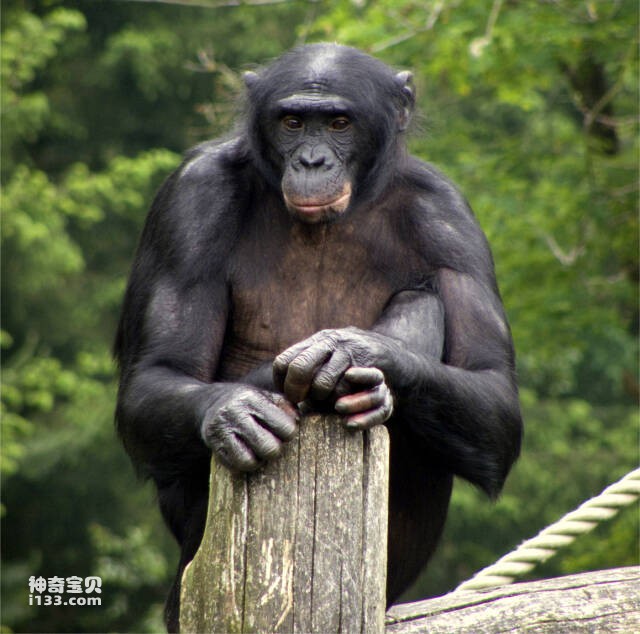
Bonobo
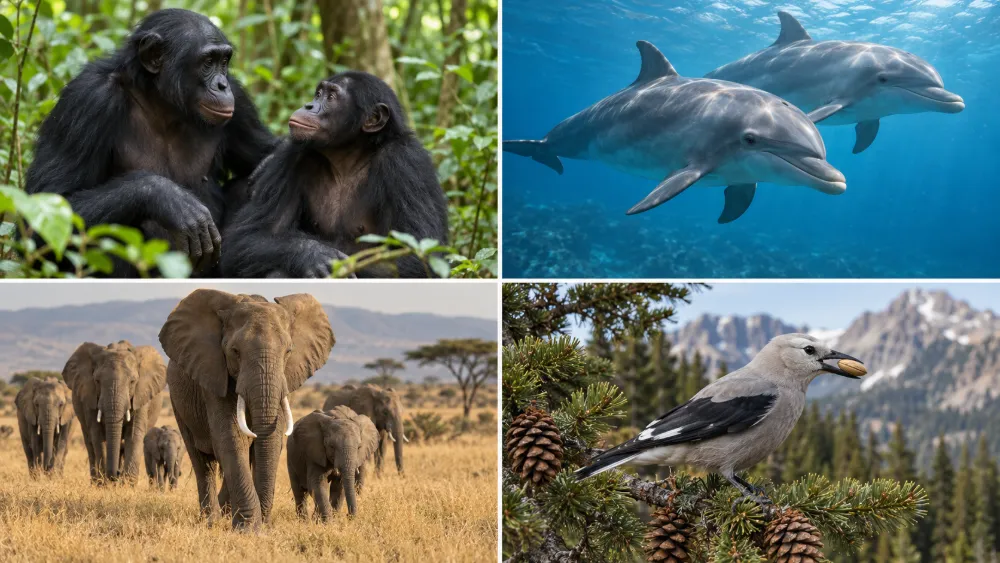
Bonobos (Pan paniscus) are among our closest living evolutionary relatives. Their faces have forward-facing eyes, mobile lips, visible ears, and a relatively flat profile compared with many monkeys. Young bonobos in particular can produce facial expressions that people immediately interpret as curiosity, surprise, concern, or playfulness.
The resemblance does not mean bonobo expressions are identical to human expressions. Different primates use facial movements in species-specific social contexts, even when those movements look familiar to us.
Chimpanzee
Chimpanzees (Pan troglodytes) share many visible facial features with humans because both species are great apes. Their eyes face forward, their lips are highly mobile, and the hairless central part of the face makes the eyes, nostrils, and mouth especially prominent.
Chimpanzees also use facial displays during social interactions. A chimpanzee face may look like a smile, grimace, pout, or surprised expression to a human observer, although the behavioral meaning should not automatically be assumed to match the equivalent human expression.
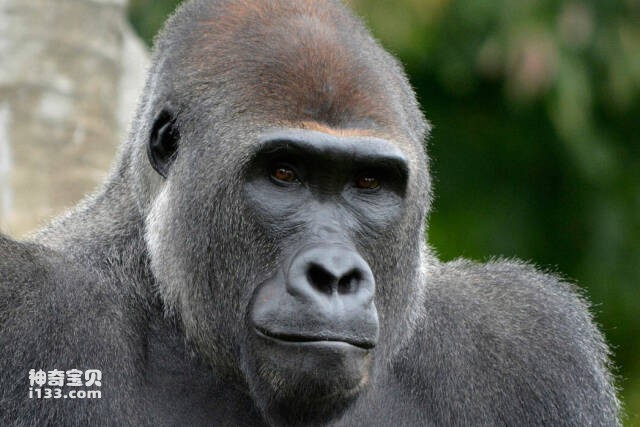
Gorilla
Gorillas have broad, mostly hairless faces with highly visible eyes, nostrils, lips, and ears. Smithsonian descriptions of western lowland gorillas note distinctive nose and lip shapes as well as prominent brow ridges. Individual gorillas can also be recognized by unique nose patterns.
The large jaw and heavy brow make an adult gorilla look very different from a human, but the basic organization of the face is immediately familiar.
Orangutan
Orangutans are great apes native to the rainforests of Sumatra and Borneo. Their forward-facing eyes, flexible lips, and expressive facial movements often produce one of the strongest visual resemblances to humans.
Adult males can develop large cheek pads, called flanges, which make their faces look much broader than those of humans. Females and younger orangutans usually have narrower faces, and the human-like arrangement of the features can be especially obvious.
Gibbon
Gibbons are small apes rather than monkeys. They have round faces, forward-facing eyes, no external tail, and extremely long arms adapted for brachiation. Smithsonian's National Zoo notes that gibbons belong to the ape group despite their smaller size.
Many gibbon species also have contrasting fur around the face, which creates a natural “frame” around the eyes, nose, and mouth and can strengthen the impression of a human-like face.
Baboon
Baboons are Old World monkeys and are less human-looking anatomically than apes because they have long, dog-like muzzles. Even so, their forward-facing eyes, mobile lips, brows, and highly social facial displays can look surprisingly familiar in photographs taken from certain angles.
This is a good example of why “looks human” is subjective. A baboon skull and muzzle are clearly unlike ours, yet the eyes and facial expressions may still trigger a strong sense of resemblance.
Capuchin Monkey
Capuchin monkeys have large forward-facing eyes, a relatively rounded head, and highly mobile facial features. They are also visually attentive and use facial and body signals in social situations, making their expressions easy for people to notice.
Capuchins are New World monkeys, not apes, so their evolutionary relationship to humans is more distant than that of chimpanzees, bonobos, gorillas, orangutans, and gibbons.
For more primate diversity, see Types of Monkeys: A Guide to 30 Species and Top 10 Smartest Monkeys in the World.
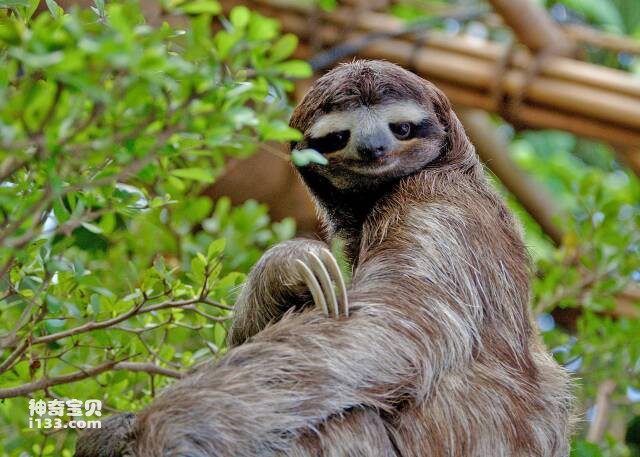
Sloth
Sloths are not primates, but their short muzzle, small nose, round head, and dark markings around the eyes can produce a surprisingly human-like impression. Their naturally curved mouth can also be interpreted by people as a relaxed smile.
That apparent “expression” should not be treated as a reliable sign of the animal's emotional state. Much of the effect comes from fixed facial anatomy rather than a human-style smile.
Red Fox
A red fox does not have a human-like skull, but certain photographs can make the animal appear unusually expressive. The combination of forward-looking eyes, eyebrow-like markings, mobile ears, and a mouth that changes shape while panting or vocalizing can give observers the impression of a familiar expression.
This resemblance is primarily perceptual rather than anatomical. Foxes remain typical canids, with long muzzles and facial proportions very different from those of primates.
Giant Panda
The giant panda's round head and black eye patches create one of the most recognizable faces in the animal world. The patches enlarge the apparent eye region, while the short muzzle and rounded ears produce a compact facial pattern that people often interpret as baby-like or human-like.
Again, this is mainly a visual impression. Pandas are bears, and their skull anatomy is specialized for powerful chewing rather than resembling the primate face.
Why Primates Usually Look the Most Human
The strongest examples on this list are primates for a simple evolutionary reason: humans are primates too. Smithsonian's Human Origins Program notes that humans are most closely related to the African great apes, including chimpanzees, bonobos, and gorillas, and that these lineages share common ancestors.
Many primates also rely heavily on vision and social communication. Forward-facing eyes support depth perception, while movements of the mouth, brows, eyelids, and other facial regions can carry social information.
Does a Human-Like Expression Mean the Same Emotion?
Not necessarily. It is tempting to describe an animal as smiling, frowning, laughing, embarrassed, or angry simply because its face resembles a human expression. That interpretation can be wrong.
Animal facial signals need to be understood in the context of the species' own behavior. A primate grimace that looks like a human smile, for example, may occur in a very different social situation. The safest approach is to separate visual resemblance from claims about what the animal is feeling.
What Is Face Pareidolia?
Face pareidolia is the tendency to perceive a face in a visual pattern that is not actually a human face. People commonly experience it when they see faces in clouds, rocks, electrical outlets, or the front of a car.
The same tendency can influence how we see animals. Two prominent eyes, a central nose, and a mouth-like line are often enough to create a strong face impression. Research has shown that face-like non-face images can engage parts of the human visual system involved in processing real faces.
Are There Animals With Actual Human Faces?
No. No non-human animal literally has a human face. Even our closest living relatives have different skull proportions, jaws, teeth, noses, skin, hair patterns, and facial musculature.
“Human-faced animal” is therefore an informal visual description, not a biological category.
Frequently Asked Questions
Which animal looks most like a human face?
Great apes such as bonobos, chimpanzees, gorillas, and orangutans usually show the strongest resemblance because humans are also great apes and share common ancestry with them.
Why do monkeys and apes look human?
Humans, monkeys, and apes are all primates. Shared ancestry contributes to similarities such as forward-facing eyes and broadly comparable arrangements of the eyes, nose, and mouth. The resemblance is strongest between humans and other apes.
Are gibbons monkeys?
No. Gibbons are apes. They are sometimes called lesser apes because they are smaller than great apes such as gorillas and orangutans.
Do sloths really smile?
A sloth's face can look as if it is smiling, but much of that appearance comes from the fixed shape of the mouth and surrounding facial markings. It should not automatically be interpreted as a human-like emotional smile.
Why do pandas look so human or baby-like?
Their round heads, short muzzles, rounded ears, and large dark eye patches create a compact face pattern that humans tend to find familiar and baby-like.
What is pareidolia?
Pareidolia is the tendency to detect a meaningful pattern, especially a face, in an ambiguous visual stimulus. It helps explain why some non-primate animals or even inanimate objects can look as though they have human faces.
Official and Reference Sources
Scientific Reports / PMC — Face Pareidolia in the Human Brain
Royal Society / PMC — Face Identity and Emotion Processing in Animals
Final Takeaway
Animals that look most like human faces are usually other primates, especially bonobos, chimpanzees, gorillas, orangutans, and gibbons. Their resemblance reflects shared evolutionary history as well as similar placement of the eyes, nose, and mouth. Sloths, foxes, pandas, and other non-primates can also look human-like in certain photos, but that effect is much more subjective and is partly explained by our brain's strong tendency to detect familiar face patterns.