If a large python begins wrapping tightly around you, call or shout for help immediately and do not allow its coils to close around your neck or upper chest. Do not assume you can simply wait for the snake to relax. Powerful constrictors can interfere with blood circulation as well as breathing, and a serious constriction can become dangerous quickly. If another capable person is present, they should help remove the snake while protecting your airway. After a significant constriction or bite, seek medical attention.
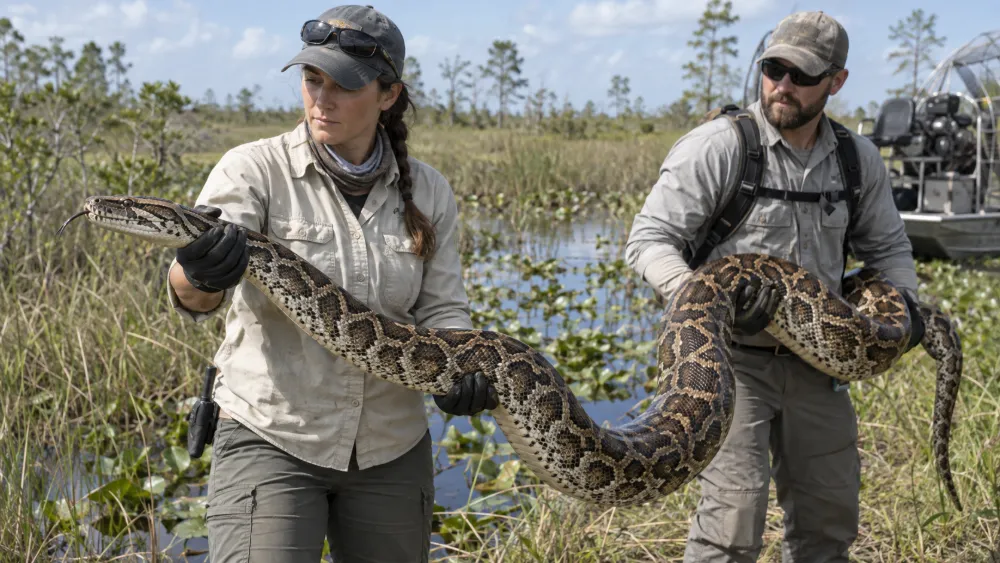
Large constrictors should not be handled alone, and they should never be allowed to form a complete coil around a person's neck or upper torso.
What Should You Do If a Python Wraps Around You?
A python loosely resting or bracing against a person's body is not automatically attacking. However, if a large snake begins tightening its coils, especially around the chest or neck, treat the situation as an emergency.
The priorities are simple:
Call or shout for help immediately.
Keep the snake away from your neck and airway if you still can.
Do not let additional coils form around your upper torso.
Have another capable person help remove the snake as quickly and safely as possible.
Call emergency services if breathing, consciousness or circulation is affected.
A person dealing with a truly large constrictor should not rely on strength alone. Prevention and having another handler present are far safer than trying to escape after a powerful snake has already established several tight coils.
Does a Python Kill by Suffocation?
Not simply by suffocation.
Older explanations often claimed that constricting snakes kill prey by squeezing until the animal can no longer breathe. Research has shown that the process can be much faster and involves the cardiovascular system.
Experimental work on constricting snakes found rapid changes in blood pressure and heart function in prey during constriction. Pressure from the snake can severely restrict circulation, interfering with the movement of oxygenated blood through the body.
Research on large pythons has also measured constriction pressures greater than the normal blood pressure of many mammalian prey animals.
Breathing restriction can still contribute to injury, but it is inaccurate to describe python constriction as nothing more than slow suffocation.
How Quickly Can Python Constriction Become Dangerous?
There is no reliable countdown that applies to every incident.
The danger depends on several factors, including:
the species of python;
the snake's length and body mass;
how many coils are involved;
where the coils are positioned;
how much pressure the snake is applying;
the size and health of the person;
whether another person is available to assist.
A loose coil around an arm is completely different from powerful constriction around the neck or chest.
For this reason, do not wait for severe symptoms before getting help if a large python is actively tightening around your upper body.
Should You Stay Still If a Python Is Constricting You?
No general safety rule says that a person should simply remain motionless while a large python is actively constricting them.
Staying calm is useful because panic can make it harder to think and communicate. But staying calm does not mean staying silent or passively waiting.
If you can call for help, do so immediately.
If another trained or capable person is nearby, they should assist with controlling and removing the snake rather than leaving the victim to deal with a large constrictor alone.
Should You Shout for Help?
Yes.
The idea that shouting will necessarily make a python more aggressive is not a sound reason to avoid calling for assistance during an emergency.
If a large snake has formed dangerous coils around your body, having another person available may be critically important.
Use your voice, phone or any other safe means available to attract help.
Protect Your Neck and Chest
The neck and upper torso are particularly dangerous places for a large constrictor to establish a complete coil.
Safety protocols for handling large constricting snakes specifically warn handlers not to allow the snake to fully wrap around the neck or upper torso.
Pressure in these areas can interfere with breathing and circulation and may also make self-release much more difficult.
If a python begins moving toward your neck during routine handling, redirect and support its body before it forms a complete loop.
Can You Unwrap a Python by Yourself?
That depends heavily on the size of the snake and the situation.
A small pet python loosely wrapped around an arm is usually very different from an adult Burmese or reticulated python applying strong constriction.
With a very large snake, a single person may not have enough leverage, reach or free movement to safely control both the snake's head and multiple coils.
This is why professional guidance emphasizes having additional capable people present when handling giant constrictors.
If another person is helping, the goal is to remove pressure from the victim and prevent the snake from establishing new coils while maintaining control of the animal.
Should You Pry the Coils Apart With a Stick?
Do not make improvised tools your first plan.
A stick or hard object can slip, injure the person, injure the snake or make an already uncontrolled situation harder to manage.
The safer strategy is to avoid handling a large python alone in the first place and to have capable assistance immediately available.
If the situation is already life-threatening, getting human help and contacting emergency services are more important than experimenting with unverified internet escape tricks.
What If the Python Bites and Holds On?
Large pythons are nonvenomous, but their bites can still cause significant injuries.
They have numerous sharp, backward-curving teeth that can produce deep punctures and lacerations.
Do not assume that a nonvenomous snake bite is harmless simply because no venom is involved.
Once you are safely away from the snake, control significant bleeding, clean the wound and obtain appropriate medical care.
Healthcare professionals may need to assess the wound, infection risk and tetanus protection.
When Should You Call Emergency Services?
Seek emergency medical help immediately if constriction causes any of the following:
difficulty breathing;
loss of consciousness or near-fainting;
confusion;
severe chest or neck pain;
persistent weakness or numbness;
major bleeding;
serious facial or neck injury;
inability to remove the snake safely.
Significant pressure to the neck or chest deserves particular caution even after the snake has been removed.
Should You Get Medical Care After a Python Bite?
Yes, especially if the bite breaks the skin deeply.
Even nonvenomous snake bites can cause punctures, lacerations, bleeding and infection.
Medical guidance generally recommends cleaning snake bites and having significant bites assessed by a healthcare professional.
If you are not completely certain what species bit you, do not assume that it was nonvenomous.
Do Pythons Normally Attack Humans?
No. Serious attacks on humans by large constrictors are rare.
Most pythons do not regard adult humans as normal prey, and wild pythons generally avoid unnecessary interaction with people.
However, very large species such as Burmese pythons, reticulated pythons and African rock pythons are physically capable of causing severe injuries.
Rare does not mean impossible, especially when people intentionally handle large snakes.
Why Would a Python Wrap Around a Person?
Wrapping does not always mean predation.
A python may wrap around a handler for support because snakes naturally use their bodies to grip stable objects while climbing or being carried.
A frightened or poorly supported snake may also hold more tightly.
In other circumstances, a feeding response can lead to a bite followed by rapid coiling and constriction.
Because the same large animal is physically powerful in all of these situations, handlers should not wait until they know the snake's exact motivation before following safety precautions.
How Dangerous Are Burmese Pythons to Humans?
Burmese pythons are among the world's largest snakes and are powerful constrictors, but attacks on people are uncommon.
The U.S. Geological Survey has reported that the overall risk to people from wild Burmese pythons in Florida is very low. No human deaths from wild-living Burmese pythons have been recorded there.
Most serious incidents involving giant constrictors occur in situations where people intentionally interact with captive snakes.
The simplest way to reduce the risk is therefore not to approach or handle a large wild python.
How to Prevent a Python Constriction Emergency
Prevention is much safer than attempting to escape a large constrictor after it has already wrapped around you.
Never Handle a Giant Python Alone
Safety guidance for large constrictors consistently recommends additional handlers for large snakes.
A U.S. Geological Survey report noted that a solitary person should not attempt to touch a giant constrictor in field situations and cited established husbandry guidance recommending additional handlers as snake size increases.
The exact number of handlers needed varies with the snake, its size, the environment and the handlers' experience.
Never Put a Large Python Around Your Neck
Do not pose with a large constrictor wrapped completely around your neck, even if the snake has always appeared calm.
A snake does not need to be deliberately attacking for its body weight and muscular grip to create a dangerous situation.
Support the Snake's Body
A poorly supported snake may grip the handler more tightly simply to avoid falling.
Proper handling distributes the animal's weight and avoids encouraging it to use the handler's neck as an anchor point.
Do Not Approach Wild Pythons
If you encounter a large python in the wild, keep your distance.
In South Florida, wildlife authorities encourage people who encounter Burmese pythons to follow local reporting and removal guidance rather than casually attempting to handle the snake without training.
What Should a Second Person Do?
The presence of another capable person is one of the most important safeguards when working with a large constrictor.
If constriction occurs, the helper should focus on freeing the person, controlling the snake and preventing additional coils from forming.
The helper should also be ready to call emergency services if the victim has breathing difficulty, loses consciousness or suffers a serious injury.
People who routinely keep very large constrictors should learn species-appropriate handling procedures before an emergency happens rather than relying on improvised advice during an incident.
Common Myths About Python Attacks
“Pythons only kill by suffocating prey.”
False. Modern research indicates that constriction can rapidly disrupt blood circulation and cardiovascular function.
“If a python wraps around you, just stay completely still.”
Misleading. Remaining calm is useful, but dangerous constriction requires prompt action and assistance.
“You should not shout because noise will make the python attack harder.”
There is no good reason to sacrifice the opportunity to summon help during a serious constriction emergency.
“A python around your shoulders is always harmless.”
False. Large constrictors should not be permitted to complete a loop around a person's neck or upper torso.
“Every python that wraps around a person is trying to eat them.”
False. Snakes also coil around objects and handlers for support. The safety risk depends on the snake's size, coil location and pressure, not only on its motivation.
Frequently Asked Questions
Can a python squeeze a human to death?
Yes, sufficiently large constrictors are physically capable of causing fatal injuries, although deaths are rare. Serious pressure around the chest or neck should always be treated as an emergency.
Can you survive being constricted by a python?
Yes. The outcome depends on the snake's size, the location and strength of the constriction, how quickly assistance is available and whether serious injuries have already occurred. There is no safe amount of time to wait when a giant python is tightly constricting the neck or chest.
Should you run if you see a python?
You generally do not need to panic or sprint away. Keep a safe distance, do not touch or corner the snake and allow it an escape route. Follow local wildlife guidance if the species needs to be reported.
Can a ball python kill an adult human?
A typical adult ball python is far smaller and less powerful than giant species such as Burmese and reticulated pythons. It is not considered a realistic predation threat to a healthy adult human. Normal responsible handling is still appropriate.
Which pythons are most dangerous to handle?
The greatest physical risk comes from very large species and individuals, especially adult reticulated pythons, Burmese pythons and African rock pythons. Size, body condition and handling circumstances matter more than simply labeling a species “aggressive.”
Do pythons have venom?
No. Pythons are nonvenomous snakes. They subdue prey primarily through constriction rather than venom.
Can a python bite while constricting?
Yes. During a feeding response, a python can bite and then rapidly wrap coils around the target. Defensive interactions can also involve biting without feeding behavior.
Should you handle a large python alone?
No. Large constrictors should be handled with capable assistance available. Safety becomes increasingly important as the snake's length, weight and strength increase.
Scientific and Official Sources
Journal of Experimental Biology — research on circulatory arrest during snake constriction.
Journal of Experimental Biology — research measuring constriction pressure in reticulated and Burmese pythons.
U.S. Geological Survey — human risk assessment and handling guidance for giant constrictor snakes.
Florida Fish and Wildlife Conservation Commission — Burmese python identification, safety and Python Patrol training.
U.S. Fish & Wildlife Service — Burmese python management and human-safety information.
NHS and Mayo Clinic — general snake-bite first aid and medical assessment guidance.