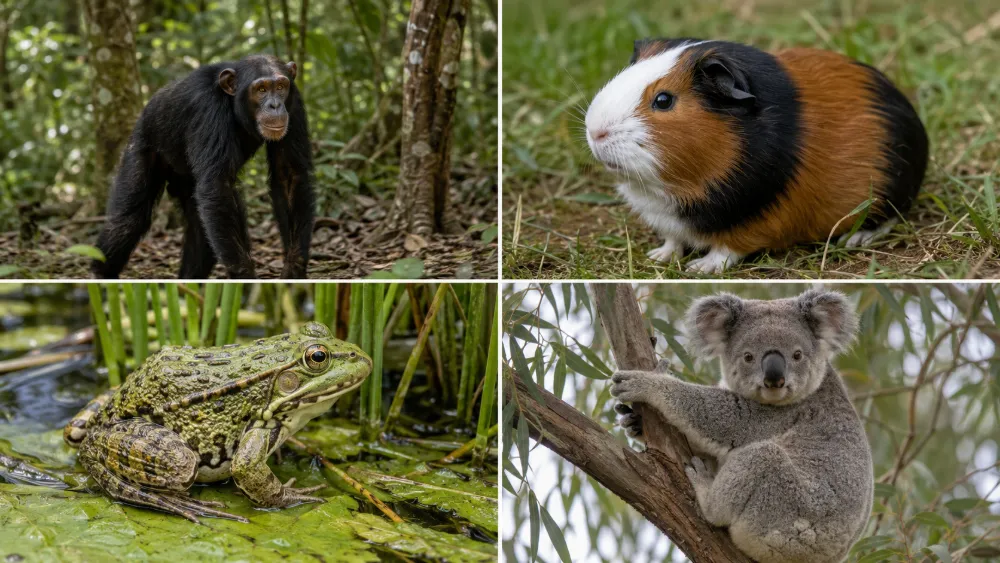
Some animals truly lack an external tail, while others only appear tailless because the tail is extremely short, reduced, hidden by fur, or transformed during development. Clear examples include apes, guinea pigs, and adult frogs and toads. Koalas also have no visible external tail, while animals such as capybaras and slow lorises retain only a very small or vestigial tail.
It is also easy to misidentify animals as tailless. Birds, snakes, whales, and most fish all have tails, even though their tails may look very different from the long furry tail people usually imagine. The key is to distinguish a truly absent external tail from a short, hidden, or specialized one.
Animals Without Tails at a Glance
| Animal or group | Tail status | Important detail |
|---|---|---|
| Apes | No external tail | Includes humans, chimpanzees, gorillas, orangutans, and gibbons |
| Guinea pigs | No external tail | Domestic guinea pigs are naturally tailless |
| Adult frogs and toads | No external tail | Tadpoles have tails, but the tail is lost during metamorphosis |
| Koalas | No visible external tail | The tail is vestigial rather than a functional external appendage |
| Capybaras | Extremely short tail | The tail can appear to be completely absent |
| Slow lorises | Vestigial tail | A tiny tail stump is hidden beneath the fur |
| Some cavies | Absent or vestigial | Several members of the guinea-pig family have highly reduced tails |
Apes Have No External Tails
One of the clearest examples of tailless animals is the ape group. Humans, chimpanzees, bonobos, gorillas, orangutans, and gibbons all belong to the ape superfamily and lack an external tail.
This is an important difference between apes and most monkeys. Many monkeys have long or short tails, while apes do not. The bones at the lower end of the ape spine are reduced into the coccyx rather than extending outward as a tail.
The absence of a tail does not mean apes lack balance or climbing ability. Gibbons, for example, move through trees using long arms and highly specialized shoulder joints rather than relying on a tail for support.
Guinea Pigs Are Naturally Tailless
Guinea pigs are another straightforward example. The Smithsonian's National Zoo notes that domestic guinea pigs have no tails. Their rounded hindquarters can make this especially obvious when compared with rodents such as rats, mice, or squirrels.
Guinea pigs belong to the cavy family, a South American rodent group in which tails are generally very reduced. In guinea pigs, there is no visible external tail at all.
This has no negative effect on their normal movement. Guinea pigs are ground-dwelling animals and do not depend on a tail for climbing or balance in the way many tree-dwelling rodents do.
Adult Frogs and Toads Lose Their Tails
Frogs and toads are particularly interesting because they begin life with a tail and later lose it. Tadpoles use a muscular tail for swimming, but during metamorphosis that tail is gradually absorbed as the legs develop and the animal changes into its adult form.
Adult frogs and toads belong to the order Anura, a name that literally refers to being without a tail. In the adult body, the rear vertebrae are modified into a structure called the urostyle instead of forming a long external tail.
This dramatic transformation is one of the clearest examples of how an animal can have a tail during one life stage and no visible tail during another.
Koalas Have No Visible External Tail
Koalas look completely tailless from the outside. Australian Museum material describes the koala as having no tail, while anatomical references often describe the structure as vestigial.
A vestigial structure is a reduced remnant inherited from ancestors. In practical terms, a koala does not have the long external tail seen in many other marsupials such as possums and kangaroos.
Koalas spend much of their time climbing eucalyptus trees, but instead of using a tail for grasping or balance, they rely on strong limbs, curved claws, and specialized hands and feet.
Capybaras Look Tailless but Have a Tiny Tail
Capybaras are often included on lists of animals without tails because no obvious tail can be seen when looking at them. Anatomically, however, their tail is better described as extremely short or vestigial rather than completely absent.
Animal Diversity Web notes that a capybara's tail is so short that it appears to be missing altogether. This makes the capybara a good example of an animal that is nearly tailless rather than strictly tailless.
The capybara's body is adapted for a semi-aquatic lifestyle. Its eyes, ears, and nostrils sit high on the head, and its feet are partly webbed. A large balancing tail is not part of its body plan.
Slow Lorises Have a Hidden Vestigial Tail
Slow lorises are another group that can look completely tailless. Their tail is highly reduced to a small stump and is hidden beneath thick fur.
Because the tail is not externally obvious, casual observers may assume it is absent. Anatomically, though, the more accurate description is vestigial.
Slow lorises move slowly through branches using strong grasping hands and feet. Their climbing style does not depend on a long tail.
Some Cavies Have Absent or Vestigial Tails
Guinea pigs are part of the wider cavy family, and tail reduction is common in this group. Animal Diversity Web describes the tail as vestigial across caviids, while some individual species are described as having an absent or nearly absent tail.
This family includes guinea pigs, rock cavies, maras, and capybara relatives. The exact external appearance differs by species, but many do not have the obvious long tail typical of other rodents.
Animals Commonly Mistaken for Being Tailless
Several animals are often listed incorrectly as having no tail. Their tails may look unusual, be hidden, or be covered by feathers, but they are still anatomically present.
Birds do have tails
Birds have caudal vertebrae at the end of the spine, and the final vertebrae are fused into a structure called the pygostyle. Tail feathers attach around this area and play important roles in steering, braking, display, and balance.
A penguin may not have a long furry tail, but it is still incorrect to say that birds as a group are tailless.
Snakes do have tails
A snake's body can make it difficult to see where the torso ends and the tail begins, but snakes do have tails. Anatomically, the tail starts behind the cloaca and continues to the tip of the body.
The proportion of the body formed by the tail varies between snake species and can also differ between males and females.
Whales have powerful tails
Whales are definitely not tailless. Their tails end in two horizontal flukes that provide propulsion through the water. NOAA describes the flukes as being controlled by powerful muscles in the caudal peduncle.
The tail of a whale simply looks very different from the tail of a terrestrial mammal.
Fish have tails too
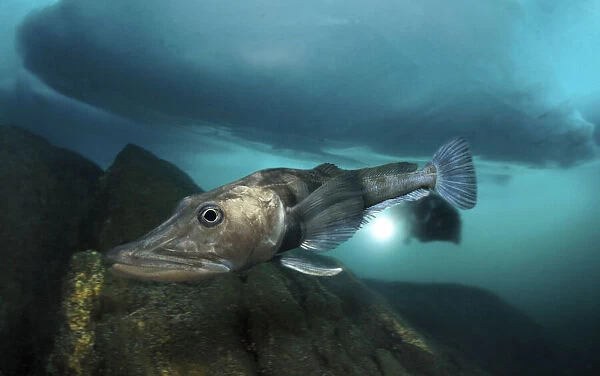
Most fish, including angelfish, have a caudal region and a caudal fin that functions as the tail. An angelfish's tail is clearly visible behind the body and helps with movement and maneuvering.
So angelfish should not be included on a list of truly tailless animals.
Why Do Some Animals Lose or Reduce Their Tails?
There is no single reason for tail loss or reduction across all animals. Evolution works differently in different lineages.
Body plan changes: apes evolved without an external tail as their locomotion and body structure changed.
Developmental transformation: frogs lose the tadpole tail during metamorphosis.
Reduced functional need: in some ground-dwelling mammals, a long tail may provide little advantage.
Vestigial structures: some species retain only a small internal or hidden remnant of a tail.
It is therefore more accurate to ask how reduced the tail is and whether it remains externally visible rather than assuming all apparently tailless animals share the same evolutionary history.
Does “No Visible Tail” Mean the Animal Has No Tail Bones?
Not necessarily. Some animals that look tailless retain reduced caudal structures internally. Apes have a coccyx at the base of the spine, koalas are commonly described as having a vestigial tail, and adult frogs have a modified posterior spinal structure rather than a normal external tail.
This is why zoologists distinguish between a truly absent external tail, a vestigial tail, and a short but functional tail.
Frequently Asked Questions
What animals truly have no tails?
Clear examples include apes, domestic guinea pigs, and adult frogs and toads. Koalas also lack a visible external tail, although the structure is often described as vestigial.
Are humans the only primates without tails?
No. All apes lack external tails. This includes humans, chimpanzees, bonobos, gorillas, orangutans, and gibbons. Most monkeys, by contrast, have tails.
Do koalas have tails?
Koalas have no visible external tail. Anatomical sources commonly describe the tail as vestigial, meaning it is a greatly reduced remnant rather than a functional external appendage.
Do guinea pigs have tails?
No visible external tail is present in domestic guinea pigs. The Smithsonian's National Zoo specifically describes guinea pigs as having no tails.
Do frogs have tails?
Tadpoles have tails, but most adult frogs and toads do not. The tail is absorbed during metamorphosis as the animal develops into its adult form.
Are whales tailless?
No. Whales have large horizontal tail flukes used for propulsion. The tail is one of the most important structures for swimming.
Are snakes tailless because their whole body looks the same?
No. Snakes have a distinct tail region beginning behind the cloaca. It may be difficult for a casual observer to identify, but anatomically it is a real tail.
Official and Reference Sources
Final Takeaway
Animals without visible tails include apes, guinea pigs, adult frogs and toads, and koalas. Other animals such as capybaras and slow lorises look tailless but actually retain extremely short or vestigial tails. Birds, snakes, whales, and angelfish should not be described as tailless because all have identifiable tail structures. Understanding the difference between absent, vestigial, hidden, and specialized tails makes the list much more accurate.