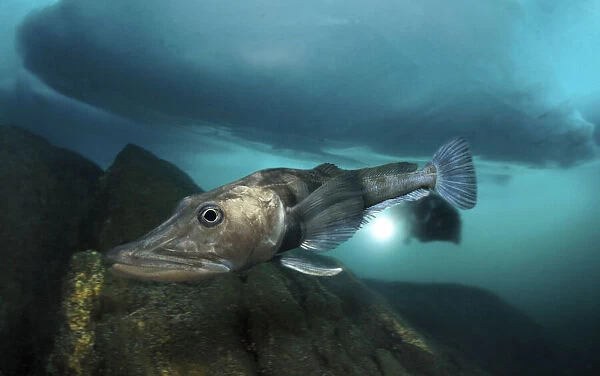
No, there are no sharks living in Lake Baikal. Lake Baikal is an enormous freshwater lake in Siberia, Russia, but no native or established shark population has ever been documented there. Most sharks cannot live permanently in freshwater. A few species, especially the bull shark, can enter rivers and freshwater lakes, but Lake Baikal is far outside their normal warm-water range. Instead, Baikal is home to unique freshwater fish such as golomyankas, omul, sculpins and sturgeon, as well as the famous Baikal seal.
The question is understandable because Lake Baikal is so enormous and deep that it can feel more like an inland sea than a normal lake. It is more than 1,600 meters deep and contains about 20% of the world's unfrozen freshwater reserve. Yet its ecosystem is fundamentally freshwater, and sharks are not part of it.
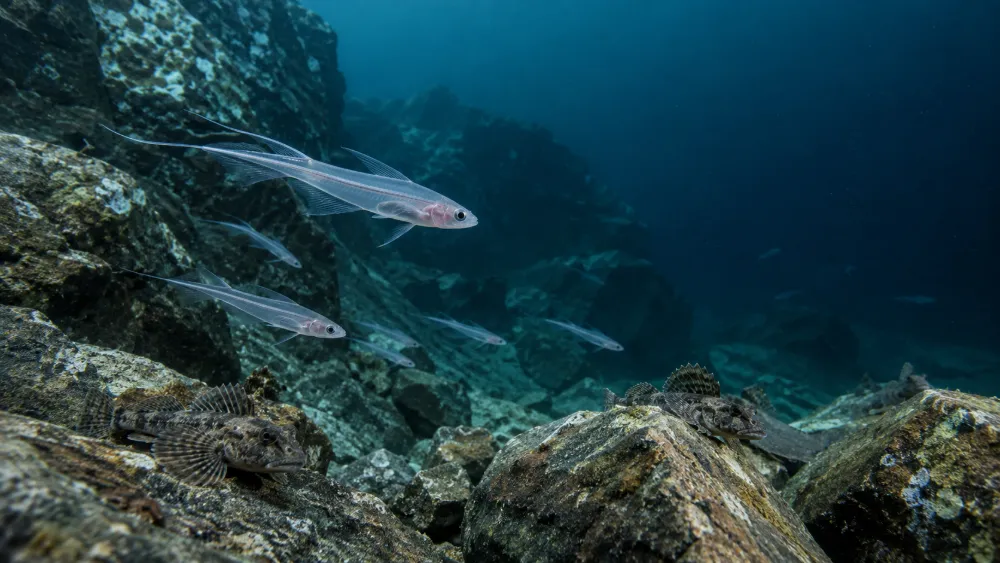
Lake Baikal has an extraordinary freshwater ecosystem with many endemic fish, but no sharks live in the lake.
Are There Sharks in Lake Baikal?
No known shark species lives naturally in Lake Baikal.
There are no resident bull sharks, river sharks, dogfish, freshwater shark populations, or any other true sharks in the lake.
Lake Baikal is a freshwater ecosystem that has been isolated for millions of years. Its long evolutionary history produced a remarkable community of organisms found nowhere else on Earth, but sharks are not among them.
UNESCO describes Baikal as the world's oldest and deepest lake and notes that its age and isolation have produced one of the richest and most unusual freshwater faunas on Earth.
Why Aren't There Sharks in Lake Baikal?
There is more than one reason.
The simplest explanation is that most shark species are physiologically adapted to saltwater.
Sharks regulate water, salts and nitrogen-containing compounds inside their bodies very differently from ordinary freshwater bony fish. Most species maintain unusually high concentrations of substances such as urea in their body fluids, an adaptation that works in a marine environment.
Moving permanently into freshwater creates major problems with water and salt balance.
Only a very small number of sharks have evolved the special physiological flexibility needed to spend substantial periods in freshwater.
Can Any Sharks Live in Freshwater?
Yes. This is where the Lake Baikal question becomes more interesting.
Although most sharks are marine animals, a few can tolerate freshwater.
The best-known example is the bull shark (Carcharhinus leucas).
Bull sharks can move between seawater, brackish estuaries and freshwater rivers. They have been documented thousands of kilometers upstream in major river systems.
Some river sharks in the genus Glyphis are also adapted to low-salinity and freshwater environments.
So the statement “sharks cannot live in freshwater” is too broad.
A more accurate statement is:
Most sharks cannot live in freshwater, but a few highly specialized species can.
Could a Bull Shark Live in Lake Baikal?
There is no wild bull shark population in Lake Baikal, and the lake is far outside the normal ecological range of bull sharks.
Bull sharks occur mainly in tropical and subtropical coastal waters, estuaries and connected river systems.
Lake Baikal, by contrast, is a cold Siberian lake. Its surface freezes during winter, and even summer water temperatures remain cold compared with typical bull shark habitat.
Freshwater tolerance alone therefore does not mean that a shark could naturally colonize every freshwater lake on Earth.
An animal also needs suitable:
temperature;
migration routes;
food resources;
breeding habitat;
seasonal conditions;
physiological tolerance.
Lake Baikal does not represent normal bull shark habitat.
Is Lake Baikal Connected to the Ocean?
Yes, but only indirectly through a very large river system.
The old claim that Lake Baikal is simply “not connected to the ocean” is inaccurate.
Lake Baikal has one major surface outflow: the Angara River.
The Angara eventually joins the Yenisey River, which flows north across Siberia and reaches the Kara Sea in the Arctic Ocean.
The hydrological pathway is therefore:
Lake Baikal → Angara River → Yenisey River → Kara Sea → Arctic Ocean
That does not mean marine animals can easily travel between the Arctic Ocean and Lake Baikal. The route covers an enormous distance and includes very different environmental conditions.
Modern dams and other barriers along the Angara system further distinguish the lake from coastal freshwater habitats regularly entered by migratory sharks.
Has a Shark Ever Been Found in Lake Baikal?
There is no credible scientific evidence of a wild shark population in Lake Baikal.
Stories about “Baikal sharks” sometimes appear because people associate very deep water with ocean predators or confuse large local fish with sharks.
Lake Baikal is deep enough to contain extraordinary animals, but depth alone does not create an ocean ecosystem.
Its chemistry, evolutionary history and biological community remain fundamentally freshwater.
Are There Ancient Sharks Hidden in the Deepest Parts?
There is no scientific evidence for hidden sharks living in Lake Baikal's deep water.
Lake Baikal is famous for unusual deep-water animals, which may help explain why this idea sounds believable.
Some native fish can live at extraordinary depths, and many Baikal species evolved in isolation over millions of years.
But extensive scientific research on the lake has not revealed a secret shark lineage.
Why Does Lake Baikal Feel Like an Inland Sea?
Lake Baikal is enormous.
UNESCO describes it as the world's deepest lake and one of the oldest, with an age of roughly 25 million years.
It contains close to one-fifth of the world's unfrozen freshwater reserve.
The lake is hundreds of kilometers long, produces substantial waves and reaches depths greater than many continental seas.
Those characteristics can make the lake look and behave like an inland sea from a human perspective.
Biologically, however, it is still freshwater.
What Fish Actually Live in Lake Baikal?
Lake Baikal has a remarkable native fish community, including many species found nowhere else.
Some of the best-known examples are:
| Animal | What Makes It Interesting |
|---|---|
| Golomyanka | Translucent endemic oilfish that lives throughout the water column, including extreme depths |
| Baikal omul | Endemic whitefish and one of the lake's best-known fish |
| Baikal sturgeon | Large native sturgeon associated with the lake and tributaries |
| Baikal sculpins | Highly diverse group of native and endemic bottom-dwelling fishes |
| Grayling | Cold-water fish occurring in the Baikal system |
| Whitefish | Cold-water salmon relatives occurring in the lake |
What Is a Golomyanka?
The golomyankas are among Lake Baikal's most unusual animals.
There are two species in the genus Comephorus:
the big golomyanka (Comephorus baicalensis);
the small golomyanka (Comephorus dybowskii).
Both are endemic to Lake Baikal.
They have pale, partly translucent bodies and lack a swim bladder. Scientific studies have recorded them throughout the lake's water column, from relatively shallow water down to extreme depths.
Golomyankas are also an important food source for the Baikal seal.
If Lake Baikal has a fish that deserves the description “strange deep-water creature,” the golomyanka is a much better example than an imaginary freshwater shark.
What Is the Baikal Omul?
The Baikal omul (Coregonus migratorius) is a cold-water whitefish endemic to the Lake Baikal system.
It has major ecological and cultural importance around the lake and has historically supported an important fishery.
Omul migrate into rivers for spawning and spend much of their lives feeding within the lake.
Recent scientific work continues to monitor omul populations because their abundance has changed substantially over time.
Does Lake Baikal Have Sturgeon?
Yes.
Lake Baikal supports the Baikal form of Siberian sturgeon, commonly referred to as the Baikal sturgeon.
Sturgeons are large, ancient-looking bony fishes with rows of hardened plates along their bodies.
Because they can grow large and have a somewhat prehistoric appearance, a quick underwater sighting might seem dramatic. But sturgeons are not sharks and are evolutionarily very different from them.
Are There Dolphins in Lake Baikal?
No native dolphins live in Lake Baikal.
One of the more serious errors sometimes repeated in descriptions of Lake Baikal is the claim that it contains a “Baikal river dolphin.”
There is no recognized Baikal river dolphin species.
The lake's famous aquatic mammal is the Baikal seal (Pusa sibirica), also called the nerpa.
Does Lake Baikal Really Have Seals?
Yes, and this is one of the lake's most remarkable biological facts.
The Baikal seal is a true seal that spends its life in freshwater.
It is found naturally only in the Lake Baikal system and is one of the world's best-known freshwater-adapted marine-mammal relatives.
Scientists believe its ancestors reached the Baikal system through northern river connections sometime in the distant past, although the exact evolutionary history remains a subject of scientific study.
The presence of seals sometimes contributes to the idea that other ocean animals such as sharks or dolphins must also live there.
That conclusion does not follow. The seal represents a specific evolutionary colonization event, not evidence that Lake Baikal contains an ocean fauna.
Could Marine Animals Have Entered Lake Baikal Long Ago?
Lake Baikal's unusual animals have inspired many hypotheses about ancient connections between the lake and northern seas.
Some lineages may ultimately trace their evolutionary ancestry to organisms that entered the Baikal drainage through ancient river systems.
However, today's Baikal ecosystem has been shaped by millions of years of freshwater evolution and isolation.
An animal's distant marine ancestry does not make the modern species marine.
Why Can Bull Sharks Enter Some Lakes but Not Lake Baikal?
Bull sharks can enter freshwater when suitable rivers provide access from warm coastal waters.
A famous example is Lake Nicaragua in Central America.
Bull sharks found there were once thought to represent a completely landlocked shark population, but research showed that sharks can move between the lake and the Caribbean through the San Juan River system.
That situation is very different from Lake Baikal.
| Feature | Lake Nicaragua | Lake Baikal |
|---|---|---|
| Climate | Tropical | Cold Siberian |
| Known bull sharks | Yes | No |
| Ocean access | River route to Caribbean | Very long indirect river route toward Arctic Ocean |
| Shark habitat suitability | Within bull shark climatic range | Far outside typical bull shark habitat |
Are There Freshwater Sharks Anywhere in the World?
Yes, but they are rare.
The bull shark is the most famous species capable of moving deep into freshwater.
River sharks in the genus Glyphis are another unusual group associated with rivers, estuaries and low-salinity habitats in parts of Asia and Australia.
Most of the world's hundreds of shark species remain marine.
This makes freshwater shark sightings biologically interesting rather than normal.
Why Can't Most Sharks Live in Freshwater?
The main challenge is osmoregulation—maintaining the correct balance of water and dissolved salts inside the body.
Marine sharks have physiological systems adapted to seawater. They retain compounds such as urea that help keep their internal fluids in osmotic balance with the ocean.
In freshwater, the balance changes dramatically. Water tends to enter the body while important ions can be lost.
Most sharks cannot adjust sufficiently to this environment for long-term survival.
Bull sharks are exceptional because their kidneys, gills and other organs can change how they regulate salts and urea as salinity changes.
Freshwater also creates a second challenge: sharks and rays become more negatively buoyant because freshwater is less dense than seawater. Scientific modeling suggests that this makes maintaining lift more energetically demanding.
How Deep Is Lake Baikal?
Lake Baikal reaches more than 1,600 meters (over 5,200 feet) at its deepest point.
That makes it the deepest lake on Earth.
Its extraordinary depth is one reason people imagine large mysterious predators living there.
But depth does not determine whether sharks can exist in a lake. Salinity, temperature, evolutionary history and access are far more important.
Is Lake Baikal Saltwater or Freshwater?
Lake Baikal is a freshwater lake.
Its mineral content is relatively low, and its enormous volume represents around one-fifth of Earth's unfrozen surface freshwater reserve.
Calling Lake Baikal an “inland sea” is a descriptive comparison based on its size, not a statement that the water is salty.
Is It Safe to Swim in Lake Baikal Because There Are No Sharks?
The absence of sharks removes one concern, but it does not make Lake Baikal automatically safe for swimming.
The lake is extremely cold, even during much of the warmer season. Cold-water shock and hypothermia can be serious risks.
Conditions can also include waves, currents, rapidly changing weather and remote shorelines.
Anyone entering Lake Baikal should therefore pay much more attention to water temperature and local conditions than to sharks.
What Is the Largest Predator in Lake Baikal?
There is no simple shark-like apex predator dominating the entire lake.
The Baikal seal is one of the most conspicuous large aquatic predators and feeds heavily on fish, particularly golomyankas and sculpins.
Large predatory fish also occur within the wider Baikal basin.
The food web is therefore built around native freshwater organisms rather than giant marine predators.
Lake Baikal Shark Myths vs Facts
| Claim | Fact |
|---|---|
| Sharks live in Lake Baikal | No established shark population is known from the lake |
| No shark can survive freshwater | False; bull sharks and some river sharks can tolerate freshwater |
| Lake Baikal has no connection to the ocean | Incorrect; its water drains through the Angara and Yenisey toward the Arctic Ocean |
| Lake Baikal has river dolphins | No; its famous aquatic mammal is the Baikal seal |
| Lake Baikal has unusual deep-water fish | Yes; golomyankas and endemic sculpins are notable examples |
| The lake is salty because it is so large | No; Lake Baikal is freshwater |
Frequently Asked Questions
Are there sharks in Lake Baikal?
No. No native or established shark population is known from Lake Baikal.
Does Lake Baikal have bull sharks?
No. Bull sharks can tolerate freshwater, but they are not found in Lake Baikal. Their normal range is in much warmer tropical and subtropical waters.
Has anyone ever found a shark in Lake Baikal?
There is no credible scientific evidence of a wild shark population in Lake Baikal.
Can sharks survive in freshwater lakes?
Most sharks cannot, but a few species can tolerate freshwater. Bull sharks are the best-known example.
Is Lake Baikal connected to the ocean?
Indirectly. Water leaves Lake Baikal through the Angara River, which joins the Yenisey River and eventually reaches the Kara Sea in the Arctic Ocean.
What large animals live in Lake Baikal?
The Baikal seal is the lake's most famous large aquatic mammal. The lake also contains sturgeon, omul, grayling, whitefish, golomyankas and many endemic sculpins.
Are there dolphins in Lake Baikal?
No native dolphin species lives in Lake Baikal. Claims about a “Baikal river dolphin” are incorrect.
What is the strangest fish in Lake Baikal?
The golomyanka is one of the strongest candidates. These small translucent endemic fish inhabit an enormous depth range and are an important food source for Baikal seals.
Why is Lake Baikal so biologically unique?
Its extreme age, great depth and long isolation allowed many freshwater species to evolve there independently. UNESCO describes its fauna as exceptionally rich and unusual.
Is Lake Baikal an ocean?
No. Despite its enormous size and depth, Lake Baikal is a freshwater lake.
Scientific and Reference Sources
Final Takeaway
There are no sharks in Lake Baikal. The lake may be enormous, ancient and deeper than many seas, but it is a cold freshwater ecosystem with its own distinctive evolutionary history.
A few sharks such as bull sharks really can enter freshwater, so the reason is more complicated than simply saying “all sharks need saltwater.” Bull sharks have special physiological adaptations that most sharks lack, but they live mainly in much warmer tropical and subtropical systems and have never established a population in Lake Baikal.
The real animals of Baikal are arguably more interesting anyway: translucent deep-water golomyankas, endemic omul and sculpins, ancient sturgeon and the world's famous freshwater Baikal seal make the lake one of Earth's most unusual aquatic ecosystems.