Skip to content
Animals Top
Home>Animals>Birds>Climbing birds
Animal Profile IUCN: LC

Pteroglossus frantzii

Pteroglossus frantzii,Fiery-billed aracari

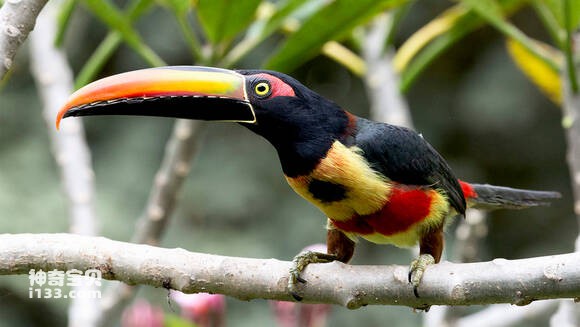
Pteroglossus frantzii, also known as Fiery billed aracari, is a medium-sized climbing bird.The red-billed Tucan is also the noisiest of the forest birds, producing loud rumbles, trumpets, and screeches. Its nest is built in a hole high in a tree. When eating, always peck the food with the tip of the
Climbing birds 521 views
Scientific Name Pteroglossus frantzii,Fiery-billed aracari
Length No textual research information is available
Weight No textual research information is available
Lifespan No textual research information is available
IUCN Status LC
Advertisement

Table of Contents

    Pteroglossus frantzii, also known as Fiery billed aracari, is a medium-sized climbing bird.4b1199256b600c3358143aec114c510fd9f9a11d_九雷图片转换器.jpg

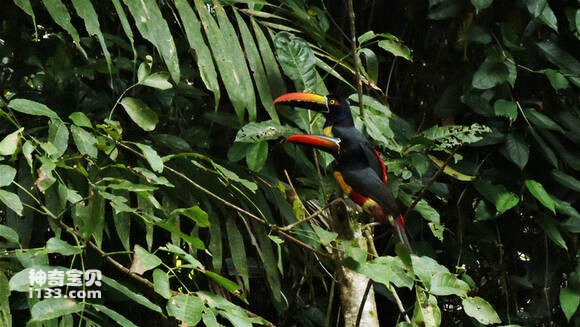
    The red-billed Tucan is also the noisiest of the forest birds, producing loud rumbles, trumpets, and screeches. Its nest is built in a hole high in a tree. When eating, always peck the food with the tip of the mouth first, then tilt the neck, throw the food upward, and then open the big mouth to accurately put the food into the throat, without having to go through the long mouth and spend time in the process of "swallowing". It is omnivorous, feeding on fruits, seeds, and insects, and sometimes raiding the nests of small birds, eating eggs and chicks.
    f7580f58252dd42ac066e58f083b5bb5c9eab81f_九雷图片转换器.jpg

    Tufted Toucans nest in tree cavities. - Lay 2 to 4 eggs. Smooth white eggs are piled in unlined holes and hatch in about 16 days. The hatchlings are completely naked, take at least three weeks to open their eyes, and begin to live their lives about 45 days after hatching.


    Protect wild animals and eliminate wild meat.


    Maintaining ecological balance is everyone's responsibility!


    Tags

    At a glance

    Profile Details

    Key characteristics, appearance, and habitat information.

    Traits & Behavior

    Appearance

    The red-billed Tufted toucan resembles a hornbill. Black upper body, black head. The lower body is predominantly yellow, with several black or red markings, the black forming a large chest spot, while the red resembles a wide belt. The proboscis exhibit a variety of color combinations, including black with yellow, orange, and red. The margin of the beak is usually clearly serrated, black or ivory in appearance, and looks somewhat like a tooth. The beak of the Tufted Toucan, despite its size, weighs less than 30 grams. The structure of the mouth bone is very special, it is not a dense entity, the outside is a layer of crust, through the middle of extremely fine fibers, porous spongy tissue, filled with air, so that it does not feel heavy pressure.

    Distribution & Habitat

    The red-billed tufted Toucan is found in Central America (located between North and South America, Including Guatemala, Belize, Honduras, El Salvador, Nicaragua, Costa Rica, Panama, Bahamas, Cuba, Haiti, Jamaica, Dominica, Antigua and Barbuda, Saint Vincent and the Grenadines, Saint Lucia, Barbados, Grenada, Trinidad and Tobago and other countries and territories).
    The red-billed Tufted Toucan inhabits warm forests and marginal areas, preferring treetops.
    Advertisement

    Visual guide

    Browse available images of this species.

    Quick answers

    Pteroglossus frantzii FAQs