Skip to content
Animals Top
Home>Animals>Birds>Climbing birds
Animal Profile IUCN: LC

Dinopium shorii

Dinopium shorii,Himalayan flameback

The three-toed woodpecker is named Dinopium shorii, Himalayan flameback, and has the same sound as the golden-backed three-toed woodpecker. Other specific habits are unknown。Listed in the International Union for Conservation of Nature (IUCN) ver 3.1:2009 Bird Red List.Protect wild animals and elimi

Climbing birds 508 views
Scientific Name Dinopium shorii,Himalayan flameback
Length About 30 cm
Weight No textual research information is available
Lifespan No textual research information is available
IUCN Status LC
Advertisement

Table of Contents

    The three-toed woodpecker is named Dinopium shorii, Himalayan flameback, and has the same sound as the golden-backed three-toed woodpecker. Other specific habits are unknown。


    f1bac887c9177f3e2c6811b27bcf3bc79e3d56a0_九雷图片转换器.jpg

    1558a95d103853430a936a9e9813b07ecb8088a1_九雷图片转换器.jpg

    ac26fbeff01f3a29086238719225bc315d607c5e_九雷图片转换器.jpg

    Listed in the International Union for Conservation of Nature (IUCN) ver 3.1:2009 Bird Red List.


    Protect wild animals and eliminate wild meat.


    Maintaining ecological balance is everyone's responsibility!


    Tags

    At a glance

    Profile Details

    Key characteristics, appearance, and habitat information.

    Traits & Behavior

    Appearance

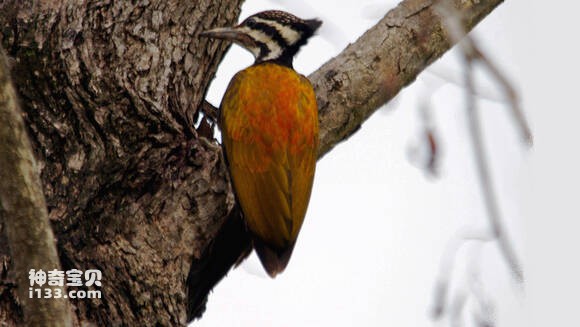
    The Himalayan three-toed woodpecker is a slightly larger (30 cm) woodpecker. The upper body is golden, the waist is red, the shape is long and the crown feathers are red. The face has black and white stripes. Indistinguishable from the golden-backed three-toed woodpecker, the difference is that the throat side has two black lines, the middle of which is brown, rather than a black central stripe. The lower body has distinct black stripes and scaly spots.
    Iris - dark brown or crimson; Mouth - near black; Feet - lead or greenish-brown.

    Distribution & Habitat

    The Himalayan three-toed woodpecker is found in the Indian subcontinent and southwest China, including India, Bangladesh, Bhutan, Sikkim, Nepal, Pakistan, Sri Lanka, Maldives, and southeast Tibet. Indochina Peninsula and southeast coastal areas of China, including Myanmar, Vietnam, Laos, Cambodia, Thailand, southeast coastal areas of China, Hong Kong region of China, Hainan Island.
    Advertisement

    Visual guide

    Browse available images of this species.

    Quick answers

    Dinopium shorii FAQs