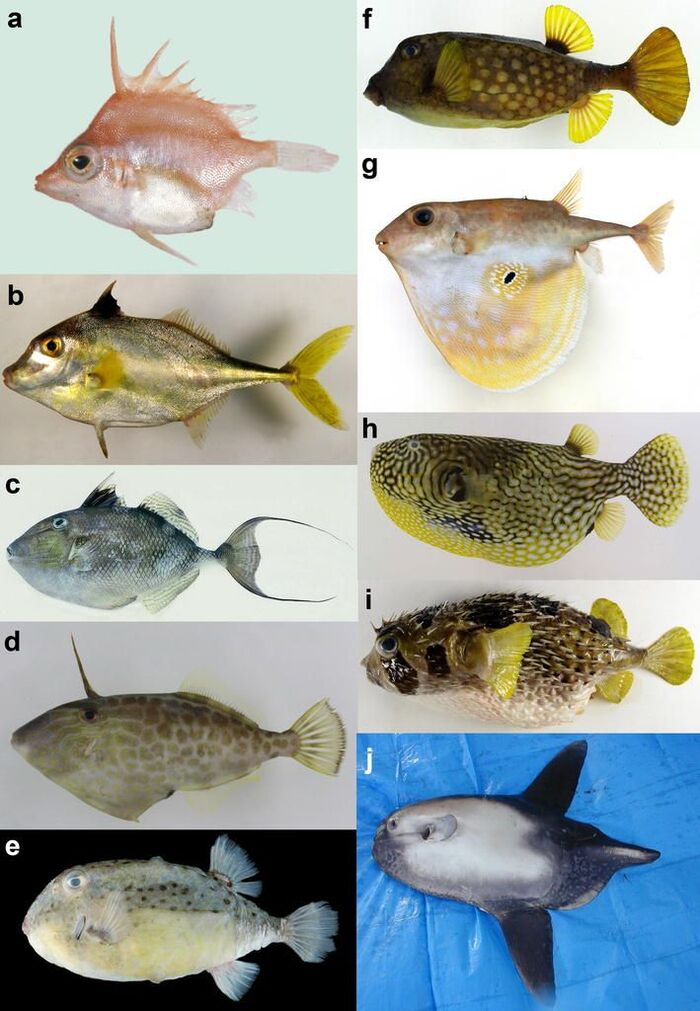
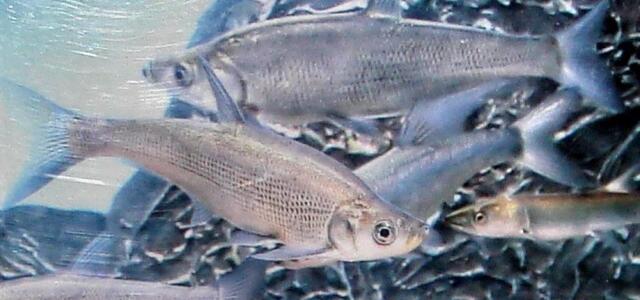
Jiangtuan fish and Qingjiang fish are not two equivalent fish species. Jiangtuan is the Chinese common name for the Chinese longsnout catfish, commonly identified as Leiocassis longirostris. Qingjiang fish, by contrast, is a regional and market name used for fish associated with the Qingjiang waters of Hubei, China, and it can refer to several different freshwater species. This means a Jiangtuan can potentially be sold as Qingjiang fish, but not every Qingjiang fish is Jiangtuan.
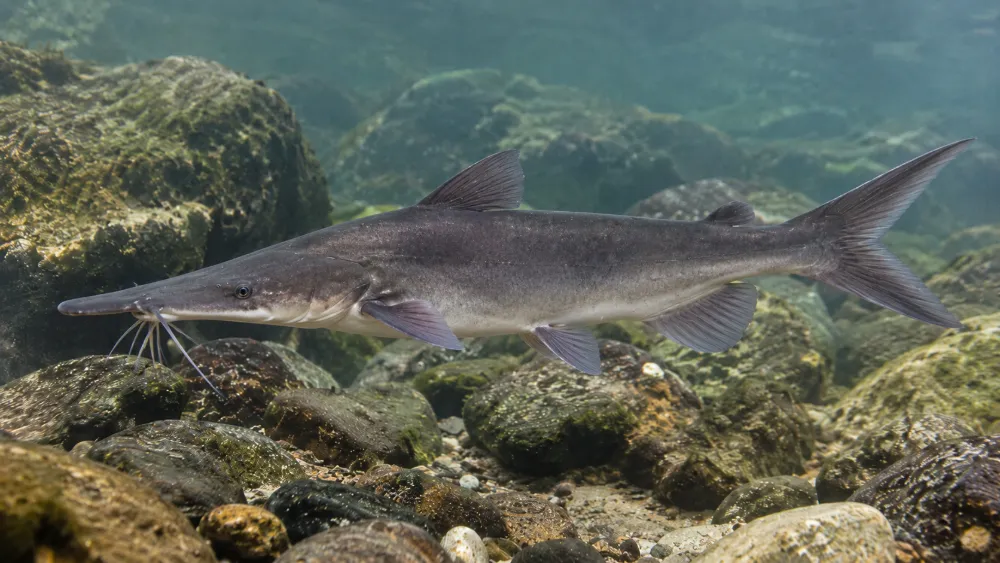
Jiangtuan is a specific type of Chinese freshwater catfish, while Qingjiang fish is a broader regional or market label.
Jiangtuan Fish vs Qingjiang Fish at a Glance
| Feature | Jiangtuan Fish | Qingjiang Fish |
|---|---|---|
| What the name means | A specific kind of freshwater fish | A regional or market name covering multiple fish species |
| Chinese name | 江团 | 清江鱼 |
| Common English name | Chinese longsnout catfish | No single scientific English species name |
| Scientific name | Leiocassis longirostris is widely used in Chinese scientific and aquaculture sources | None, because the term can include different species |
| Fish group | Catfish, family Bagridae | Varies by the fish being sold |
| Body | Smooth, scaleless body with barbels and a forked tail | Appearance varies by species |
| Origin of the name | Traditional common name for a particular fish | Associated with the Qingjiang area of Hubei |
| Can the names overlap? | Yes. A Jiangtuan produced or marketed as part of the Qingjiang fish industry may be described using both terms. | |
What Is Jiangtuan Fish?
Jiangtuan, also written as “Jiang Tuan,” is a Chinese common name for the Chinese longsnout catfish. Chinese fisheries and aquaculture sources commonly use the scientific name Leiocassis longirostris.
It belongs to the order Siluriformes, the group that contains catfishes, and to the family Bagridae.
Jiangtuan is native to freshwater systems in China and is particularly associated with major river systems including the Yangtze. It has also become an important aquaculture fish.
What Does Jiangtuan Look Like?
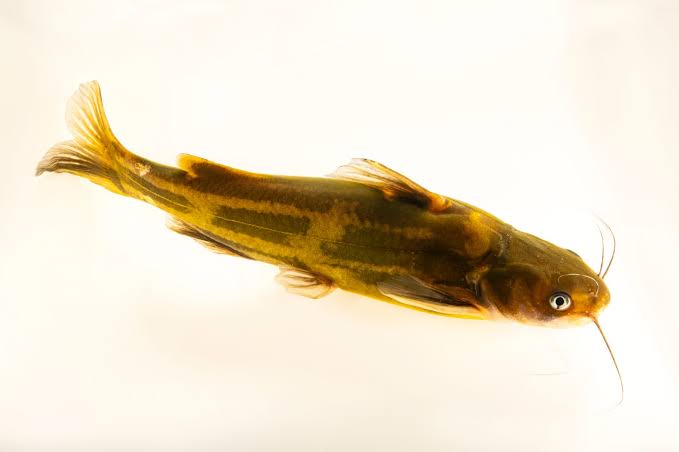
Unlike the small, silvery fish described in the old version of this article, Jiangtuan is a relatively large catfish with a smooth body and no scales.
Typical identifying features include:
a relatively long and projecting snout;
a smooth, scaleless body;
small eyes;
several pairs of barbels around the mouth;
an adipose fin behind the dorsal fin;
a distinctly forked tail.
Its body is generally grayish to dark gray on top and paler underneath, sometimes with irregular darker or purplish-gray markings.
How Large Does Jiangtuan Get?
Jiangtuan is not normally a 10-centimeter fish. Chinese fisheries guidance describes ordinary individuals weighing roughly 1.3 to 3 kilograms, while substantially larger individuals can occur.
This alone separates the real Jiangtuan from the small fish incorrectly described in many machine-translated articles.
What Does Jiangtuan Eat?
Jiangtuan is primarily a bottom-oriented predatory fish. Its natural diet can include small fish, shrimp, aquatic worms and other animal prey.
Farmed Jiangtuan can also be trained to accept formulated aquaculture feeds.
What Is Qingjiang Fish?
Qingjiang fish is not the scientific name of one species.
The term is associated with fish produced or marketed from the Qingjiang region of Hubei Province, especially around Changyang and the Qingjiang reservoir system.
Official Chinese fisheries information has described dozens of fish varieties associated with the Qingjiang fish industry. Examples have included silver carp, bighead carp, crucian carp, channel catfish, yellow catfish, sturgeon and other freshwater fish.
That means there is no single scientific name, body shape, adult size or diet that applies to every fish called “Qingjiang fish.” Those characteristics depend on the actual species.
Is Qingjiang Fish a Species?
No. In zoological terms, “Qingjiang fish” does not identify a species in the way that common names such as largemouth bass, rainbow trout or Chinese longsnout catfish do.
It is better understood as a geographical, commercial or regional product term.
This distinction is important because restaurant menus and online food descriptions sometimes make “Qingjiang fish” sound like the name of a single fish. Biologically, that interpretation is misleading.
Can Jiangtuan Also Be Qingjiang Fish?
Yes. The two labels describe different things, so they are not mutually exclusive.
“Jiangtuan” identifies the type of fish, while “Qingjiang fish” can describe its regional production or marketing identity.
For example, if a genuine Jiangtuan is raised or supplied through the Qingjiang fish industry, both descriptions may be applicable.
But a Qingjiang fish could instead be another species entirely. You cannot identify a fish as Jiangtuan simply because a menu calls it Qingjiang fish.
Why Are Jiangtuan and Qingjiang Fish Often Confused?
Most of the confusion comes from restaurant terminology rather than fish biology.
Chinese restaurants, especially grilled-fish and hot-pot restaurants, may offer fish under names based on species, production area, trade name or local culinary usage. These categories can overlap.
As a result, customers may see “Jiangtuan,” “Qingjiang fish,” “channel catfish” and other names presented as if they were parallel species choices even though the terms are not always being used at the same taxonomic level.
Translation adds another problem. Chinese common fish names often have several English spellings, and automatic translation can incorrectly match them to unrelated species.
Is Jiangtuan the Same as Silver Carp or Bighead Carp?
No.
Jiangtuan is a catfish. Silver carp and bighead carp belong to a completely different group of fishes.
The confusion probably comes from the fact that silver carp and bighead carp can both be among the many fish produced in the broader Qingjiang fish industry. That does not make them Jiangtuan.
| Fish | Scientific Name | Same as Jiangtuan? |
|---|---|---|
| Jiangtuan / Chinese longsnout catfish | Leiocassis longirostris | Yes |
| Silver carp | Hypophthalmichthys molitrix | No |
| Bighead carp | Hypophthalmichthys nobilis | No |
| Channel catfish | Ictalurus punctatus | No |
Is Jiangtuan a Catfish?
Yes. Jiangtuan is a genuine catfish.
It belongs to the family Bagridae and has several familiar catfish features, including a scaleless body and barbels around the mouth.
However, “catfish” is a very broad term covering thousands of species. Jiangtuan should not be treated as interchangeable with channel catfish, walking catfish or other unrelated catfish species.
How Can You Tell What “Qingjiang Fish” Really Is at a Restaurant?
The most reliable approach is to ask which species the restaurant is serving.
The words “Qingjiang fish” alone are not enough for scientific identification. A restaurant may be using the term for one commonly supplied farmed species, while another restaurant may use it for something different.
If accurate identification matters, ask for the Chinese species name or scientific/common species name rather than relying only on the regional product label.
Which Has Fewer Bones: Jiangtuan or Qingjiang Fish?
This question cannot be answered accurately without knowing which species the Qingjiang fish actually is.
Jiangtuan is valued as a food fish partly because its flesh does not contain the dense network of tiny intermuscular bones associated with some carp species.
But Qingjiang fish can refer to several species, so its bone structure varies. A Qingjiang-labeled channel catfish, carp and sturgeon will not have the same skeleton or eating characteristics.
Which Is More Expensive?
There is no fixed rule.
The price of Jiangtuan depends on size, source, whether it is farmed or wild-origin stock legally entering the market, local demand and season.
“Qingjiang fish” is too broad a category to have one biological or market price. Its price depends first on the species being sold and then on its production and marketing conditions.
The Simplest Way to Remember the Difference
Think of the names this way:
Jiangtuan = what kind of fish it is.
Qingjiang fish = where or under what regional market identity the fish is produced or sold.
That is why comparing Jiangtuan and Qingjiang fish as if they were two separate species creates confusion.
Frequently Asked Questions
Are Jiangtuan fish and Qingjiang fish the same?
No. Jiangtuan is a particular catfish, while Qingjiang fish is a broader regional or commercial term covering multiple fish species. A Jiangtuan can sometimes be marketed as Qingjiang fish, but Qingjiang fish is not automatically Jiangtuan.
What is the scientific name of Jiangtuan fish?
The name most commonly used in Chinese aquaculture literature and in NCBI taxonomy is Leiocassis longirostris, commonly called the Chinese longsnout catfish. Fish taxonomy can change as classifications are revised, so different taxonomic databases may sometimes handle scientific names differently.
Does Qingjiang fish have a scientific name?
No single scientific name applies to Qingjiang fish because the term can refer to several species produced or marketed from the Qingjiang region.
Is Qingjiang fish a type of catfish?
Not necessarily. Some fish marketed under the Qingjiang name are catfish, but other Qingjiang fish are not. The actual species must be identified separately.
Is Jiangtuan the same as channel catfish?
No. Jiangtuan is the Chinese longsnout catfish, while channel catfish is Ictalurus punctatus, a North American species that is also widely farmed in China.
Is Jiangtuan the same as silver carp?
No. Silver carp is Hypophthalmichthys molitrix. It is a completely different fish from Jiangtuan.
Why do some restaurants list both Jiangtuan and Qingjiang fish?
Restaurant names often mix biological species names with regional and trade names. The “Qingjiang fish” offered by one restaurant may refer to a particular farmed species, while Jiangtuan identifies a more specific type of fish. Ask the restaurant for the actual species if you need a precise identification.
Scientific and Official Sources
NCBI Taxonomy — Leiocassis longirostris, Chinese longsnout catfish.
Shanghai Municipal Agriculture and Rural Affairs Commission — aquaculture information for Chinese longsnout catfish and the common name Jiangtuan.
Fisheries Administration of the Ministry of Agriculture and Rural Affairs of China — information on the Qingjiang fish industry and the multiple species produced in the Qingjiang reservoir area.
Wuhan Academy of Agricultural Sciences — Chinese longsnout catfish aquaculture and species information.