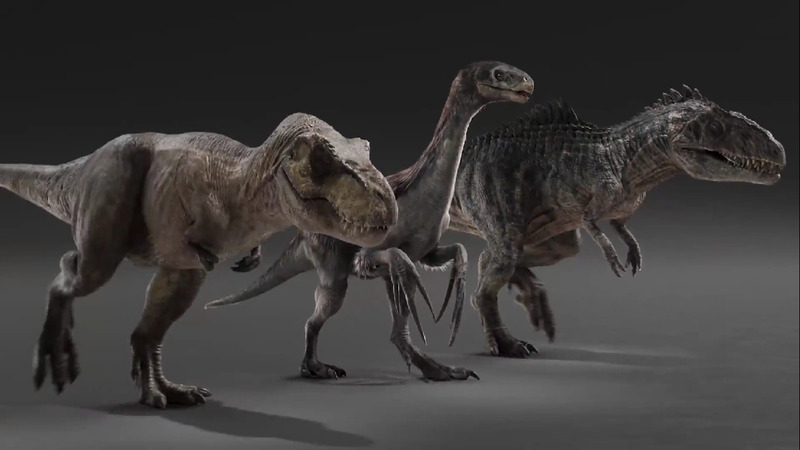
In 1824, the British paleontologist Buckland discovered the carnivorous Megalodon for the first time, which opened the prelude to the kingdom of ferocious and brutal carnivorous dinosaurs. The discovery of Sinoraptor this time allows people to reveal at a deeper level the secrets of theropod dinosaurs that have not been revealed in the past, so it is of high academic significance. The researchers proposed that Hepingyongchuanosaurus, which was discovered in Zigong, Sichuan, be merged into the genus Sinoraptosaurus as the first species of this genus, that is, Heping Sinoraptosaurus.
The Late Jurassic was the most prosperous period for carnivorous dragons. In addition to Monophorosaurus, the carnivorous dinosaurs discovered in my country during the same period also include Sinoraptosaurus, Yongchuanosaurus and Sichuanosaurus. The latter three form a family of their own, called Sinoraptoridae. There are two species under the genus Sinraptor: Sinraptordongi (Sinraptordongi) and Sinraptorhepingensis (Sinraptorhepingensis). Sinoraptosaurus Dong was discovered in the Junggar Basin of Xinjiang, while Sinoraptosaurus heping was found in Heping Township, Zigong City, Sichuan Province, indicating that Sinoraptosaurus was once widely distributed.
The skull of Sinoraptosaurus is quite well preserved and is characterized by the development of large air cavities in the zygomatic bones, pneumatization of the palatine bones, long temporal intermalar bones, and postorbital bones. Sinoraptosaurus is more primitive than Allosaurus, and is more closely related to Yongchuanosaurus. The two species of Sinoraptor are similar in size, both about 7 meters.
The discovery of Sinoraptosaurus Dong is one of the great achievements of the collaborative research between Chinese and Canadian paleontologists. This dinosaur was discovered in the Shishugou Formation of the Junggar Basin and was dated to the Late Jurassic. Its fossils are preserved in very hard surrounding rocks and were excavated after two years of hard work by paleontologists in 1987 and 1988. This is a fairly complete skeleton, with only the forelimbs and part of the tail vertebrae missing. It was jointly studied by Curie of Canada and Zhao Xijin of China. The identification results showed that it is a new family, new genus and new species. The species name was given to Dong Zhiming to commemorate his discovery of this dinosaur and his great contribution to the study of Yongchuanosaurus.
Chinese name: Sinoraptor
Latin name: Sinraptor
Age of survival: Early Cretaceous
Fossil origin: Junggar Basin, Xinjiang, China
Physical characteristics: 7 meters
Diet: Carnivorous
Type: Theropod
Definition: Thief from China