China is home to dozens of indigenous chicken breeds shaped by centuries of local farming, climate and food culture. Famous examples include the Wenchang chicken of tropical Hainan, the white-feathered Taihe Silkie with black skin and bones, the tall Langshan chicken, the Qingyuan Partridge Chicken of Guangdong and the high-altitude Tibetan chicken. There is no official scientific ranking of China's “top ten” chickens, so this list highlights 10 notable breeds for their history, distinctive traits, agricultural importance or international influence.
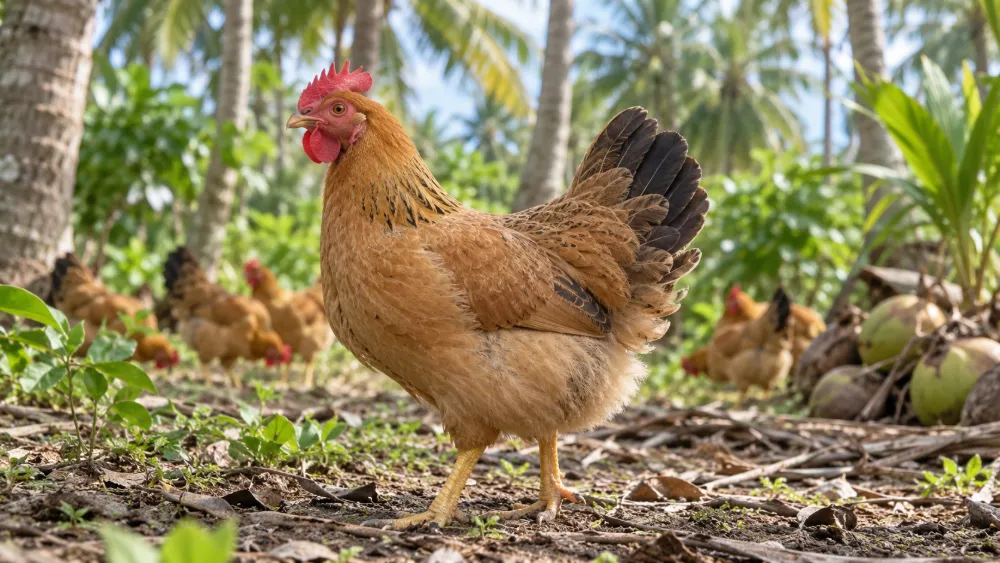
Wenchang chicken is a native Hainan breed known for its adaptation to a tropical island environment and its importance in local cuisine.
10 Famous Chinese Chicken Breeds at a Glance
| Breed | Origin | Known For | Traditional Use |
|---|---|---|---|
| Wenchang Chicken | Hainan | Tropical adaptation, compact body, meat quality | Meat and regional cuisine |
| Taihe Black-Boned Silkie | Jiangxi | Silky white plumage, dark skin, flesh and bones | Food, traditional culture and ornamental keeping |
| Langshan Chicken | Jiangsu | Tall build, black plumage, international breed influence | Dual-purpose |
| Qingyuan Partridge Chicken | Guangdong | Partridge-pattern plumage and renowned meat quality | Meat |
| Beijing-You Chicken | Beijing | Crest, beard and feathered shanks | Dual-purpose |
| Tibetan Chicken | Qinghai-Tibet Plateau | High-altitude adaptation | Local eggs and meat |
| Hetian Chicken | Fujian | Yellow body coloration with darker neck, wings and tail | Meat |
| Lushi Chicken | Henan | Active foraging and mountainous adaptation | Eggs and meat |
| Shouguang Chicken | Shandong | Large frame and traditional northern Chinese lineage | Dual-purpose |
| Lingshan Fragrant Chicken | Guangxi | Compact body and important regional poultry industry | Meat |
The order above is not an official ranking. China has many additional recognized native chicken breeds that could equally deserve inclusion.
Wenchang Chicken
Wenchang chicken is a native breed from Hainan Island in southern China and one of the country's best-known regional meat chickens.
Modern genetic research confirms that it is a distinct local breed adapted over generations to Hainan's tropical island environment.
Researchers have found substantial variation even within the breed, including different feather-color strains maintained through artificial selection.
Wenchang chickens are generally more compact and slower-growing than modern industrial broilers. They are valued primarily for meat quality rather than maximum growth rate.
Is Wenchang Chicken a Breed or a Dish?
It is both.
Wenchang chicken first refers to the local chicken breed associated with Wenchang, Hainan.
The same name is also used for a famous Hainanese dish traditionally prepared from these chickens.
This can cause confusion in English, where search results sometimes describe Wenchang chicken only as a recipe.
Taihe Black-Boned Silkie
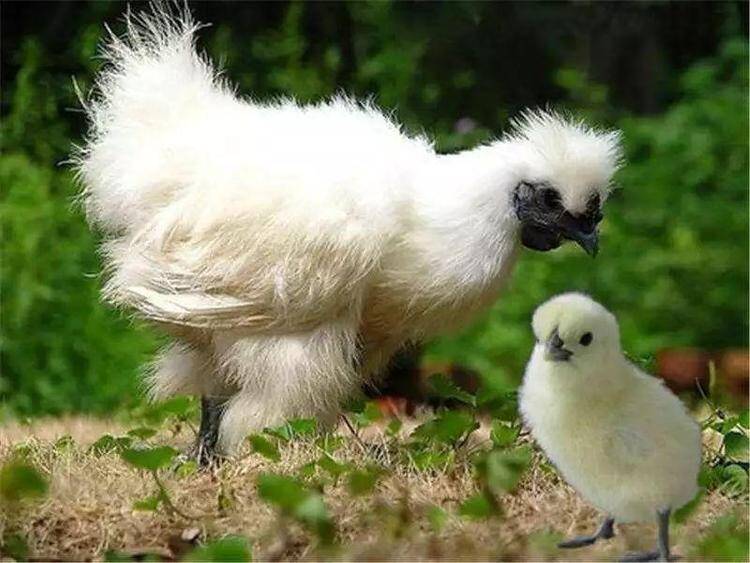
The Taihe black-boned Silkie is famous for white, hair-like feathers combined with dark skin, flesh and bones.
The Taihe Black-Boned Silkie originated in Taihe County, Jiangxi Province.
Scientific literature describes the breed as having a history extending for more than 2,000 years.
Its most recognizable features include:
white filament-like or silky plumage;
a feathered crest;
dark or bluish skin;
dark-pigmented flesh and bones;
feathered legs;
five toes on each foot in the classic type.
The dark tissues result from unusually extensive pigmentation rather than the bird having ordinary black feathers.
Taihe Silkie has a long association with traditional Chinese food culture. Older sources often attribute numerous medicinal effects to black-boned chicken, but traditional use should not be interpreted as proof that eating the meat can treat specific diseases.
Is Taihe Chicken the Same as Every Silkie?
No.
Silkie-type chickens now exist in many countries and have been selectively bred into different ornamental forms.
The Taihe black-boned Silkie is a historic Chinese local genetic resource associated specifically with Taihe County.
Langshan Chicken
The Langshan chicken is one of the Chinese breeds with the greatest international historical influence.
It originated in the Langshan region of Jiangsu Province near the lower Yangtze River.
Classic Langshans are tall birds with a deep body, dark plumage and feathering on the lower legs.
China's national livestock standardization authorities describe Langshan as an ancient and important Chinese local breed that became known internationally.
Langshan ancestry also contributed to the development of later poultry breeds outside China, including lines associated with the Orpington and Australorp.
What Is a Croad Langshan?
Croad Langshan is the internationally standardized line descended from Chinese Langshan chickens exported to Britain in the nineteenth century.
Over time, international exhibition breeding produced populations somewhat different from chickens remaining in their original Chinese region.
This is one reason “Langshan” can mean slightly different populations depending on whether a source is discussing the Chinese landrace or standardized poultry-show strains.
Qingyuan Partridge Chicken
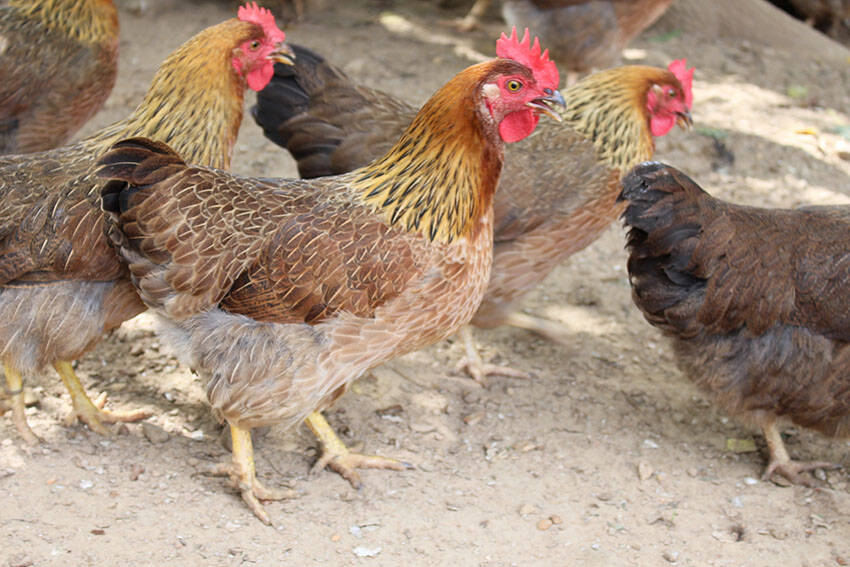
Qingyuan Partridge Chicken, also called Qingyuan Ma Chicken, is a famous Guangdong native breed.
The Qingyuan Partridge Chicken, also known as Qingyuan Ma Chicken, comes from Qingyuan in Guangdong Province.
The Chinese word ma in the breed's name refers to the sesame-like or partridge pattern visible across the hens' plumage.
Traditional descriptions emphasize several characteristic traits, including yellow skin and relatively fine bones.
Modern genomic studies confirm that Qingyuan Partridge Chicken forms a recognizable Chinese native breed population, although selective breeding has produced several modern strains within it.
It remains particularly important as a high-quality meat chicken in southern China.
Beijing-You Chicken
Beijing-You Chicken is the major indigenous chicken breed associated with Beijing.
Scientific research traces its history for more than 300 years in areas around Beijing such as Datun and Wali.
It is traditionally considered a dual-purpose breed used for both meat and eggs.
The breed is particularly recognizable because some birds combine several unusual traits:
yellow or golden plumage;
a crest;
beard or muff-like facial feathers;
feathers on the shanks;
extra toes in some traditional lines.
Beijing-You chickens are much slower-growing than modern industrial broilers, but preserving them remains important for maintaining China's domestic poultry genetic diversity.
Tibetan Chicken
The Tibetan chicken represents a very different kind of Chinese poultry adaptation.
It is an indigenous population associated mainly with the Qinghai-Tibet Plateau.
Instead of being famous primarily for unusual feathering or culinary branding, Tibetan chickens attract scientific interest because generations of life at high altitude have exposed them to:
low oxygen levels;
cold temperatures;
strong ultraviolet radiation;
large daily temperature changes.
Genetic and physiological research has therefore used Tibetan chickens to investigate high-altitude adaptation in domestic animals.
They tend to be relatively small, active birds rather than heavy commercial broilers.
Hetian Chicken
Hetian Chicken originates in Changting County, Fujian Province, especially around Hetian Town.
It is a traditional local meat breed strongly associated with western Fujian cuisine.
A typical traditional description includes yellow skin and shanks combined with darker feathers around parts of the neck, wings and tail.
The modern Hetian chicken industry has grown well beyond small household flocks. Fujian agricultural authorities continue to support breeding farms, chick production and standardized commercial production for this regional breed.
Claims sometimes repeated online that Hetian chicken is officially one of the “five most famous chickens in the world” should be treated as promotional language rather than a recognized international zoological ranking.
Lushi Chicken
Lushi Chicken is a native breed from Lushi County in Henan Province.
It is recognized through China's geographical-indication standards and has traditionally been kept in mountainous environments.
Lushi chickens are relatively active foragers and have historically been valued as a dual-purpose local chicken rather than a specialized modern broiler.
The breed is useful for understanding why native poultry remains important even when commercial hybrids grow faster.
Traditional breeds can carry locally adapted genetic traits that may be useful for future breeding and conservation.
Shouguang Chicken
Shouguang Chicken originates from Shandong Province in northern China.
It is one of the Chinese indigenous breeds regularly included in modern genomic studies of native poultry diversity.
Shouguang chickens are generally known for their comparatively large frame and traditional dual-purpose use.
Older regional names include Cilun Chicken, reflecting villages historically associated with the breed.
Like many Chinese native breeds, Shouguang has been affected by the spread of fast-growing commercial poultry, making preservation of pure genetic resources increasingly important.
Lingshan Fragrant Chicken
Lingshan Fragrant Chicken is a regional chicken from Lingshan County in Qinzhou, Guangxi.
It is a small, compact local meat chicken traditionally associated with yellow skin and shanks and mottled or patterned plumage.
Unlike several heritage breeds that survive mainly in conservation flocks, Lingshan chicken remains part of a large regional agricultural industry.
Chinese government information reported that standardized production has expanded substantially in recent years, with millions of birds marketed annually.
The breed is therefore a good example of a local genetic resource that remains economically important rather than existing only as a heritage animal.
What About Jingyang, Dehua and Chongren Chickens?
They are real Chinese local breeds or regional poultry resources.
The fact that they are not included in this revised list does not mean they are less legitimate.
China has far more than ten indigenous chicken breeds.
Examples not covered in detail here include:
Jingyang Chicken;
Dehua Black Chicken;
Chongren Partridge Chicken;
Gushi Chicken;
Xinghua Chicken;
Xiaoshan Chicken;
Dongxiang Green-Shell Egg Chicken;
Dagu Chicken;
Chahua Chicken;
Huiyang Bearded Chicken.
A list of only ten breeds must therefore be selective rather than definitive.
How Many Native Chicken Breeds Does China Have?
China has one of the world's richest collections of domestic chicken genetic resources.
National livestock genetic-resource catalogues recognize many dozens of native chicken breeds spread across the country's very different climates and agricultural regions.
These populations developed under different selective pressures, including:
high altitude;
tropical heat;
cold northern winters;
mountain farming;
egg production;
meat quality;
ornamental characteristics;
traditional food preferences.
This diversity is scientifically valuable because local breeds may carry genetic traits that are absent or uncommon in highly standardized commercial poultry.
Are Chinese Chicken Breeds Different From Commercial Broilers?
Usually, yes.
Modern commercial broilers have been intensively selected for rapid growth, feed efficiency and uniform carcass production.
Most traditional Chinese breeds grow more slowly and show greater variation.
Depending on the breed, they may instead have been historically selected for:
local climate adaptation;
foraging ability;
meat texture and flavor;
egg characteristics;
appearance;
survival under low-input farming conditions.
Neither type is inherently “better.” They represent different breeding objectives.
What Is the Most Famous Chinese Chicken Breed Outside China?
The Silkie and Langshan are probably among the Chinese-origin chickens most familiar to poultry keepers outside China.
Silkies are instantly recognizable because of their fluffy feather structure and dark pigmentation.
Langshans became internationally important during the nineteenth century and influenced later poultry breeding programs.
Wenchang chicken is also increasingly familiar internationally because of the spread of Hainanese culinary traditions, although many people know the dish before realizing that Wenchang is also a chicken breed.
Is Silkie Chicken From China?
Silkie chickens have a long historical association with China and East Asia.
The Taihe black-boned Silkie of Jiangxi is one of the best-documented Chinese local forms.
Modern exhibition Silkies kept in Europe, North America and elsewhere have undergone additional selective breeding, so they should not automatically be treated as genetically identical to the traditional Taihe population.
Which Chinese Chicken Has Black Bones?
The Taihe black-boned Silkie is the most famous example.
Its skin, connective tissues, muscles and bones contain unusually high levels of dark pigmentation.
China also has several other local black-boned chicken populations, so black bones do not identify only one breed.
Which Chinese Chicken Is Best Adapted to High Altitude?
Tibetan chicken is the classic example.
It has lived for generations on the Qinghai-Tibet Plateau and has become an important model for research into genetic adaptation to low-oxygen environments.
Why Are Native Chinese Chicken Breeds Important?
Native livestock breeds preserve genetic diversity built through centuries of local selection.
If a breed disappears, potentially useful traits can disappear with it.
Scientists and breeders therefore conserve native chickens not only because of cultural history but also because their genes may contribute to future poultry breeding.
Traits associated with environmental tolerance, disease response, reproduction or food quality may become increasingly valuable as farming conditions change.
Frequently Asked Questions
What are some famous Chinese chicken breeds?
Well-known examples include Wenchang Chicken, Taihe Black-Boned Silkie, Langshan Chicken, Qingyuan Partridge Chicken, Beijing-You Chicken, Tibetan Chicken, Hetian Chicken, Lushi Chicken and Shouguang Chicken.
Is there an official list of China's top 10 chicken breeds?
No. China has many officially recognized native chicken genetic resources, but there is no universal scientific ranking that identifies exactly ten breeds as the country's official “top ten.” Lists like this are best treated as selections of notable examples.
What chicken breed originated in Hainan?
Wenchang Chicken is the best-known native breed associated with Hainan. It developed under the island's tropical conditions and is also closely connected with Hainanese cuisine.
What is a Chinese Silkie chicken?
Silkie-type chickens are famous for soft, hair-like feathers and dark pigmentation. The Taihe Black-Boned Silkie from Jiangxi is an important historic Chinese local population.
Where did Langshan chickens originate?
Langshan chickens originated in Jiangsu Province in eastern China. They later became internationally influential and contributed genetic material to several poultry breeds developed outside China.
What is Qingyuan Ma Chicken?
Qingyuan Ma Chicken is another name for Qingyuan Partridge Chicken, a native Guangdong breed. The name refers to the mottled or sesame-like pattern of the hens' feathers.
What is Beijing-You Chicken?
Beijing-You is an indigenous chicken breed from Beijing with a history of more than 300 years. Traditional birds may show a crest, beard, feathered shanks and additional toes.
Are Tibetan chickens domestic chickens?
Yes. Tibetan chickens are domestic chickens adapted to life at high elevations on the Qinghai-Tibet Plateau.
Are Chinese native chickens good egg layers?
It depends on the breed. Some are dual-purpose or egg-oriented, while others are primarily valued for meat. Most have not been selected for the extreme egg production achieved by specialized commercial layer hybrids.
Are Chinese local chicken breeds endangered?
The status differs by breed. Some remain economically common, while others require conservation programs because crossbreeding, commercial poultry production and shrinking traditional farming populations can reduce purebred genetic resources.
Scientific and Official Sources
National livestock and poultry genetic-resource standards of China — Chinese indigenous chicken breeds and breed standards.
Poultry Science — genomic studies of Wenchang Chicken and Qingyuan Partridge Chicken.
Genome Biology and Evolution — genomic diversity of Chinese indigenous breeds including Beijing-You, Shouguang, Taihe Silkie and Tibetan chickens.
PLOS ONE and related poultry-science research — Taihe Black-Boned Silkie genetics and phenotype.
Chinese national standardization authorities — Langshan Chicken and Lushi Chicken breed and geographical-indication standards.
Ministry of Education of China — development and conservation of the Lingshan Fragrant Chicken industry.
Fujian provincial agricultural authorities — Changting Hetian Chicken breeding and agricultural development.