The Weddell seal, which inhabits the ice areas and ice edges of the Southern Ocean, is a master of drilling holes and a powerful assistant to oceanographers.
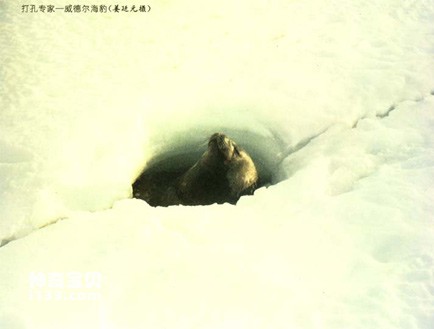
Burrowing expert--Weddell seal
Weddell seals need to constantly surface to breathe, with intervals of 10 to 20 minutes and up to 70 minutes. When there is no ice, it is easy to rise to the surface to breathe. However, when the sea surface freezes, breathing becomes a big problem for Weddell seals. When the Weddell seal is sealed in the bottom layer of sea ice or ice floes, it cannot surface to breathe at any time. When it becomes unbearably stuffy, it will chew on the ice desperately. After expending a lifetime of efforts, it gnawed a hole, and then it was able to get out of the hole, lie down feebly, and breathe the air to its heart's content. However, its mouth was worn out and blood flowed, staining the inside and outside of the ice cave red; its teeth were shortened, flattened, and worn away, and it could no longer eat or fight with its powerful enemies. It is for this reason that Weddell seals that can live for more than 20 years generally only live for 8 to 10 years, and some even die after only 4 to 5 years. What's more serious is that some Weddell seals die from lack of oxygen and physical exhaustion before they can get out of the hole.
In order to preserve the ice cave that they spent their blood and life on, Weddell seals must re-gnaw at intervals to prevent the cave entrance from freezing again. In this way, the ice cave becomes a gateway for it to enter and exit the ocean, breathe and carry out activities.
The ice caves that Weddell seals exchanged for their blood and lives are excellent places for oceanographers to conduct marine scientific research. Oceanographers can use these ice caves to collect seawater samples to conduct research on marine chemistry and marine biology; they can also put various oceanographic instruments into the ice caves to conduct research on ocean physics and other disciplines. If you drill such an ice hole manually, it will consume a lot of manpower and material resources. Therefore, people call the Weddell seal a master of drilling holes and a powerful assistant to oceanographers.