Quick answer: There is no standardized IQ test that can rank every parrot species, but the African grey parrot has some of the strongest experimental evidence for advanced cognition. Research with grey parrots has demonstrated numerical understanding, symbolic labeling, category concepts, and a zero-like concept. Goffin’s cockatoos stand out for innovative tool use, kea for flexible problem-solving and cooperation, and sulphur-crested cockatoos for socially transmitted urban innovations. Talking ability alone does not determine which parrot is smartest.
The ranking below is therefore based on the quality and breadth of published cognitive evidence, not on a fictional human-style IQ score. Different parrots excel in different domains, including communication, tool use, social learning, memory, self-control, and physical problem-solving.
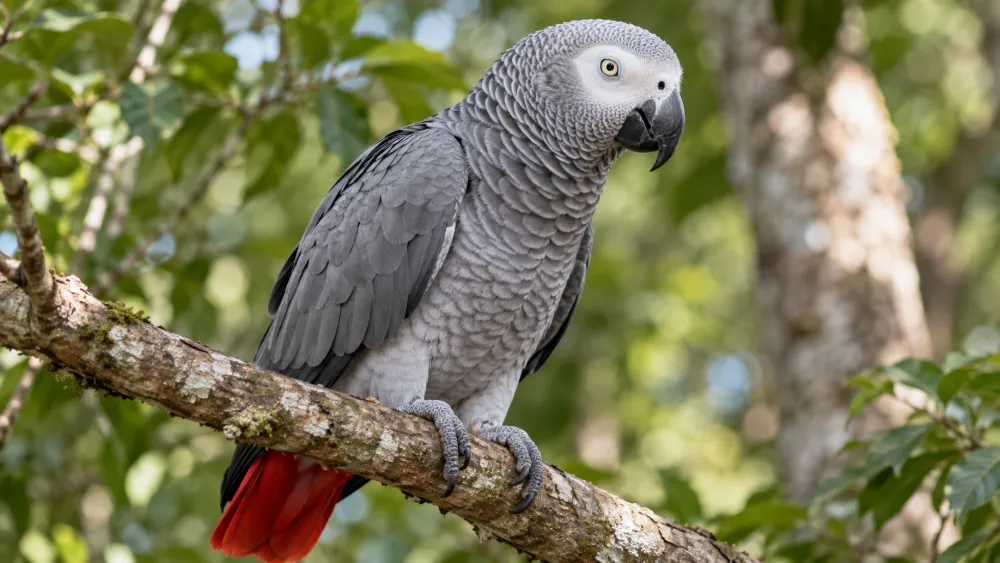
African grey parrots are among the best-studied parrots in cognitive science, with evidence for numerical concepts, symbolic labels, and flexible learning.
10 Smartest Parrots at a Glance
| Parrot | Scientific name | Strongest cognitive evidence | Why it stands out |
|---|---|---|---|
| African Grey Parrot | Psittacus erithacus | Numbers, labels, categories, inference | Exceptional depth of experimental research |
| Goffin’s Cockatoo | Cacatua goffiniana | Tool manufacture and composite tool use | Highly innovative physical problem-solving |
| Kea | Nestor notabilis | Cooperation, problem-solving, flexibility | Can coordinate with partners and solve novel tasks |
| Sulphur-Crested Cockatoo | Cacatua galerita | Social learning and cultural spread | Wild populations spread complex bin-opening behavior |
| Palm Cockatoo | Probosciger aterrimus | Tool manufacture and rhythmic drumming | Wild males make and use sound tools with individual styles |
| Blue-Fronted Amazon | Amazona aestiva | Multi-access problem-solving and discrimination | Solves several experimentally tested physical tasks |
| Greater Vasa Parrot | Coracopsis vasa | Spontaneous tool use | Captive birds independently used objects as tools |
| Blue-Throated Macaw | Ara glaucogularis | Problem-solving and self-control | Some individuals solve complex multi-step physical tasks |
| Monk Parakeet | Myiopsitta monachus | Social and vocal flexibility | Wild colonies show highly diverse individual calls |
| Budgerigar | Melopsittacus undulatus | Vocal production learning | Highly flexible learned vocal repertoire |
Important: this is an evidence-based editorial comparison, not an official scientific league table. A species can rank highly because one cognitive ability has been studied exceptionally well, while another species may possess abilities that researchers have barely tested.
What Is the Smartest Parrot in the World?
The African grey parrot is the strongest overall answer if the question is based on published experimental evidence.
Much of its reputation comes from decades of work with African grey parrots, especially the well-known research subject Alex. In controlled experiments, Alex learned labels for colors, shapes, materials, and quantities rather than merely repeating sounds.
He could identify quantities up to at least six in early experiments, respond correctly to number-related questions, distinguish larger and smaller numerical values, and use “none” in situations involving an absence of the requested quantity. Later work also demonstrated addition and ordinal relationships involving numerical symbols.
That does not mean an African grey has a human IQ score or the mind of a child of a specific age. Statements such as “an African grey has an IQ of 100” or “the intelligence of a five-year-old child” are oversimplifications because human IQ tests are not valid cross-species measurements.
The more defensible conclusion is that African greys show unusually sophisticated abilities in several experimentally tested domains.
African Grey Parrot
African grey parrots are famous for vocal mimicry, but their scientific importance goes far beyond copying human speech.
In numerical experiments, a grey parrot demonstrated comprehension of number labels with accuracy above chance and could use those labels flexibly when different objects, colors, and quantities were presented. The bird also used a word meaning “none” when the relevant quantity was absent—a behavior often discussed as a zero-like concept.
Other studies showed understanding of ordinal relationships, symbolic Arabic numerals, relative size, same-versus-different relationships, and categories such as color, shape, and material.
This distinction is critical: mimicking the sound of a word is not the same as using a learned label appropriately in a novel question.
African greys therefore rank first here not because they are the loudest or best human-speech mimics, but because their cognition has been tested in unusually rich and systematic ways.
For a broader look at parrot diversity, see 15 Types of Parrots and Their Characteristics.
Goffin’s Cockatoo
Goffin’s cockatoos are among the most remarkable non-primate tool innovators studied so far.
They are not dependent on habitual tool use for everyday survival, yet captive individuals have spontaneously manufactured tools from different materials and transferred the same functional solution to unfamiliar substrates.
In one experiment, some birds solved a “Golf Club Task” that required combining two objects with complementary functions. The cockatoos had to manipulate one object to control the movement of another and ultimately move a reward into reach.
Only some individuals solved the task, which is important. Intelligence research should not turn successful performances by a few birds into a claim that every member of the species will instantly solve the same puzzle.
Still, the ability to innovate composite tool use places Goffin’s cockatoos among the most compelling examples of technical intelligence in parrots.
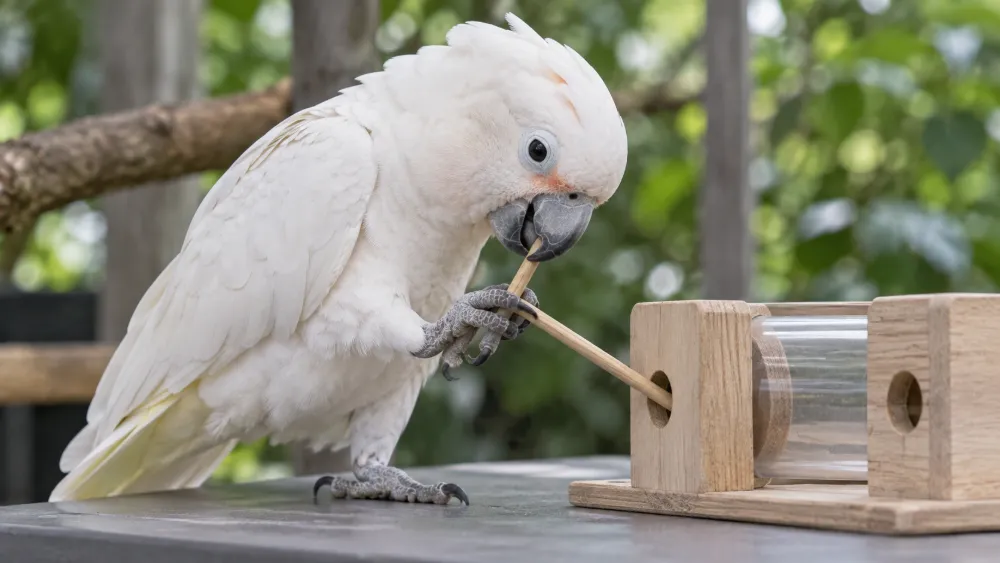
Goffin’s cockatoos have repeatedly demonstrated flexible tool manufacture and novel physical problem-solving in experimental studies.
Kea
The kea is a large alpine parrot endemic to New Zealand and one of the best-known avian problem solvers.
Kea are unusually exploratory. They manipulate objects, investigate unfamiliar situations, and often persist when confronted with new physical problems.
In cooperative experiments, kea learned that some tasks required a partner. They could wait for another bird to arrive before acting, with successful individuals waiting as long as about 65 seconds when cooperation was necessary.
The birds were also less likely to wait when a partner was not required. That matters because simply tolerating a delay is different from adjusting behavior according to whether another individual is actually needed.
Kea have also performed well in studies of object relationships, multi-access puzzle boxes, probabilistic reasoning, and behavioral flexibility.
Their intelligence is not defined by human speech. In fact, the kea is a strong example of why “best talking parrot” and “smartest parrot” are two different questions.

Kea are highly exploratory parrots known for flexible problem-solving and experimentally demonstrated cooperative cognition.
Sulphur-Crested Cockatoo
Wild sulphur-crested cockatoos in Australian cities have provided one of the clearest examples of cultural transmission in parrots.
In Sydney, some cockatoos learned how to open household garbage bins. Researchers used community reports and direct observations to track the behavior as it spread geographically.
The innovation was initially concentrated in a small number of suburbs but later appeared across dozens of suburbs. The distribution pattern supported social learning rather than repeated independent invention by every bird.
Researchers also observed local and individual differences in how birds performed the multi-step opening sequence. In other words, the behavior developed recognizable local styles.
This is a different type of intelligence from the symbolic numerical work seen in African greys or the tool manufacture of Goffin’s cockatoos. It shows how cognition can help a wild parrot adapt to a rapidly changing human environment.
Palm Cockatoo
Palm cockatoos are unusual because wild males manufacture tools primarily for display and sound production.
A male can break off a stick or prepare part of a seed pod, hold the object in one foot, and strike it rhythmically against a hollow tree or other resonant surface.
Scientific analysis of more than one hundred drumming sequences found that beats occurred at non-random, regular intervals. Different males also had statistically distinguishable rhythmic styles.
This combination of tool manufacture, controlled percussion, regular beat production, and individual style is extremely rare outside humans.
It would be an exaggeration to call palm cockatoo drumming “human music,” but the behavior is an exceptional example of motor planning, object manipulation, and communicative display.
Blue-Fronted Amazon
Amazon parrots are often promoted as intelligent pets and talented mimics, but the strongest approach is to look at actual experiments rather than pet anecdotes.
The blue-fronted Amazon (Amazona aestiva) has been tested with multiple problem-solving paradigms. In one study, captive and reintroduced birds completed a pebble-and-seed discrimination task with high average success rates.
Some birds also solved parts of a multi-access box that offered several possible routes to food. Performance varied considerably among individuals, and relatively few solved multiple different access methods.
That individual variation is scientifically useful. It shows why a species label cannot function like a guaranteed IQ score.
Blue-fronted Amazons also show the beak-and-foot coordination needed for complex manipulation, an important part of parrot physical cognition.
Greater Vasa Parrot
The greater vasa parrot of Madagascar deserves a place because researchers documented spontaneous tool use in captive individuals.
Birds used pebbles or date-pit fragments to grind against shells, apparently obtaining calcium-rich powder, and sometimes used tools in ways that changed the object being worked on.
The behavior was especially interesting because greater vasa parrots were not previously recognized as habitual tool users. Multiple individuals showed tool-related behavior, suggesting an unusual capacity for exploration and innovation.
Researchers have also noted complex object manipulation during play, including combinations between objects and environmental structures.
As with Goffin’s cockatoos, this is evidence for flexible physical intelligence rather than evidence for a human-style general IQ.
Blue-Throated Macaw
The blue-throated macaw is a large Bolivian parrot that has participated in several comparative cognition studies.
In an innovative problem-solving experiment, one blue-throated macaw spontaneously solved a task that required inserting multiple stones into a horizontal tube to push a food reward within reach after relevant functional experience.
Other individuals eventually solved the task under additional conditions, although their performance was inconsistent. The researchers therefore cautioned against assuming that the birds fully understood every causal relationship involved.
Blue-throated macaws have also been included in delayed-gratification studies. Some individuals waited for a better reward instead of immediately taking a less-preferred one.
This combination of problem-solving and self-control research makes the species more defensible for a “smart parrots” list than relying simply on the reputation of macaws as clever pets.
Monk Parakeet
The monk parakeet, also called the Quaker parrot, is highly social and unusual among parrots because it builds large communal stick nests.
A 2025 field study recorded thousands of vocalizations from hundreds of wild monk parakeets while also measuring their social relationships.
Individuals showed high diversity in their contact calls, and aspects of vocal diversity were associated with social variables such as age, nest-mate number, and group size.
Birds with stronger affiliative relationships sometimes had more acoustically distinct calls, suggesting that communication in a crowded social network may favor individual vocal identity.
Vocal complexity is not identical to intelligence, but flexible communication within a complex social system is an important cognitive domain.
Budgerigar
Budgerigars, commonly called budgies, are small parrots but should not be dismissed because of their size.
They possess a well-documented capacity for vocal production learning. Rather than having a completely fixed adult call repertoire, budgerigars can modify vocalizations through learning and social interaction.
Experimental work has shown that they can learn to produce particular contact calls in response to specific combinations of visual and auditory cues.
The studies also highlight an important limitation: even a highly capable vocal learner does not automatically learn every arbitrary association researchers present. Some acoustic-only tasks proved difficult.
That is useful evidence because cognition is not an all-or-nothing trait. Even an intelligent, flexible learner has constraints shaped by its sensory system, ecology, and evolutionary history.
Why Parrots Are So Intelligent
Parrot brains are physically small compared with mammalian brains, but brain mass alone does not reveal processing capacity.
Comparative studies have found that parrots and songbirds pack neurons at unusually high densities. Large parrots can have forebrain neuron numbers comparable to or greater than some primates with much larger brains.
Parrots also possess specialized forebrain circuitry that may support sophisticated motor control, vocal learning, and cognitive flexibility.
Several ecological and social traits may also favor advanced cognition:
long lifespans and extended learning periods;
complex social relationships;
flexible diets and changing food sources;
manipulation of food and objects with the beak and feet;
learned vocal communication;
the need to adapt to variable environments.
These factors do not prove that every parrot is equally intelligent, but they help explain why sophisticated cognition has evolved repeatedly across Psittaciformes.
Does a Parrot Have an IQ Score?
No scientifically accepted human-style IQ score exists for parrots.
Human IQ tests depend on language, cultural experience, visual conventions, motor responses, and standardized norms developed specifically for humans.
Giving the same test to a parrot would measure whether the bird can interact with a human-designed task, not its complete cognitive ability.
Animal cognition researchers instead use targeted experiments that ask narrower questions:
Can the bird distinguish quantities?
Can it solve a new physical problem?
Can it delay gratification?
Can it learn from another individual?
Can it manufacture or select a tool?
Can it remember a rule or location?
Can it change behavior when circumstances change?
These tests reveal cognitive strengths and limits without inventing a misleading single-number IQ.
Is the Best Talking Parrot Also the Smartest?
Not necessarily.
A parrot can be an excellent mimic because of strong vocal-learning abilities, auditory memory, social motivation, and repeated exposure to human speech. That does not automatically mean it will outperform another species in tool use, numerical reasoning, memory, or cooperation.
African greys are unusual because their reputation for speech is supported by experiments showing meaningful use of learned labels. But even in African greys, researchers distinguish between sound imitation and conceptual understanding.
Kea provide the opposite example: they are not famous for human-like speech, yet they perform impressively in physical and cooperative cognition tasks.
Which Parrot Is Best at Talking?
African grey and several Amazon parrots are among the parrots most famous for clear human-speech mimicry, while budgerigars can also become remarkable vocal mimics despite their small size.
There is no standardized world championship for vocabulary size. Online claims that a particular species “normally knows 2,000 words” should be treated cautiously unless the individual bird and testing method are documented.
Alex, the most famous African grey research subject, is important not because he memorized thousands of words, but because researchers tested how he used a much smaller learned vocabulary to answer questions about properties, categories, numbers, and relationships.
Can Parrots Understand Human Words?
Some trained parrots can learn that particular human vocal labels correspond to objects, properties, actions, or outcomes.
The strongest evidence comes from controlled testing in which researchers change the objects and questions so the bird cannot succeed by simply repeating the most recent sound.
That is different from human language. Parrots do not possess the full grammar, generative linguistic system, or cultural language development characteristic of humans.
It is nevertheless inaccurate to reduce all parrot speech to meaningless mimicry. Under the right training conditions, some individuals demonstrably learn functional associations and concepts connected to vocal labels.
Are African Greys Smarter Than Macaws?
African greys have a stronger research record for symbolic and numerical cognition. Macaws have demonstrated problem-solving, self-control, social cognition, and object-related skills.
That does not prove that every African grey is “smarter” than every macaw. Research effort is uneven: African greys have been studied intensively for decades, whereas many macaw species have much smaller experimental datasets.
For this reason, the ranking reflects available evidence as much as underlying biological ability.
Are Cockatoos Smarter Than African Greys?
They excel in different ways.
African greys have some of the strongest evidence for symbolic labels and number concepts. Goffin’s cockatoos are extraordinary physical problem solvers and tool innovators. Sulphur-crested cockatoos demonstrate sophisticated social learning in the wild, while palm cockatoos manufacture drumming tools.
There is no single experiment that can fairly combine all of those skills into one universal intelligence score.
Parrot Intelligence vs Monkey Intelligence
Parrots and primates evolved sophisticated cognition independently. Their brains are organized very differently, yet both groups can solve challenging tasks involving learning, social information, memory, and physical problems.
Comparative work has even found parrots performing similarly to primates in selected cognitive tasks, although direct comparisons are difficult because a task designed for hands and human-like vision may disadvantage a bird using its beak and feet.
For a primate comparison, see Top 10 Smartest Monkeys in the World.
How Smart Are Parrots Compared With Crows?
Parrots and corvids—including crows and ravens—are two of the most extensively discussed groups in avian cognition.
Both contain species capable of advanced problem-solving, social learning, behavioral flexibility, and tool-related behavior. Neither group can simply be declared universally smarter because results depend strongly on the task and species tested.
Their similarities are especially interesting because parrots and corvids are separated by a long evolutionary distance, suggesting that complex cognition can evolve through different anatomical routes.
See Corvids: Intelligence, Traits, and Main Types for the other major group of cognitively sophisticated birds.
Frequently Asked Questions
What is the smartest parrot?
The African grey parrot is the strongest overall answer based on the breadth of published cognitive research, especially studies of numbers, labels, categories, and symbolic concepts. Goffin’s cockatoos and kea are equally impressive in other cognitive domains.
What is the IQ of an African grey parrot?
There is no scientifically valid human-style IQ number for an African grey. Researchers measure specific abilities such as numerical cognition, memory, categorization, and problem-solving instead.
Which parrot has the highest IQ?
No recognized test ranks all parrots by IQ. African greys are often considered leading candidates because they have unusually strong experimental evidence across several cognitive domains.
Which parrot is best at talking?
African greys and several Amazon parrots are famous for clear speech mimicry. Budgerigars can also learn extensive vocal repertoires. Talking ability, however, is not the same as general intelligence.
Do parrots understand what they say?
Sometimes. Controlled research shows that some trained parrots can use learned vocal labels appropriately for objects, colors, shapes, numbers, and other concepts. Many everyday imitated sounds may still be simple mimicry or context associations.
Can parrots use tools?
Yes. Goffin’s cockatoos can manufacture and use tools, palm cockatoos make tools for rhythmic drumming, and greater vasa parrots have displayed spontaneous object use that functions as tooling.
Can parrots count?
African grey research provides strong evidence for quantity labeling and numerical relationships. Saying parrots “count like humans” is too broad, but some individuals can perform sophisticated number-related tasks.
Are kea intelligent?
Yes. Kea show strong behavioral flexibility, exploration, problem-solving, and cooperative cognition. Experiments have shown that they can wait for and coordinate with a partner when a task requires cooperation.
Are budgies intelligent?
Yes. Budgerigars are highly capable vocal learners with flexible learned calls and complex social communication. Their small body and brain size should not be confused with low cognitive ability.
Why can parrots talk?
Parrots are vocal production learners. They can modify sounds after hearing others rather than relying entirely on fixed inherited vocalizations. Their brain circuitry, social lifestyle, hearing, and vocal control all contribute to this ability.
Scientific and Reference Sources
Animal Cognition — Number Comprehension and a Zero-Like Concept in an African Grey Parrot
Journal of Comparative Psychology — Ordinality and Inferential Abilities of a Grey Parrot
Scientific Reports — Innovative Composite Tool Use by Goffin’s Cockatoos
Biology Letters — Flexible Tool Manufacture in Goffin’s Cockatoos
Science — Cultural Spread of Bin Opening in Sulphur-Crested Cockatoos
Science Advances — Tool-Assisted Rhythmic Drumming in Palm Cockatoos
Animal Cognition — Problem-Solving in Blue-Fronted Amazon Parrots
Biology Letters — Spontaneous Tool Use in Greater Vasa Parrots
Royal Society Open Science — Social Structure and Vocal Flexibility in Monk Parakeets
Learning & Behavior — Vocal Production Learning in Budgerigars
Final Takeaway
African grey parrots have the strongest overall claim to being the smartest parrots based on the depth of experimental evidence, but there is no scientifically valid universal parrot IQ ranking. Goffin’s cockatoos excel at tool innovation, kea at flexible and cooperative problem-solving, sulphur-crested cockatoos at socially transmitted innovation, and palm cockatoos at tool-assisted rhythmic display.
The most useful way to compare parrot intelligence is therefore not to ask for one fictional IQ number. Instead, compare the cognitive skill being tested: numbers, communication, tools, memory, social learning, self-control, or problem-solving. Different species reveal different solutions to the challenge of being an intelligent bird.