The largest living piranhas include the black piranha, piraya, Serrasalmus manueli and several other large South American species. FishBase even lists a 50 cm (19.7 in) standard-length record for the red-bellied piranha, although most adults are much smaller. Because published fish records sometimes use standard length (SL) and sometimes total length (TL), an exact one-to-ten ranking can be misleading. The list below therefore compares 10 of the largest piranha species using published maximum sizes.
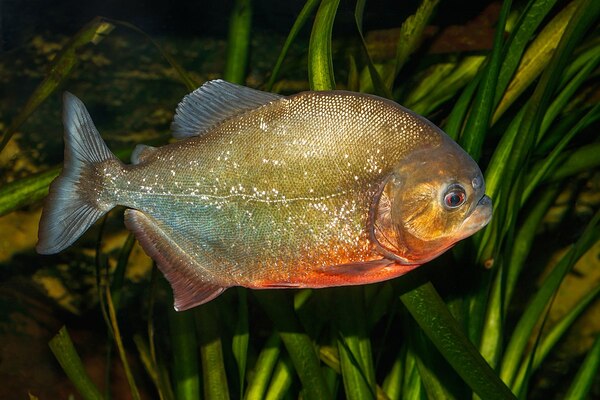
The red-bellied piranha is the best-known piranha species, although exceptionally large published records are much bigger than the size of most adults.
How Big Can Piranhas Get?
Most piranhas are not giant fish. Many species remain well below 30 cm (12 in), but several can exceed that size.
Some of the largest documented species belong to the genera Pygocentrus and Serrasalmus.
There is one important complication when comparing them: fish scientists use different length measurements.
SL — Standard Length: measured from the tip of the snout to the base of the tail fin.
TL — Total Length: measured from the snout to the end of the tail fin.
A 35 cm SL fish is therefore longer than 35 cm in total length. For that reason, the numerical order below should be viewed as an approximate comparison of published maximum records rather than a perfectly precise ranking.
Largest Piranha Species Compared
| Species | Scientific Name | Published Maximum | Main Range |
|---|---|---|---|
| Red-bellied piranha | Pygocentrus nattereri | 50 cm SL reported* | Amazon, Paraguay-Paraná and nearby South American basins |
| Black piranha | Serrasalmus rhombeus | 41.5 cm SL | Amazon, Orinoco and Guiana Shield rivers |
| Piraya | Pygocentrus piraya | 38 cm SL | São Francisco River basin, Brazil |
| Manuel's piranha | Serrasalmus manueli | 36 cm SL | Amazon and Orinoco basins |
| Serrasalmus eigenmanni | Serrasalmus eigenmanni | 35 cm SL | Amazon basin and Guiana Shield rivers |
| Spotted piranha | Serrasalmus maculatus | 34.5 cm TL | Amazon and Paraguay-Paraná basins |
| Serrasalmus marginatus | Serrasalmus marginatus | 32.4 cm TL | Paraguay-Paraná basin |
| Slender piranha | Serrasalmus elongatus | 30 cm TL | Amazon and Orinoco basins |
| White piranha | Serrasalmus brandtii | 29.1 cm SL | São Francisco River basin |
| Black spot piranha | Pygocentrus cariba | 27.9 cm TL | Orinoco River basin |
*FishBase lists a 50 cm standard-length maximum for Pygocentrus nattereri, but other authoritative sources give much smaller typical adult sizes. Maximum records should not be interpreted as the normal size of the species.
Red-Bellied Piranha — Pygocentrus nattereri
The red-bellied piranha is probably the most recognizable piranha in the world.
Adults have a deep, compressed body with a gray or silver upper surface and reddish-orange coloration across much of the belly, cheeks and lower body.
FishBase lists an exceptionally large maximum record of 50 cm standard length and a maximum published weight of about 3.9 kg.
However, this is not representative of an ordinary adult red-bellied piranha.
The Smithsonian's National Zoo describes the species as growing to a little over 30.5 cm (12 in) and weighing up to about 1.8 kg (4 lb).
This difference is a useful reminder that a species' largest reported specimen and its typical adult size are not the same thing.
Are Red-Bellied Piranhas Always Aggressive?
No. The popular image of a permanently frenzied fish is exaggerated.
Red-bellied piranhas eat fish, insects, worms and other animal material, but they can also scavenge. Their behavior changes with food availability, season, water conditions and group structure.
They often form schools, but schooling is not simply a coordinated strategy for attacking large animals.
Black Piranha — Serrasalmus rhombeus
The black piranha is one of the largest and most powerfully built living piranhas.
FishBase lists a maximum of about 41.5 cm standard length and a published weight of up to approximately 3.8 kg.
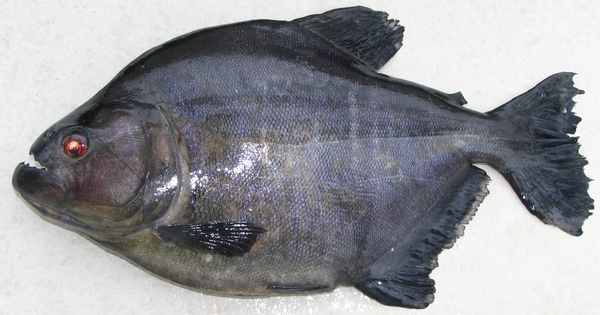
Large adult black piranhas can develop very dark coloration and are famous for exceptionally powerful jaws relative to their body size.
The species occurs across a broad area of northern South America, including the Amazon and Orinoco river systems and rivers of the Guiana Shield.
Black piranhas are especially famous for their bite.
In a scientific study of live Serrasalmus rhombeus, a specimen weighing about 1.1 kg produced a maximum measured bite force of roughly 320 newtons.
The remarkable feature is not that the fish has the strongest bite of any animal, but that its bite is extremely powerful relative to its relatively small body.
Piraya — Pygocentrus piraya
Pygocentrus piraya, usually called the piraya or San Francisco piranha, is another contender for the title of largest living piranha.
FishBase records a maximum of about 38 cm standard length and a maximum published weight of approximately 3.2 kg.
Unlike many piranhas with enormous geographic ranges, the piraya is associated with Brazil's São Francisco River basin.
It is a heavy-bodied fish with powerful jaws and often develops yellow, orange or reddish coloration on its lower body.
Older aquarium websites sometimes claim lengths of 50 cm or more for this species. Verified database measurements should be preferred over unsupported aquarium trade claims.
Serrasalmus manueli
Serrasalmus manueli is one of the biggest members of its genus, with FishBase listing a maximum of approximately 36 cm standard length and a published weight of up to 2.5 kg.
It occurs in the Amazon and Orinoco river basins.
The species receives much less attention than the red-bellied or black piranha, but its verified maximum size places it among the largest living piranhas.
Serrasalmus eigenmanni
Serrasalmus eigenmanni can reach about 35 cm standard length.
Its distribution includes parts of the Amazon basin and rivers of the northern and eastern Guiana Shield.
This species illustrates one of the main problems with many online “largest piranha” lists: lesser-known scientifically recognized species are often ignored while aquarium trade varieties with dramatic names are included instead.
Spotted Piranha — Serrasalmus maculatus
Serrasalmus maculatus has a published maximum female total length of approximately 34.5 cm.
It occurs in South American river systems including the Amazon and Paraguay-Paraná basins.
Young individuals feed on small aquatic animals and may nip fins from other fish. Larger individuals become capable predators.
Because the 34.5 cm figure is total length rather than standard length, it cannot be compared directly with the 35 or 36 cm standard-length records listed for some other species.
Serrasalmus marginatus
Serrasalmus marginatus occurs primarily in the Paraguay-Paraná River basin.
Published records include females reaching approximately 32.4 cm total length.
The species hunts other fish and may approach prey using vegetation as cover.
Smaller individuals can maintain feeding territories rather than forming the stereotypical giant schools associated with piranhas in movies.
Slender Piranha — Serrasalmus elongatus
As its English name suggests, the slender piranha has a more elongated body than many of the deep-bodied piranha species.
It reaches approximately 30 cm total length and occurs in both the Amazon and Orinoco river basins.
Its shape is a good reminder that piranhas are more diverse than the familiar rounded red-bellied species.
White Piranha — Serrasalmus brandtii
Serrasalmus brandtii, sometimes called the white piranha, is native to Brazil's São Francisco River basin.
FishBase records a maximum of approximately 29.1 cm standard length.
Older piranha articles sometimes describe a São Francisco species reaching around 50 cm while using ambiguous trade names such as “rouge piranha.” Those claims may confuse Serrasalmus brandtii, Pygocentrus piraya and aquarium trade terminology.
Using the scientific name avoids that problem.
Black Spot Piranha — Pygocentrus cariba
Pygocentrus cariba is the Orinoco representative of the genus Pygocentrus.
FishBase lists a maximum total length of approximately 27.9 cm and a maximum published weight of about 560 g.
It is easily recognized by the dark humeral spot behind the gill region, especially in mature fish.
The species is native to the lowlands and tributaries of Venezuela's Orinoco River basin.
What About Serrasalmus gouldingi?
Serrasalmus gouldingi also deserves mention.
FishBase lists a maximum of approximately 27.9 cm standard length, which means it may be comparable in overall size to or larger than some species appearing at the end of this list.
This is another reason an exact numbered ranking is difficult: the underlying records do not all use the same measurement method.
Which Is the Largest Piranha in the World?
There is no perfectly simple answer because published maximum records and measurement methods differ.
FishBase currently contains a 50 cm standard-length record for the red-bellied piranha, Pygocentrus nattereri. However, authoritative zoo information describes normal adults as substantially smaller.
The black piranha, Serrasalmus rhombeus, has a well-documented maximum of 41.5 cm standard length, while Pygocentrus piraya is another exceptionally large and heavy-bodied piranha, reaching at least 38 cm standard length in published records.
For practical purposes, all three belong among the largest living piranhas.
Was There Ever a Giant Piranha Bigger Than Modern Species?
Yes.
An extinct South American relative called Megapiranha paranensis was much larger than living piranhas.
Scientists have estimated its size from fossil jaw material rather than from a complete skeleton, so exact body-length estimates have uncertainty.
Research on piranha jaw mechanics has estimated an individual around 71 cm long for biomechanical comparisons, considerably larger than typical modern piranhas.
Megapiranha should not, however, be included in lists of the largest living piranha species because it is extinct.
Do Piranhas Really Eat Large Animals in Seconds?
Popular movies greatly exaggerate piranha behavior.
Piranhas have sharp teeth and some species can inflict serious bites, but they are not constantly searching for humans or large mammals to consume.
Their diets vary greatly between species and can include:
fish;
fish fins and scales;
aquatic insects;
crustaceans;
worms;
carrion;
seeds and other plant material.
Some close piranha relatives specialize heavily in eating fish scales, while other serrasalmids consume large amounts of plant material.
Are All Piranhas Aggressive Carnivores?
No.
“Piranha” describes a diverse evolutionary group rather than one identical feeding strategy.
Species differ in prey choice, social behavior, body shape and feeding ecology.
Even classic predatory species may scavenge or consume non-fish food when it is available.
This is why descriptions such as “every piranha is a ferocious meat eater” should be avoided.
Which Piranha Has the Strongest Bite?
The black piranha, Serrasalmus rhombeus, is famous for having one of the most powerful bites relative to body size measured in a vertebrate.
Researchers recorded more than 320 newtons of bite force from a roughly 1.1 kg specimen.
This does not mean it has a stronger absolute bite than large sharks, crocodilians or big mammals. It means the amount of force generated relative to the fish's small body mass is exceptional.
Why Do Piranha Size Numbers Differ Between Websites?
There are several reasons.
Some sources report standard length while others report total length.
An exceptional maximum specimen may be much larger than a normal adult.
Aquarium trade names may refer to more than one species.
Old species identifications can change after taxonomic revisions.
Some websites simply repeat unsourced size claims from other websites.
For comparisons, scientific names and clearly labeled measurement methods are much more reliable than aquarium nicknames alone.
Frequently Asked Questions
How big is the biggest piranha?
Living piranhas can exceed 40 cm in published records. FishBase lists an exceptional 50 cm standard-length record for the red-bellied piranha, while the black piranha reaches about 41.5 cm standard length and the piraya about 38 cm standard length. Typical adults of many species are considerably smaller.
What is the biggest piranha species?
Several species compete for the title depending on which published measurement is used. The red-bellied piranha has an unusually large 50 cm FishBase record, while black piranhas and pirayas are consistently recognized among the largest heavy-bodied living piranhas.
How big does a red-bellied piranha get?
The Smithsonian's National Zoo states that red-bellied piranhas can grow to a little over 30.5 cm. FishBase lists a much larger exceptional maximum record of 50 cm standard length, illustrating the difference between normal adult size and extreme database records.
How big does a black piranha get?
FishBase lists a maximum of approximately 41.5 cm standard length and a maximum published weight of around 3.8 kg for Serrasalmus rhombeus.
What is the largest extinct piranha?
Megapiranha paranensis was a much larger extinct relative of modern piranhas. Because it is known from incomplete fossil material, its exact adult size remains an estimate rather than a directly measured record.
Can piranhas bite humans?
Yes. Piranhas have sharp teeth and can cause painful cuts. Human bites occur, but the movie image of schools routinely stripping people to the bone is a major exaggeration.
Do piranhas live outside South America?
Piranhas are native to freshwater systems in South America. Individual fish have occasionally been released elsewhere through the aquarium trade, but that does not make those regions part of their natural distribution.
Are pacus piranhas?
No. Pacus and piranhas are close relatives within the family Serrasalmidae, but “pacu” generally refers to different lineages that tend to have different teeth and feeding adaptations. They should not be treated as interchangeable names.
Scientific Sources
FishBase — species records, taxonomy, geographic distributions and published maximum lengths for living piranhas.
Smithsonian's National Zoo and Conservation Biology Institute — red-bellied piranha biology and typical adult size.
Grubich et al., Scientific Reports — experimental research on black piranha bite force and the extinct Megapiranha paranensis.
Fink — taxonomic revision of the genus Pygocentrus.
Jégu — systematic information on serrasalmine fishes, including piranhas and pacus.