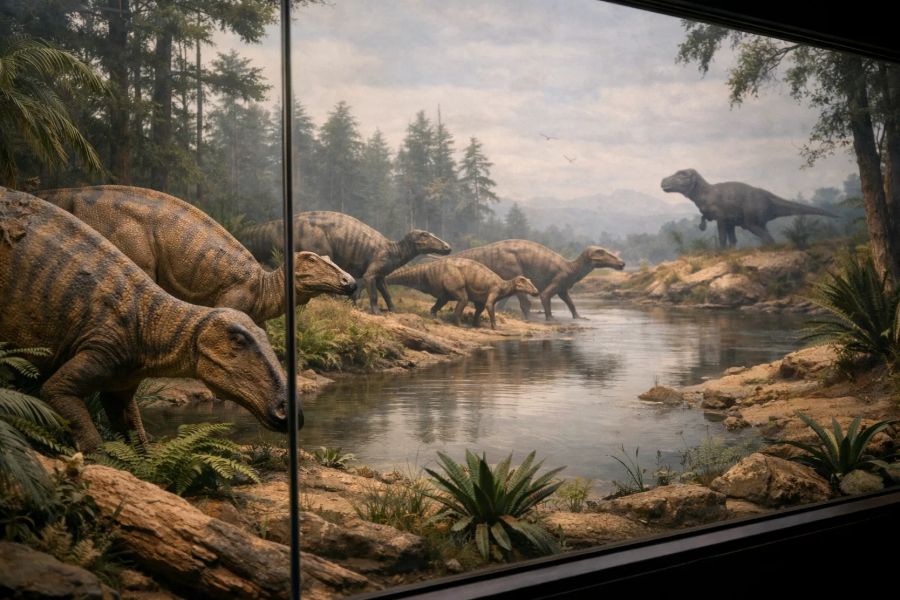
Walk into a dinosaur museum and you’ll see towering skeletons, dramatic dioramas, and fossil bones that look like relics from another planet. But the real story is bigger than spectacle: a dinosaur museum is a working interface between research, conservation, education, and public trust—a place where raw field discoveries become evidence-based narratives about life’s history. [1,2]
1) What a “dinosaur museum” actually is
Most dinosaur museums are natural history museums (or specialized paleontology museums) that do three jobs at once:
Research: scientists study fossils to understand evolution, anatomy, ecology, and extinction. [1,2]
Collections & conservation: museums permanently curate specimens (often millions of items) so they remain available for future science. [1]
Public interpretation: exhibitions translate technical evidence into stories people can grasp—how dinosaurs lived, changed, and relate to modern biodiversity (including birds). [1,2]
A key point: the exhibition hall is only the visible tip. Behind it are storage collections, preparation labs, archives, and research offices—essential parts of the scientific workflow.
2) What you’re seeing in the gallery (and why it looks the way it does)
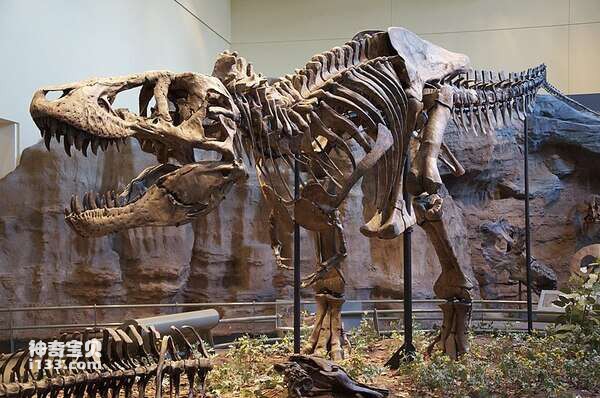
Skeleton mounts: originals vs casts
A mounted “skeleton” can be:
Original fossil bone (real specimen pieces)
Casts (high-fidelity replicas)
A hybrid (often the most practical option)
Museums use casts for good reasons: original fossils may be too fragile, incomplete, or scientifically important to keep permanently on display; casts allow safer mounting, sharing between institutions, and replacing missing elements without misleading visitors. [1,2]
Why many dinosaur halls are organized like an evolutionary walk
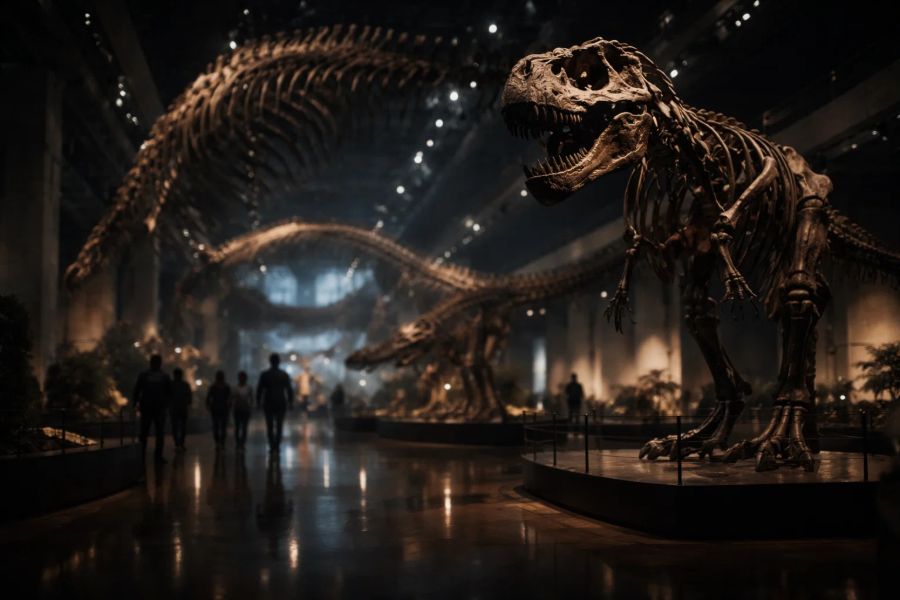
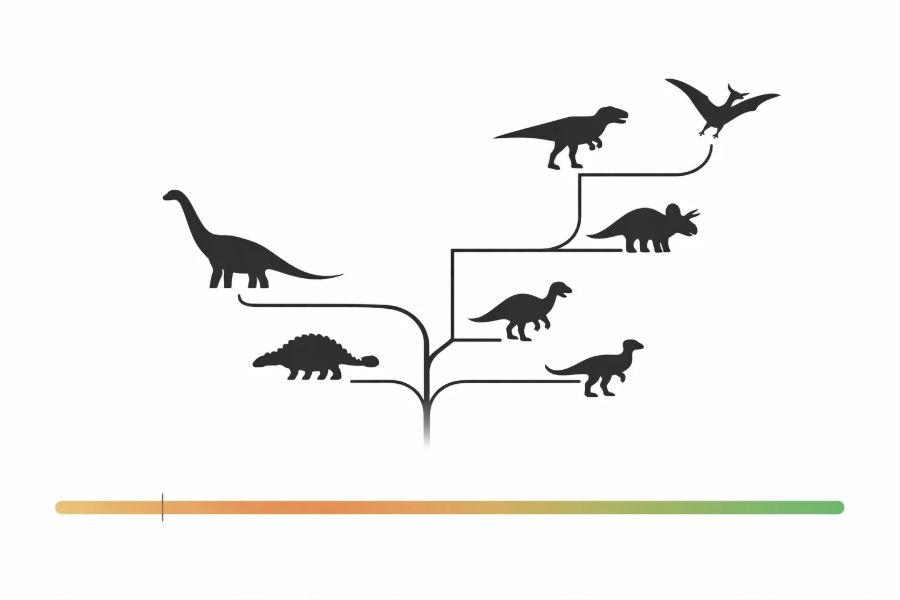
Many modern dinosaur exhibitions are arranged to reflect evolutionary relationships—so moving through the space is like moving along branches of the dinosaur family tree (from broader groups to more specialized ones). The American Museum of Natural History explicitly describes organizing its dinosaur exhibits this way.
3) The hidden engine: fossil preparation and “from field to floor”
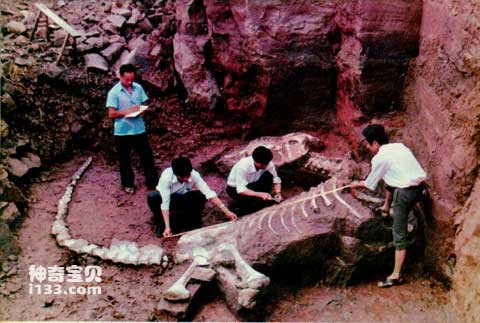
A dinosaur museum is also a production pipeline that turns rock-encased fossils into study-ready specimens.
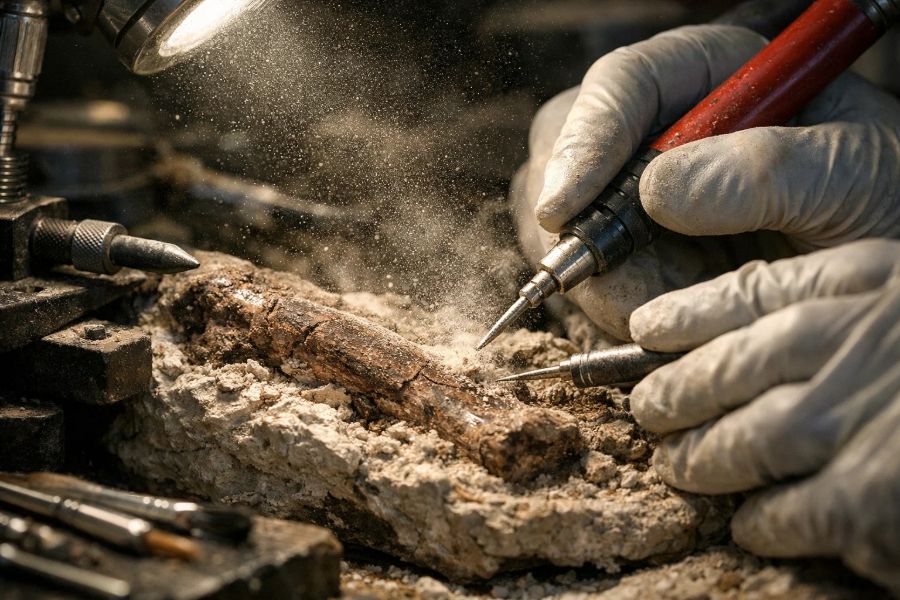
What fossil preparators do
Fossil preparation is not just “making fossils look nice.” Preparators carefully remove surrounding rock (matrix), stabilize cracks, and reveal diagnostic details needed for research. The Natural History Museum (UK) emphasizes that removing matrix is crucial for exposing scientific information.
“Live science” behind glass
Some museums let visitors watch preparation in real time. The Royal Tyrrell Museum’s public-facing Preparation Lab describes technicians removing surrounding rock so fossils can be studied and displayed.
4) How museums turn fossils into knowledge (not just displays)
Research value: a named specimen is a scientific reference point
A famous example is SUE, the Tyrannosaurus rex specimen at the Field Museum: the museum notes SUE is over 40 feet long and among the most complete T. rex skeletons, with extensive preserved material used for ongoing study and interpretive updates.
Education value: museums teach “how we know,” not just “what we know”
The best dinosaur museums help visitors learn how evidence works:
How a single tooth differs from a full skeleton
Why trackways are fossils too (trace fossils)
How CT scanning and 3D modeling can reveal internal structures
How interpretations change when new data arrives [1,2]
5) A practical guide to what’s inside a dinosaur museum (table)
| Museum area / feature | What you typically see | What it teaches you | Common misconceptions it corrects |
|---|---|---|---|
| Dinosaur hall (main mounts) | Large skeletons, life reconstructions, groupings by clade | Scale, anatomy, evolution, diversity of diets and locomotion | “All dinosaurs were giant predators” |
| Phylogeny / “tree of life” displays | Cladograms, timelines, branching diagrams | Dinosaurs as related lineages, not a random “monster set” | “Birds are not dinosaurs” (they are living dinosaurs in scientific classification) [1,2] |
| Fossil preparation lab | Tools, jackets, matrix removal, stabilization | How fossils become research specimens; why preparation is slow and careful | “Fossils are found clean and complete” |
| Collections / visible storage | Drawers, cabinets, labeled specimens | Museums preserve evidence for decades/centuries | “Museums only keep what’s on display” |
| Taphonomy & geology section | Sediment layers, quarry maps, fossilization demos | How environment and burial shape what gets preserved | “A fossil is a perfect snapshot of life” |
| Interactive / media zone | Touch casts, AR overlays, animations | Hypothesis testing, anatomy, motion, uncertainty | “Science is fixed; museums never change” |
6) The complicated modern issue: fossils, money, and museum ethics
In recent years, high-profile fossil sales have pushed museums into public debate about ownership, access, and scientific stewardship.
For example, Reuters reported the American Museum of Natural History unveiled “Apex,” a notably complete Stegosaurus fossil, after it was sold at auction and then loaned to the museum.
The Financial Times also covered the same auction context, highlighting how premium fossils can reach extraordinary prices and how private buyers may place them in museums.
The core scientific concern is consistent: research depends on stable access to specimens. Museums generally advocate that significant fossils remain in institutions where they are curated, documented, and available for study. [1,2]
7) How to get more out of a dinosaur museum visit
If you want the experience to feel like “field science” rather than a photo opportunity:
Start with the timeline: locate Triassic → Jurassic → Cretaceous anchors; it makes everything else click.
Look for labels that say “cast” vs “original”: it teaches you how museums balance access and conservation.
Don’t skip the prep lab / geology corners: they explain why fossils are rare and why interpretations evolve.
Pick one specimen and follow its story: discovery site → preparation → mounting choices → what scientists learned.
References (cited in the text)
Weishampel, D. B., Dodson, P., & Osmólska, H. (Eds.). The Dinosauria (2nd ed.). University of California Press.
Brusatte, S. L. The Rise and Fall of the Dinosaurs. William Morrow.
Natural History Museum (UK). “Fossil preparation” (institutional explainer webpage).
Royal Tyrrell Museum of Palaeontology. “Preparation Lab” (exhibit page) and related lab overview video.
American Museum of Natural History. “The Dinosaurs on Display” (how the halls are organized).
Field Museum. “SUE the T. rex” (specimen overview) and “Visiting SUE” (exhibit notes/updates).
Reuters. “New York museum unveils ‘Apex’ — an almost complete Stegosaurus” (news report).
Financial Times. “Ken Griffin buys 150mn-year-old stegosaurus for $44.6mn” (news report).