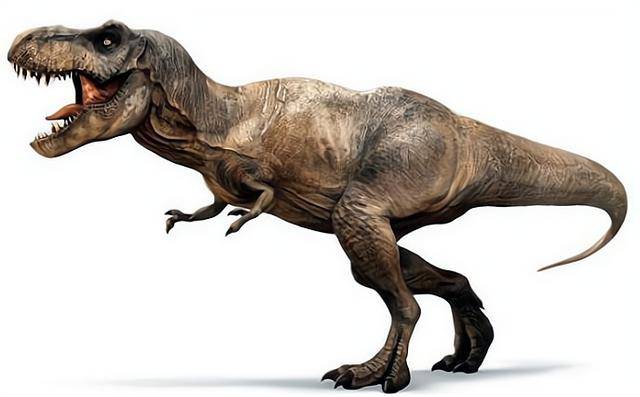
Giganotosaurus and T. rex were both giant meat-eating dinosaurs, but they never met. Giganotosaurus lived about 99–95 million years ago in South America, while T. rex lived about 68–66 million years ago in North America. Giganotosaurus was likely longer and lighter-built; T. rex was heavier-skulled, more powerfully bitten, and better adapted for crushing bone.

| Feature | Giganotosaurus | Tyrannosaurus rex | Key Difference |
|---|---|---|---|
| Scientific name | Giganotosaurus carolinii | Tyrannosaurus rex | They belonged to different theropod lineages. |
| Name meaning | “Giant southern lizard” | “Tyrant lizard king” | Both names reflect their enormous predator status. |
| Time period | Late Cretaceous, roughly 99–95 million years ago | Late Cretaceous, roughly 68–66 million years ago | T. rex lived around 30 million years later. |
| Location | Patagonia, Argentina, South America | Western North America | They lived on different continents. |
| Family group | Carcharodontosauridae | Tyrannosauridae | Giganotosaurus was closer to allosaur-type predators; T. rex was a tyrannosaur. |
| Length | Often estimated around 12–13 m | Often around 12–12.8 m for large specimens | Giganotosaurus may have been slightly longer. |
| Weight | Often estimated around 6–8 tonnes, with debate | Often estimated around 7–9+ tonnes for large adults | T. rex was probably bulkier and heavier on average. |
| Skull | Long, lower, blade-toothed skull | Deep, heavily reinforced, wide skull | T. rex had the stronger crushing skull. |
| Teeth | Blade-like, serrated teeth suited for slicing flesh | Thick, conical, deeply rooted teeth suited for crushing bone | Giganotosaurus sliced; T. rex crushed. |
| Bite force | Powerful, but likely lower than T. rex | Among the strongest known bites of any land animal | T. rex clearly wins bite force. |
| Likely hunting style | Slashing bites, blood loss, attacking huge sauropods or other prey | Crushing bites, bone damage, ambush attacks on large herbivores | Different weapons for different ecosystems. |
| Famous prey | May have lived alongside giant sauropods such as titanosaurs | Lived with Triceratops, Edmontosaurus, Ankylosaurus, and other large herbivores | They hunted very different prey communities. |
| Who would win? | Could have length, reach, and slicing advantages | Would likely have bite force, skull strength, and mass advantages | In a fictional fight, T. rex has the stronger case, but outcome depends on individuals. |
Are Giganotosaurus and T. rex Related?
Giganotosaurus and T. rex were both theropod dinosaurs, meaning they were bipedal saurischian dinosaurs in the broad meat-eating dinosaur group. However, they were not close cousins in the way many people imagine. They belonged to different branches of giant predatory dinosaurs.
Giganotosaurus carolinii was a carcharodontosaurid. This group included long-skulled, blade-toothed predators such as Carcharodontosaurus and Mapusaurus. These dinosaurs were part of a lineage more closely associated with allosauroid-style predators.
Tyrannosaurus rex was a tyrannosaurid. Tyrannosaurs developed deep skulls, heavy jaws, thick teeth, strong necks, and extreme bite forces. They became the dominant giant predators of western North America near the very end of the Cretaceous Period.
So both were giant carnivorous theropods, but they solved the “large predator” problem in different ways. Giganotosaurus emphasized length, slicing teeth, and a long skull. T. rex emphasized skull reinforcement, bite force, and bone-crushing power.
Did Giganotosaurus and T. rex Live at the Same Time?
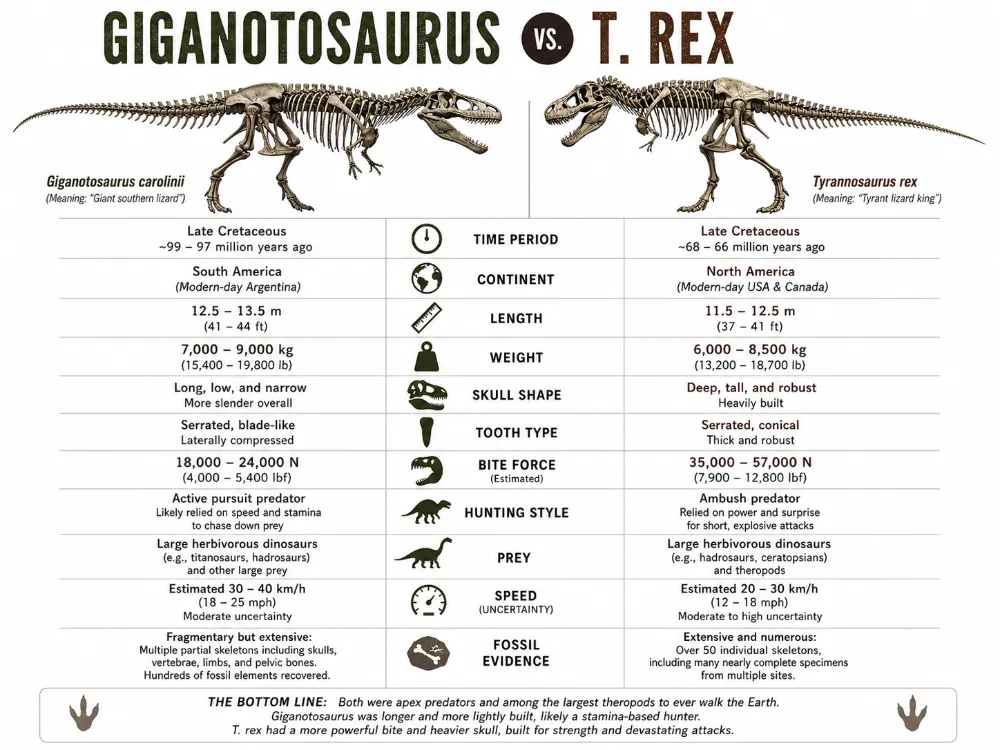
No. Giganotosaurus and T. rex never met in real life. They were separated by both time and geography.
Giganotosaurus lived in what is now Argentina during the earlier part of the Late Cretaceous, roughly 99 to 95 million years ago. T. rex lived in western North America much later, roughly 68 to 66 million years ago. That means T. rex appeared around 30 million years after Giganotosaurus.
This time gap is enormous. It is longer than the time between humans today and some of the earliest apes. Any fight between Giganotosaurus and T. rex is therefore pure fiction, not a real prehistoric event.
Where Did They Live?
Giganotosaurus lived in South America, especially Patagonia in Argentina. Its fossils come from rocks that preserve a very different ecosystem from the world of T. rex. This was a landscape with rivers, floodplains, large herbivorous dinosaurs, and other predators.
T. rex lived in western North America, especially regions preserved in formations such as the Hell Creek Formation and related Late Cretaceous deposits. Its world included horned dinosaurs, duck-billed dinosaurs, armored dinosaurs, small mammals, turtles, crocodile relatives, birds, and many other animals.
| Category | Giganotosaurus | T. rex |
|---|---|---|
| Continent | South America | North America |
| Known region | Patagonia, Argentina | Western North America |
| General environment | Cretaceous floodplains and river systems | Coastal plains, forests, rivers, and floodplains |
| Major prey context | Large sauropods and other South American dinosaurs | Triceratops, hadrosaurs, ankylosaurs, and other North American herbivores |
Size Comparison
Giganotosaurus is often described as longer than T. rex. Many reconstructions place it around 12 to 13 meters long. T. rex also reached enormous size, with large individuals around 12 to nearly 13 meters long. The difference in length may not have been dramatic, but Giganotosaurus may have had a slightly longer body and skull.
Weight is more difficult. Fossil mass estimates depend on how complete the skeleton is, how the body is reconstructed, and which specimen is used. Modern estimates often make T. rex heavier and more robust, while Giganotosaurus is interpreted as longer but more lightly built.
| Measurement | Giganotosaurus | T. rex | Interpretation |
|---|---|---|---|
| Length | About 12–13 m | About 12–12.8 m for large adults | Giganotosaurus may have been slightly longer. |
| Weight | Often around 6–8 tonnes, debated | Often around 7–9+ tonnes for large adults | T. rex was likely bulkier. |
| Skull length | Very long and low | Massive, deep, and wide | Different skull designs, not just different sizes. |
| Body build | Long, powerful, relatively lighter | Deep-bodied, muscular, heavily built | T. rex had a more compact power build. |
The best summary is: Giganotosaurus may have been longer, but T. rex was probably heavier, deeper-bodied, and more powerfully built.
Which Dinosaur Was Bigger?
The answer depends on what “bigger” means. If bigger means longer from nose to tail, Giganotosaurus may have the advantage. If bigger means heavier, more massive, and more strongly built, T. rex probably has the advantage.
Popular media often says Giganotosaurus was “bigger than T. rex.” That is partly true if focusing on length. But length alone can mislead readers. A long, lightly built predator is not necessarily more massive than a slightly shorter but deeper-bodied predator.
A useful comparison is a greyhound and a mastiff. The longer animal is not always the heavier or stronger one. In the same way, Giganotosaurus may have been a longer giant, while T. rex was a more compact and bone-crushing giant.
Skull and Jaw Differences
The skulls of Giganotosaurus and T. rex reveal two very different predatory designs.
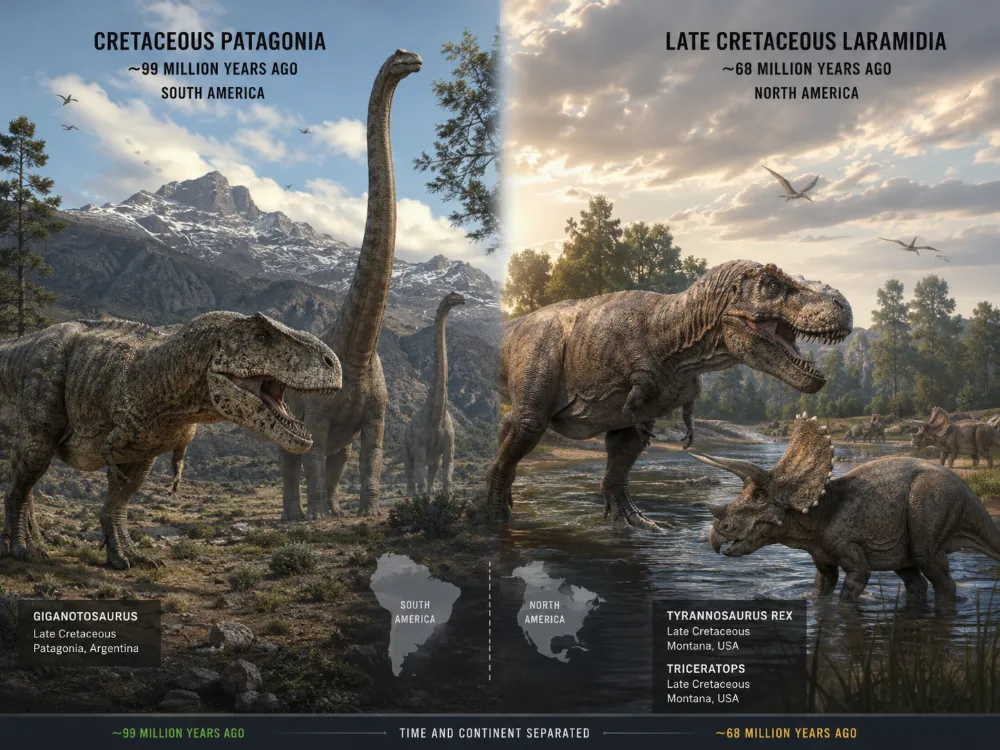
Giganotosaurus had a long, relatively lower skull with blade-like serrated teeth. This skull was suited for slicing flesh and making deep wounds. Its teeth were sharp cutting tools, probably effective for slashing large prey.
T. rex had a deep, wide, heavily reinforced skull. Its skull bones were built to handle huge bite forces. Its teeth were thick, conical, and deeply rooted, more like railroad spikes than knife blades. These teeth could puncture, grip, crush, and break bone.
| Skull Feature | Giganotosaurus | T. rex |
|---|---|---|
| Skull shape | Long and lower | Deep, wide, and heavily reinforced |
| Tooth shape | Blade-like and serrated | Thick, conical, and bone-crushing |
| Main bite style | Slashing and cutting | Crushing and puncturing |
| Best analogy | Meat cleaver or steak knife | Hydraulic bone-crusher |
Bite Force Comparison
T. rex clearly wins the bite force comparison. Its skull, jaw muscles, and teeth were adapted for one of the most powerful bites known among land animals. It could puncture deeply, crush bone, and process carcasses in a way few other predators could.
Giganotosaurus also had a powerful bite, but its skull was not built like the skull of T. rex. It likely relied more on slicing wounds than on bone-crushing force. Its teeth were dangerous cutting blades, not thick crushing pegs.
This does not make Giganotosaurus weak. A slashing bite from a multi-ton predator would be devastating. But if the question is pure bite power, T. rex is the stronger animal.
Teeth: Blades vs Bone Crushers
The teeth of Giganotosaurus and T. rex show two different feeding strategies. Giganotosaurus had serrated teeth that were better for slicing meat. These teeth likely opened long wounds and helped remove flesh from large prey.
T. rex teeth were thicker and more rounded in cross-section. They were designed to handle intense stress without snapping easily. This allowed T. rex to bite into bone, twist, pull, crush, and consume parts of carcasses that many predators would leave behind.
In simple terms:
Giganotosaurus teeth: better for cutting and slashing soft tissue.
T. rex teeth: better for puncturing, gripping, and crushing bone.
Arms and Claws
Both dinosaurs had small arms relative to body size, but their arm anatomy differed. T. rex is famous for its tiny but muscular two-fingered arms. These arms were not useless, but they were not the main hunting weapons. The skull and jaws did most of the work.
Giganotosaurus also had relatively small forelimbs compared with its body, but it had three fingers, as typical of many large allosauroid theropods. Its arms were still not huge relative to the animal, and they probably played a limited role in killing large prey.
| Arm Feature | Giganotosaurus | T. rex |
|---|---|---|
| Fingers | Three-fingered hand | Two-fingered hand |
| Relative arm size | Small compared with body | Very small compared with body |
| Main weapon | Jaws and teeth | Jaws and teeth |
| Combat importance | Probably limited | Probably limited |
Speed and Agility
Neither Giganotosaurus nor T. rex was a movie-style sprinting monster that could chase vehicles at highway speed. These were enormous animals. Their movement would have been powerful but limited by body mass, balance, muscle stress, and bone strength.
Giganotosaurus may have been somewhat lighter and longer-legged in a way that could suggest better stride efficiency, but exact speed is debated. T. rex was heavily built, but it had strong hind limbs and a body designed for balance. It may have been capable of fast walking or moderate running, but not extreme high-speed sprinting.
For a realistic comparison:
Giganotosaurus may have had a slight advantage in length and possibly reach.
T. rex may have had better turning power, mass, and shock-absorbing bite mechanics.
Both were dangerous ambush or short-burst predators, not long-distance pursuit runners.
Intelligence and Senses
T. rex likely had excellent senses for a dinosaur. Its large olfactory bulbs suggest a strong sense of smell. Its forward-facing eyes gave it good depth perception. Its inner ear and brain anatomy suggest strong sensory abilities for tracking prey, scavenging, and navigating its environment.
Giganotosaurus was also a capable predator, but the available evidence suggests T. rex may have had a more advanced sensory package, especially in smell and binocular vision. This may have helped T. rex locate carcasses, detect prey, and judge distances during attacks.
Predators do not survive by strength alone. Senses, decision-making, and experience matter. In this area, T. rex probably had an advantage.
Hunting Style
Giganotosaurus may have hunted or scavenged large South American dinosaurs, including giant sauropods. Its long jaws and slicing teeth may have been useful for attacking huge animals by opening deep wounds. It may have relied on repeated slashing bites, blood loss, and targeting vulnerable areas.
T. rex lived among large, heavily defended herbivores such as Triceratops, Edmontosaurus, and Ankylosaurus. Its skull was built for high-force biting, allowing it to crush bone and grip struggling prey. It also scavenged when opportunities appeared.
Both were likely flexible predators. A living predator does not follow one simple script. It hunts when it can, scavenges when it can, and avoids unnecessary injury when possible.
Prey and Ecosystem Differences
Giganotosaurus lived in an ecosystem that included huge sauropods. These long-necked dinosaurs were among the largest animals ever to walk on land. A predator attacking such prey would need cutting power, stamina, and caution.
T. rex lived in a later ecosystem with very different prey. Triceratops had horns and a powerful body. Ankylosaurus had armor and a tail club. Hadrosaurs were large, social, and strong. T. rex evolved in a world where prey could fight back with size, armor, horns, and speed.
| Prey Context | Giganotosaurus | T. rex |
|---|---|---|
| Common prey type | Possibly sauropods and other large herbivores | Hadrosaurs, ceratopsians, ankylosaurs, and other dinosaurs |
| Predatory challenge | Very large prey, thick soft tissue, massive bodies | Armored, horned, and powerful prey |
| Likely feeding method | Slicing flesh | Crushing bone and tearing flesh |
Scavenger or Hunter?
Both Giganotosaurus and T. rex were almost certainly both hunters and scavengers. The old idea that T. rex was “only a scavenger” is too simple. Its body, teeth, jaws, senses, and healed bite evidence from prey animals all support an active predatory role, although it would also have scavenged carcasses.
Giganotosaurus likely behaved similarly in broad terms. A giant carnivore would not ignore a dead animal. Scavenging is efficient, and modern large predators do it whenever possible. Lions, hyenas, bears, crocodiles, wolves, and eagles all mix hunting with scavenging.
The real question is not “hunter or scavenger?” but “how did each predator use its weapons when food was available?” T. rex was a crushing specialist. Giganotosaurus was likely more of a slicing specialist.
Could Giganotosaurus Kill T. rex?
In a fictional encounter, Giganotosaurus could be dangerous to T. rex. It was enormous, long, strong, and equipped with a huge skull full of serrated teeth. A deep slashing bite could cause serious wounds, blood loss, and muscle damage.
Giganotosaurus might have advantages in:
Body length
Reach
Long slicing jaws
Potential agility from a lighter build
Experience attacking very large prey
However, it would need to avoid the front of T. rex. One full-force T. rex bite to the skull, neck, spine, hip, or leg could be catastrophic.
Could T. rex Kill Giganotosaurus?
Yes. T. rex would have a strong chance in a fictional fight because of its massive skull, extreme bite force, thick teeth, and likely heavier body. If T. rex landed a solid bite, it could crush bone and disable its opponent quickly.
T. rex might have advantages in:
Bite force
Skull strength
Bone-crushing teeth
Body mass
Neck power
Sensory abilities
The main risk for T. rex would be receiving repeated slicing wounds before landing a decisive bite. In a realistic animal fight, injury risk matters. Even the “winner” could die later from wounds, infection, or starvation.
Who Would Win: Giganotosaurus or T. rex?
If forced to choose a likely winner in a one-on-one fictional fight between similarly mature, healthy adults, T. rex has the stronger case. Its bite force, skull reinforcement, thick teeth, and heavier build are major advantages in close combat.
However, the answer should be cautious. Real animals are not video game characters. A fight could change depending on body size, age, health, terrain, surprise, angle of attack, and first bite. A larger-than-average Giganotosaurus could defeat a smaller T. rex, while a prime adult T. rex could likely overpower many opponents.
The most scientifically honest answer is:
T. rex likely wins in bite force and close-range crushing power.
Giganotosaurus may win in length and slicing-style wounds.
They never met, so any fight is speculative.
Why They Never Met
Giganotosaurus and T. rex were separated by tens of millions of years and by continents. Giganotosaurus lived in South America long before T. rex appeared in North America. No natural environment ever placed these two predators together.
This matters because dinosaur comparison articles often present them as rivals. In reality, they were products of different evolutionary histories. Giganotosaurus belonged to an earlier world of giant carcharodontosaurids and titanosaurs. T. rex belonged to the final chapter of the dinosaur age, just before the end-Cretaceous extinction.
Why Giganotosaurus Became Famous
Giganotosaurus became famous because it challenged the popular image of T. rex as the undisputed largest meat-eating dinosaur. When it was described, its great length and giant skull made headlines. It showed that South America had produced enormous predators rivaling the biggest theropods known anywhere.
Its fame also increased because of movies, games, and dinosaur documentaries. Popular media often presents it as a direct T. rex rival, even though they never lived together.
Scientifically, Giganotosaurus is important because it shows that giant predatory dinosaurs evolved more than once. Tyrannosaurids were not the only dinosaurs capable of becoming top predators at massive size.
Why T. rex Remains So Famous
T. rex remains the most famous predatory dinosaur because of its size, dramatic skull, name, fossil record, museum displays, and cultural history. It is also one of the best-studied large theropods. Many specimens preserve important information about growth, injury, feeding, senses, and variation.
T. rex lived at the very end of the Cretaceous, making it one of the last giant non-avian dinosaurs. It shared the world with famous dinosaurs such as Triceratops and Edmontosaurus. Its fossils show bite marks, healed injuries, growth stages, and feeding behavior.
Its fame is not just hype. T. rex was a genuinely remarkable predator with a skull unlike that of any other giant carnivorous dinosaur.
Giganotosaurus vs T. rex in Popular Culture
Movies and games often exaggerate both dinosaurs. Giganotosaurus is sometimes portrayed as a monster larger and more terrifying than T. rex. T. rex is often portrayed as a roaring hero-villain with near-supernatural power.
Real paleontology is more interesting than the exaggerations. Giganotosaurus was not simply a “bigger T. rex.” It was a different kind of giant predator with a different skull, different teeth, different ecosystem, and different evolutionary background.
T. rex was not just a brute. It had sophisticated senses, a powerful feeding system, and a body plan highly specialized for its time and place. Comparing them helps readers understand predator diversity, not just rank them like fighters.
Common Myths About Giganotosaurus and T. rex
Myth: Giganotosaurus and T. rex fought each other.
Fact: They lived on different continents and at different times.Myth: Giganotosaurus was simply a bigger T. rex.
Fact: It was a different type of theropod with a different skull and feeding style.Myth: T. rex was only a scavenger.
Fact: T. rex likely hunted and scavenged, like many large predators.Myth: The longer dinosaur is always stronger.
Fact: Body mass, skull strength, bite force, and muscle design matter too.Myth: Giganotosaurus had a stronger bite because it was longer.
Fact: T. rex had the more powerful and better-reinforced bite system.Myth: We know their exact speed and weight.
Fact: Size, mass, and speed estimates are debated and depend on fossil evidence and modeling methods.
Which Dinosaur Was the Better Predator?
Neither was “better” in a universal sense. Each was highly successful in its own ecosystem. Giganotosaurus was adapted for the prey and environment of Cretaceous South America. T. rex was adapted for the prey and environment of late Cretaceous North America.
A good predator is not simply the one with the strongest bite. It must find prey, avoid injury, reproduce, compete, and survive in a real ecosystem. Giganotosaurus and T. rex both reached the top predator role through different anatomical solutions.
The best comparison is not “which one was superior?” but “how did two different giant theropods become apex predators?”
Final Takeaway
Giganotosaurus and T. rex were two of the greatest land predators in Earth’s history, but they were not direct rivals. Giganotosaurus lived earlier in South America and may have been slightly longer, with slicing teeth and a lighter build. T. rex lived later in North America and was probably bulkier, with a deeper skull, thicker teeth, and a much stronger bite.
In a fictional fight, T. rex likely has the advantage because of bite force and skull power. But Giganotosaurus was still a massive, dangerous predator that could inflict devastating wounds.
The real lesson is that giant carnivorous dinosaurs were not all built the same. Giganotosaurus was a slashing giant. T. rex was a crushing giant. Both were extraordinary apex predators in worlds that never overlapped.
FAQs About Giganotosaurus vs T. rex
Did Giganotosaurus and T. rex live at the same time?
No. Giganotosaurus lived roughly 99–95 million years ago, while T. rex lived roughly 68–66 million years ago. They were separated by around 30 million years.
Did Giganotosaurus and T. rex live in the same place?
No. Giganotosaurus lived in what is now Argentina in South America. T. rex lived in western North America.
Which was bigger, Giganotosaurus or T. rex?
Giganotosaurus may have been slightly longer, but T. rex was probably heavier and more robust. “Bigger” depends on whether you mean length or body mass.
Was Giganotosaurus bigger than T. rex?
In length, possibly yes. In weight and overall bulk, probably not. T. rex was likely the more heavily built animal.
Which had the stronger bite?
T. rex had the stronger bite. Its skull and teeth were specialized for crushing bone and delivering extreme bite force.
Could Giganotosaurus beat T. rex?
It is possible in a fictional scenario, especially if the Giganotosaurus was larger or landed damaging slicing bites first. However, T. rex likely has the stronger overall combat case because of its bite force and skull strength.
Who would win, Giganotosaurus or T. rex?
A prime adult T. rex would likely win more often because of its heavier build, reinforced skull, and bone-crushing bite. But the result would depend on individual size, health, terrain, and first contact.
Was Giganotosaurus faster than T. rex?
Possibly, but speed estimates are uncertain. Giganotosaurus may have been more lightly built, while T. rex was more massive. Neither was likely a high-speed movie-style sprinter.
Was Giganotosaurus smarter than T. rex?
T. rex probably had better-developed sensory abilities, especially smell and binocular vision. Intelligence is hard to measure from fossils, but T. rex likely had an advantage in sensory ecology.
What did Giganotosaurus eat?
Giganotosaurus likely hunted or scavenged large South American dinosaurs, possibly including sauropods and other herbivores from its ecosystem.
What did T. rex eat?
T. rex ate large North American dinosaurs such as hadrosaurs, ceratopsians, and possibly armored dinosaurs. It likely hunted and scavenged.
Is Giganotosaurus related to Allosaurus?
Giganotosaurus was not an Allosaurus, but it belonged to the broader allosauroid side of theropod evolution. It was a carcharodontosaurid, a group of large blade-toothed predators.
Is T. rex a carcharodontosaurid?
No. T. rex was a tyrannosaurid. Tyrannosaurids had different skulls, teeth, arms, and evolutionary history from carcharodontosaurids.
Why is Giganotosaurus often compared with T. rex?
They are compared because both were enormous meat-eating dinosaurs and Giganotosaurus may have rivaled T. rex in length. Popular media also presents them as competitors, even though they never met.
Which dinosaur was more dangerous?
Both were extremely dangerous apex predators. Giganotosaurus was a slashing predator with a huge body and long jaws. T. rex was a crushing predator with an extraordinary bite. In close combat, T. rex was probably more dangerous.