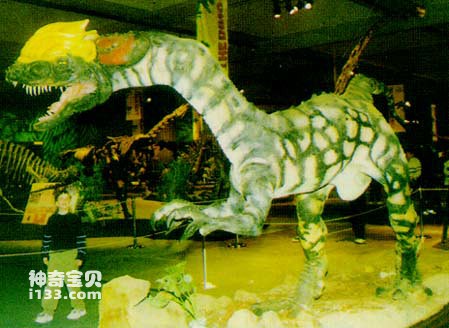
1) What counts as a dinosaur (and what doesn’t)?
“Dinosaur” is not a catch-all word for any big prehistoric reptile. Dinosaurs are a specific branch of archosaurs (the group that also includes crocodilians and birds) with a distinctive body plan—most famously, upright limbs held under the body rather than sprawling to the sides. Many classic dinosaur traits are associated with how their hips, legs, and ankles are built for efficient walking and running. [1–3]
Just as important: several famous Mesozoic animals were not dinosaurs:
Pterosaurs (flying reptiles) were close relatives, but not dinosaurs. [1,2]
Ichthyosaurs, plesiosaurs, mosasaurs were marine reptiles, not dinosaurs. [1,2]
Synapsids (the lineage leading to mammals) are an entirely different branch. [3]
In everyday language, people say “dinosaur” for lots of ancient creatures, but in biology and paleontology, the word refers to members of Dinosauria and their descendants—meaning birds are living dinosaurs. [2,4]
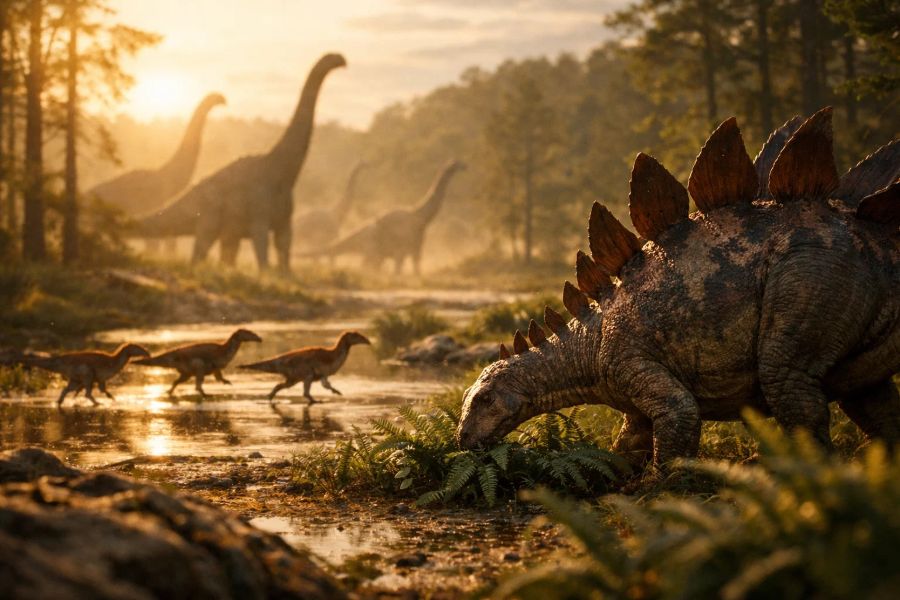
2) The two great “types”: the dinosaur family splits early
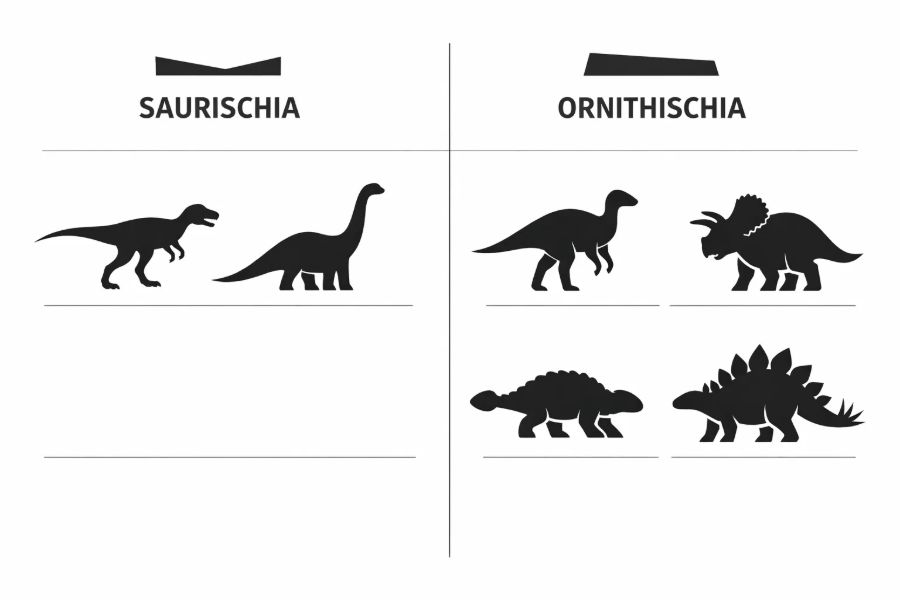
Most dinosaur diversity can be organized around a deep evolutionary split into two primary lineages (often taught as the “two types” of dinosaurs):
Saurischia (“lizard-hipped” dinosaurs)
Ornithischia (“bird-hipped” dinosaurs)
Despite the names, birds evolved within Saurischia (specifically within theropod dinosaurs), not within Ornithischia. The “hip names” describe pelvis shapes, not ancestry of birds. [1,2,4]
3) Saurischians: theropods and long-necked giants
A) Theropods — mostly predators, and the origin of birds
Theropoda includes many of the best-known dinosaurs: Tyrannosaurus, Allosaurus, Velociraptor, and the ancestors of modern birds. Early theropods were generally bipedal (walking on two legs), with grasping hands in many lineages and lightweight, air-filled bones in some groups. [1,2,4]
Theropods weren’t all classic carnivores. Over time, they evolved a wide range of diets:
Apex predators (e.g., tyrannosaurids) [5]
Small insectivores/omnivores
Herbivores (e.g., some therizinosaurs) [2,4]
Fish specialists (often discussed for spinosaurids) [2,4]
A defining evolutionary story: feathers and flight-related anatomy appear within theropods, and birds represent the only dinosaur lineage that survived the end-Cretaceous extinction. [2,4]
B) Sauropodomorphs — the long-necked plant-eaters
Sauropodomorpha includes the classic “long-necked” dinosaurs (sauropods) such as Brachiosaurus, Diplodocus, and Apatosaurus. Many were gigantic herbivores with:
extremely long necks and tails
pillar-like limbs for supporting huge body mass
small heads relative to body size
high-capacity guts for fermenting tough plant material [1,2,6]
Their rise reshaped Jurassic ecosystems: massive browsing pressure likely influenced plant communities and how other herbivores and predators partitioned habitats. [1,2,6]
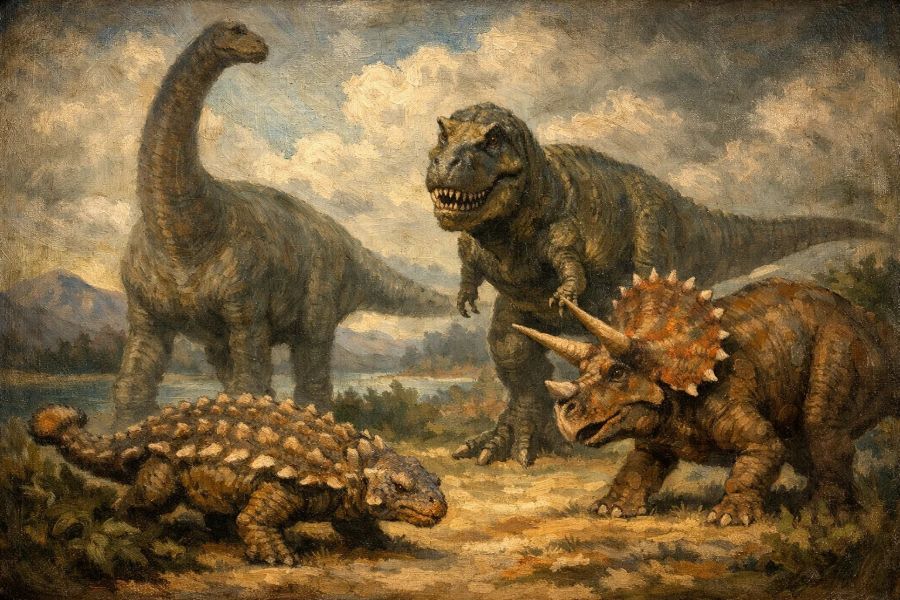
4) Ornithischians: beaks, armor, and spectacular headgear
Ornithischians commonly evolved beaks and specialized chewing adaptations, making them some of the most sophisticated herbivores of the Mesozoic. [1,2]
A) Thyreophorans — armored dinosaurs (stegosaurs and ankylosaurs)
Thyreophora are the armored dinosaurs:
Stegosaurs (e.g., Stegosaurus) with plates and tail spikes
Ankylosaurs (e.g., Ankylosaurus) with heavy armor and, in some, tail clubs [1,2]
These defenses likely evolved under strong predator pressure, and the armor also may have played roles in display and species recognition. [1,2]
B) Ornithopods — runners, grazers, and “duck-bills”
Ornithopoda includes iguanodontians and hadrosaurs:
Iguanodontians (e.g., Iguanodon) often medium-to-large, sometimes shifting between two- and four-legged locomotion.
Hadrosaurs (“duck-billed” dinosaurs) with complex dental batteries capable of efficient plant processing—among the best chewing systems in non-mammals. [1,2,7]
C) Marginocephalians — the “frills and domes”
Marginocephalia includes:
Ceratopsians (horned dinosaurs like Triceratops) with beaks, frills, and horns used for defense, display, and social signaling. [1,2,8]
Pachycephalosaurs (dome-headed dinosaurs) with thickened skull roofs, possibly used in display and (in some cases) head-butting behavior—though interpretations vary. [1,2]
5) A practical “field guide” table: major dinosaur types at a glance
| Big lineage (“type”) | Major group | Typical diet | Usual locomotion | Signature traits | Representative genera (examples) | Notes |
|---|---|---|---|---|---|---|
| Saurischia | Theropods | Mostly carnivory; also omnivory/herbivory in some | Mostly bipedal | Grasping hands (many), hollow bones (some), feathers in multiple lineages | Tyrannosaurus, Allosaurus, Velociraptor, Archaeopteryx | Birds evolved from theropods [1,2,4,5] |
| Saurischia | Sauropodomorphs | Herbivory | Mostly quadrupedal (giant forms) | Very long neck/tail, huge body size, small head | Diplodocus, Brachiosaurus, Apatosaurus | Extreme gigantism and high browsing [1,2,6] |
| Ornithischia | Stegosaurs (Thyreophora) | Herbivory | Quadrupedal | Back plates, tail spikes | Stegosaurus, Kentrosaurus | Defense + display hypotheses [1,2] |
| Ornithischia | Ankylosaurs (Thyreophora) | Herbivory | Quadrupedal | Heavy armor; tail club in some | Ankylosaurus, Euoplocephalus | “Tank” strategy against predators [1,2] |
| Ornithischia | Ornithopods | Herbivory | Bipedal to facultative quadrupedal | Beaks; efficient chewing; hadrosaur dental batteries | Iguanodon, Edmontosaurus, Parasaurolophus | Highly successful Late Cretaceous herbivores [1,2,7] |
| Ornithischia | Ceratopsians (Marginocephalia) | Herbivory | Quadrupedal (large forms) | Beak, frill, horns | Triceratops, Centrosaurus | Social signaling + defense [1,2,8] |
| Ornithischia | Pachycephalosaurs (Marginocephalia) | Herbivory/omnivory debated in some | Bipedal | Thick skull dome | Pachycephalosaurus, Stegoceras | Behavior interpretations vary [1,2] |
6) “Types” by ecology: what dinosaurs were doing in ecosystems
Another useful way to talk about dinosaur “types” is by ecological role:
Apex predators: large theropods that hunted big prey (e.g., tyrannosaurids). [5]
Mid-level predators/omnivores: smaller theropods occupying diverse niches. [2,4]
High browsers: tall sauropods feeding on higher vegetation. [6]
Low browsers/grazers: ankylosaurs, many ornithopods, some ceratopsians. [1,2,7,8]
“Armored specialists”: thyreophorans relying on protection rather than speed. [1,2]
Thinking in niches helps explain why so many dinosaur lineages could coexist: they partitioned food, space, and behavior—like modern savannas or forests, but with very different cast members. [1,2]
7) How scientists decide “what type” a dinosaur is
Classification is not just looks; it’s evidence-based biology.
Comparative anatomy: bone shapes, joints, teeth, and muscle attachment sites. [1,2]
Cladistics: a method that builds evolutionary trees using shared derived traits (“synapomorphies”). [1,2,9]
Geological context: rock age and environment help interpret what the animal was and how it lived. [1–3]
Functional inference: biomechanics, bite force, limb proportions, and wear patterns on teeth. [2,5,7]
Because fossils are incomplete, classification can change with new discoveries—especially in early dinosaur evolution where many forms are fragmentary and the boundary between “early dinosaur” and “close relative” can be subtle. [3,10]
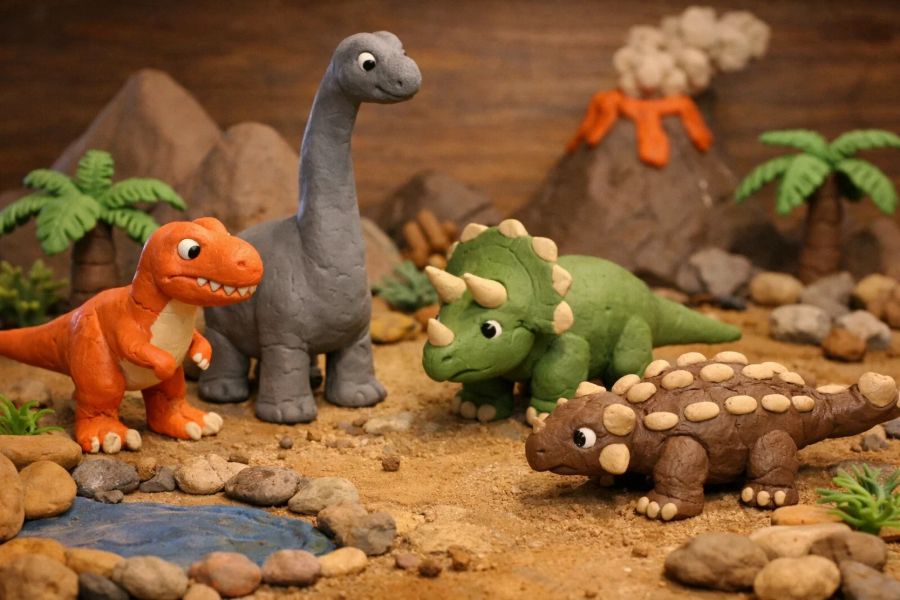
8) Why “types of dinosaurs” still matters today
Understanding dinosaur types is not just naming groups—it’s about:
Evolutionary innovation: how feathers, gigantism, armor, and advanced chewing evolved. [1,2,4,6,7]
Ecosystem structure: predator–prey dynamics over ~160+ million years. [1,2]
Extinction and survival: why birds made it through the end-Cretaceous while other dinosaur lineages did not. [2,4]
Dinosaurs are a case study in how life experiments with form and function across deep time—and how one branch (birds) can carry that legacy into the present. [2,4]
References (cited in the text)
Weishampel, D. B., Dodson, P., & Osmólska, H. (Eds.). (2004). The Dinosauria (2nd ed.). University of California Press.
Brusatte, S. L. (2018). The Rise and Fall of the Dinosaurs: A New History of a Lost World. William Morrow.
Benton, M. J. (2015). Vertebrate Paleontology (4th ed.). Wiley-Blackwell.
Gauthier, J. (1986). Saurischian monophyly and the origin of birds. In The Origin of Birds and the Evolution of Flight (Memoirs of the California Academy of Sciences).
Carrano, M. T., Benson, R. B. J., & Sampson, S. D. (2012). The phylogeny of Tetanurae (Dinosauria: Theropoda). Journal of Systematic Palaeontology, 10(2), 211–300.
Upchurch, P., Barrett, P. M., & Dodson, P. (2004). Sauropoda. In The Dinosauria (2nd ed.). University of California Press.
Horner, J. R., Weishampel, D. B., & Forster, C. A. (2004). Hadrosauridae. In The Dinosauria (2nd ed.). University of California Press.
Dodson, P., Forster, C. A., & Sampson, S. D. (2004). Ceratopsidae. In The Dinosauria (2nd ed.). University of California Press.
Sereno, P. C. (1999). The evolution of dinosaurs. Science, 284(5423), 2137–2147.
Nesbitt, S. J. (2011). The early evolution of archosaurs: relationships and the origin of major clades. Bulletin of the American Museum of Natural History, 352, 1–292.