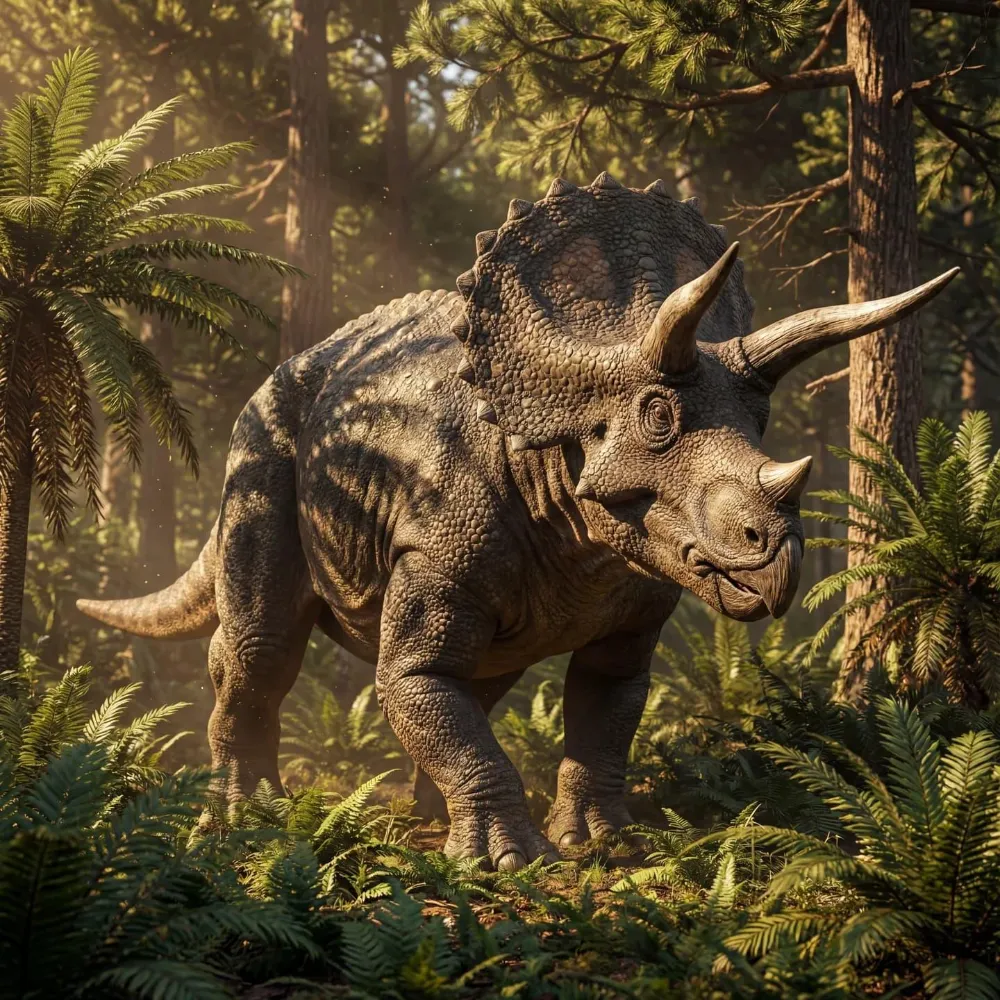
Styracosaurus was a striking horned dinosaur from the Late Cretaceous of North America. It is best known for the dramatic arrangement of long spikes projecting from the frill at the back of the skull, along with a prominent horn on the nose. As a centrosaurine ceratopsian, it was related to other horned dinosaurs but had one of the most recognizable head shapes in the group. For many visitors, Styracosaurus is one of the easiest dinosaurs to identify because its skull ornamentation is so extreme and memorable.
Time Period
Styracosaurus lived during the Late Cretaceous, likely around 75 million years ago. For a simple backend category, Cretaceous is the best fit. More specifically, it belonged to the Campanian stage, when western North America was home to a rich variety of horned dinosaurs, duck-billed dinosaurs, tyrannosaurs, and other famous prehistoric animals.
Habitat
Styracosaurus lived in what is now Alberta, Canada, in environments shaped by rivers, floodplains, forested lowlands, and seasonal coastal plains. At the time, this region was part of Laramidia, the western landmass of North America that existed when a vast inland sea split the continent. The Dinosaur Park ecosystem supported abundant plant life and many large herbivores, making it an ideal habitat for a heavily built plant-eater such as Styracosaurus.
Size and Appearance
Styracosaurus was about 5.5 to 5.8 meters long and may have weighed roughly 2.5 to 3 tonnes, although body mass estimates remain approximate. It had a strong, stocky body, a broad beak, powerful limbs, and the classic ceratopsian frill. Its most distinctive feature was the skull. The frill carried several long spikes, and the nose supported a large forward-pointing horn. Compared with some other horned dinosaurs, Styracosaurus had a very dramatic silhouette that was likely useful for display as well as protection.
Diet and Lifestyle
As a herbivore, Styracosaurus likely fed on low-growing plants, including tough vegetation that could be cropped with its beak and processed by its teeth. Like other ceratopsians, it probably relied on a strong jaw system for efficient plant feeding. It may have lived in groups at least some of the time, as horned dinosaurs are often suspected to have shown herd behavior, though the details are not always certain for every species. Its horns and frill may have helped with defense, visual display, rivalry, and species recognition.
What Were the Horns For?
The horns and frill of Styracosaurus are among the most discussed display structures in dinosaur paleontology. They may have helped intimidate predators, but many researchers also think they were important in communication between members of the same species. Visual display, mating competition, and species recognition are all likely possibilities. The safest summary is that the skull ornamentation probably served more than one function rather than a single simple purpose.