The Apostlebird (Struthidea cinerea) is an Australian endemic best known for its social life rather than bright colours. It commonly travels in cohesive family parties of 6–20 birds that forage together on the ground, move like a coordinated squad through open woodland, and communicate with loud, scolding calls. In the breeding season, that same social unit becomes a cooperative team: group members help build the nest, share incubation duties, feed the chicks and defend the nesting area.
The English name “Apostlebird” reflects the frequent sight of a dozen or so birds moving together, a scene that reminded early observers of the biblical apostles. Ecologically, apostlebirds function as adaptable, ground-feeding omnivores in dry inland landscapes, taking a wide range of invertebrates and plant material. Their cooperative breeding strategy is especially well suited to environments where rainfall and food supply can be unpredictable from year to year.
Taxonomy and naming
Apostlebirds are passerines in the family Corcoracidae, often described as Australia’s mud‑nest builders, and they are closely associated with the chough and related species. The specific name cinerea is Latin for “ash‑grey,” fitting the bird’s overall grey tones. The species is also known by many local nicknames that reflect its noisy calls and strong group cohesion.
Physical features
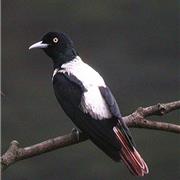
Adults are about 30–35 cm long with a long tail. Plumage is predominantly dark grey, with paler grey streaking on the head and upper breast that can look brushed or slightly shaggy. The bill is short, strong and black, and the legs are black as well. Eye colour is variable, ranging from brown to noticeably pale. Built for ground living, apostlebirds walk and run quickly under trees, pausing to probe leaf litter and soil for food.
Range and habitat
The species occurs across inland eastern Australia and extends into parts of northern Australia. It favours dry to semi‑arid open woodland, scrub and woodland edges, and it readily uses pastoral landscapes with scattered trees, shelterbelts and roadside woodland. Because it forages mostly on the ground, it does best in habitats with open space beneath the canopy and accessible leaf litter. Nests are typically placed several metres up in a tree fork or on a sturdy limb.
Behaviour and social life
Apostlebirds are strongly social and maintain stable group structure. A breeding group is usually centred on a primary pair, supported by several helpers that are often offspring from previous seasons. Group members cooperate in vigilance, mobbing predators, defending the nest area and coordinating movement through calls and displays. When alarmed, birds may fly into nearby trees, but they often regroup quickly and resume ground foraging once the threat has passed.
Diet
They are omnivores with a strong invertebrate component in the diet. Common foods include insects and larvae, spiders and other small invertebrates, and they also take seeds, fruits and other plant material. Foraging parties often focus on patches of leaf litter, bare soil and short grass where prey is easiest to detect and capture, and they may shift activity to cooler times of day during very hot inland conditions.
Reproduction and life history
Breeding timing varies with region and local conditions, but apostlebirds are well known for building robust mud cup nests. Mud is mixed with plant fibres and shaped into a sturdy bowl in a tree fork or on a branch. Several eggs are usually laid, and both the breeding pair and helpers may take turns incubating. After hatching, group members contribute to chick feeding, nest sanitation and defence. Cooperative breeding can increase chick survival, particularly when drought or food shortages would otherwise limit the breeding pair’s capacity to raise young.
Relationship with people
Apostlebirds can live alongside rural land use and are regularly seen on farmland edges, tracks and camp areas where food can be easier to find. Their loud calls sometimes make them seem noisy to people, but they can provide ecosystem services by consuming large numbers of insects and other invertebrates. They are also a valuable study species for understanding kin cooperation, group living and the ecological benefits of helping behaviour.
Conservation status and threats
The apostlebird is generally assessed as Least Concern (LC) at the global level, reflecting a wide range and broadly stable population. Local declines can occur where woodland structure is simplified, mature trees are removed, or ground cover is heavily altered by grazing. Increased frequency of severe drought and extreme heat can reduce breeding success and juvenile survival by limiting food supply. Conservation actions that retain scattered trees, protect nesting sites and maintain dry woodland mosaics, especially around key water sources, can help buffer populations against climatic extremes.