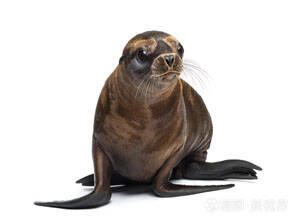
The New Zealand fur seal (Arctocephalus forsteri) is an “eared seal” (family Otariidae) known for visible ear flaps, powerful foreflippers and a dense, fur‑seal coat. Native to New Zealand and parts of southern Australia, it was heavily hunted in the 18th and 19th centuries and disappeared from many mainland sites. With legal protection and the end of commercial sealing, populations have rebounded and the species has re‑established breeding sites in parts of its former range.
On land, New Zealand fur seals are far more agile than “true seals” (phocids): they can lift their bodies on their foreflippers and move quickly over rocks. In the water, they swim primarily with strong foreflipper strokes. They are skilled divers and predators of fish and squid, and they occupy an important role in coastal food webs while also being vulnerable to higher‑level predators such as sharks and killer whales.
Taxonomy and names
This species belongs to Carnivora (Pinnipedia), family Otariidae, genus Arctocephalus. In New Zealand it is often called “kekeno” (a Māori name). In Australia and older literature you may also see names like “southern fur seal” or “long‑nosed fur seal” applied to this species or to regional groupings.
Appearance
New Zealand fur seals have a thick coat made of coarse guard hairs over a dense underfur—one reason fur seals were historically targeted by sealers. The head is relatively pointed, with prominent whiskers and clearly visible external ear flaps. Sexual dimorphism is strong: adult males are much larger and more muscular, with a thicker neck and shoulders and generally darker coloration; females are smaller and more streamlined. Pups are born with a darker natal coat and gradually moult as they grow.
Range and habitat
New Zealand fur seals occur widely around New Zealand’s coasts and on offshore and sub‑antarctic islands. Breeding is especially associated with the South Island (notably southern and western coasts) and nearby islands, though some colonies have expanded. The species also occurs along parts of southern and south‑western Australia, where it overlaps or borders the range of closely related fur seal forms.
They favour rocky shorelines, boulder beaches, wave‑cut platforms and offshore rocks or islands that provide safe haul‑out space. Breeding sites are typically on rugged coasts with ledges and crevices above heavy surf. Outside the breeding season, juveniles and non‑breeding animals may haul out more broadly, including near harbours and exposed headlands.
Behaviour
At sea, fur seals usually forage alone, but on land they are gregarious and often rest in groups. During the breeding season, adult males defend territories using vocal displays, posturing and occasional fights, and may hold harems of multiple females. Females show strong maternal behaviour immediately after birth and then adopt a classic foraging cycle—leaving to feed at sea for several days and returning to nurse for a period on shore. When mothers are away, pups often form “pods” and interact, play and learn social behaviours in familiar areas of the colony.
Pups gradually develop swimming and diving ability, first using sheltered tidal pools and calm nearshore water. As they grow, time in the water and diving capacity increase, which is critical preparation for independent life after weaning.
Diet
The diet is dominated by fish and cephalopods (especially squid), with crustaceans and other prey taken opportunistically. Diet varies by region, season and age class. Lactating females tend to forage in ways that balance pup‑care constraints, while adult males can range differently and dive in deeper habitats. Studies of pup prey remains and scat contents show that fish, crustaceans and cephalopods can all be important during the period when pups are learning to forage.
Reproduction and life history
Birth season: Most pups are born from early December through late January. Pregnant females usually come ashore shortly before giving birth, and mothers quickly establish recognition with their pups through scent and vocal cues.
Delayed implantation: Females typically mate about 1–2 weeks after giving birth, but the fertilised egg does not implant for roughly three months. This delayed implantation means that although mating occurs about 12 months before the next pup is born, the active gestation period is about nine months.
Lactation and weaning: After an initial guarding period, mothers alternate between offshore feeding trips and nursing periods on land. Pups generally remain at the breeding colony until weaning, which commonly occurs at about 8–12 months of age. Before weaning, pups start to sample solid foods and gradually build diving and foraging skills while still receiving milk.
Longevity: Lifespan varies with conditions. Field data record maximum observed ages of around 25 years for females and 19 years for males; average wild lifespan is often estimated at about 12 years (females) and 15 years (males). In captivity, individuals have been recorded living beyond 20 years.
Relationship with people
New Zealand fur seals are a well‑known coastal wildlife species and a major draw for nature tourism. Most animals avoid close contact, but seals can bite if approached, cornered or disturbed—especially near pups. Public guidance typically stresses keeping a generous distance, not feeding seals and ensuring dogs do not harass hauled‑out animals.
Conservation status and threats
The New Zealand fur seal is generally assessed as Least Concern (LC) on the IUCN Red List, reflecting its recovery under protection and overall large population. However, local pressures still matter. Key threats include fisheries bycatch, entanglement in marine debris and discarded fishing gear, disturbance at haul‑outs and breeding sites, and pollution and environmental variability that can affect prey availability. Effective management focuses on reducing bycatch and entanglement, protecting important breeding sites from disturbance, rescuing injured animals when feasible, and long‑term monitoring of colony growth and pup production.