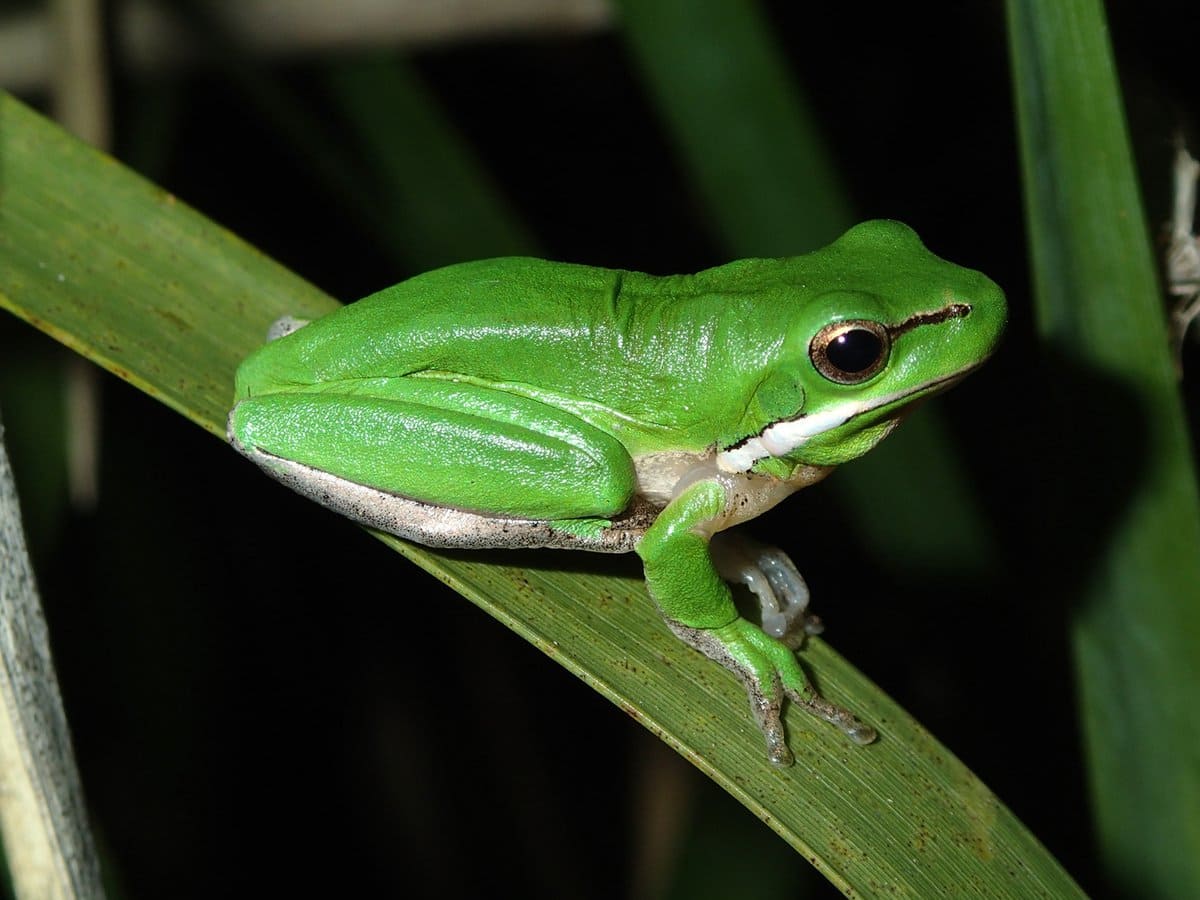
The Eastern Dwarf Tree Frog (Litoria fallax, also referred to as Ranoidea fallax in some sources) is a tiny, bright green tree frog native to eastern Australia. It is one of the most familiar small frogs around suburban gardens, ponds and wetlands along the east coast.
Taxonomy & Names
English name: Eastern Dwarf Tree Frog
Scientific name: Litoria fallax (often still used in field guides)
Genus: Litoria (Australian tree frogs)
Family (broad sense): Australian tree frog group related to other small green tree frogs
Appearance
This frog is very small but attractively coloured and well adapted to life among leaves and reeds:
Body size: adults are typically about 2–3 cm in length;
Dorsal colour: bright green to yellow-green, sometimes with a fine pale stripe or small markings on the back;
Side stripe: a narrow brown, bronze or golden stripe often runs from the snout, through the eye and along the flank, which is a key field mark;
Belly: underside is whitish or cream, with the throat sometimes slightly mottled;
Feet: fingers and toes have distinct round toe pads for gripping leaves, and the toes are partially webbed for moving in and around water plants;
General build: light-bodied with slender limbs, giving the typical “tree frog” look.
Distribution & Habitat
The Eastern Dwarf Tree Frog is widespread along the eastern and north-eastern coasts of Australia:
occurs through much of coastal Queensland and New South Wales and into parts of eastern Victoria;
found in both natural and highly modified habitats.
It favours warm, moist environments with abundant vegetation and surface water:
natural habitats include swamps, marshes, pond and lake margins, slow-flowing streams and wetland edges;
in human-dominated landscapes it is common around garden ponds, farm dams, irrigation channels, roadside ditches and constructed wetlands;
wherever shallow water and dense grasses, reeds or aquatic plants occur, this species may be present.
Behaviour & Call
The Eastern Dwarf Tree Frog is nocturnal and strongly associated with vegetation around water:
by day individuals rest on or within clumps of reeds, grasses and shrubs, or hide in crevices and human structures near water;
at dusk and through the night they become active, moving among vegetation and hunting for small prey;
during the breeding season males call from reeds, floating leaves and other plants at the water’s edge, producing a rapid, high-pitched series of “trik… trik… trik” or “creek… creek…” notes.
In many eastern Australian suburbs the chorus of these small tree frogs is a familiar sound on warm, humid summer nights.
Diet
The Eastern Dwarf Tree Frog feeds mainly on small invertebrates:
mosquitoes and other small flying insects around water and lights;
tiny beetles, ants, aphids and other insects on leaves and stems;
small spiders and other arthropods living among vegetation.
It hunts by watching for movement and then flicking out its sticky tongue to capture passing prey.
Breeding & Development
Breeding is tied to warm, wet conditions:
breeding takes place mainly in the warmer, wetter months and is often stimulated by rain;
males gather around shallow water, calling from emergent vegetation and other perches;
females lay small clumps or thin layers of eggs in still or slow-moving water, often attached to aquatic plants;
tadpoles develop in the water and are sensitive to water quality and temperature; in temporary pools they must complete metamorphosis before the water disappears;
after metamorphosis, tiny froglets move into surrounding vegetation and gradually adopt a more arboreal or reed-dwelling lifestyle.
Conservation Status & Threats
On the IUCN Red List the Eastern Dwarf Tree Frog is currently assessed as Least Concern (LC), reflecting its wide distribution and apparently stable populations.
Local pressures may include:
loss of small wetlands and vegetated pond margins through drainage, infilling and canalisation;
pollution and pesticide runoff affecting eggs, tadpoles and adults;
introduced fish and other aquatic predators that consume eggs and tadpoles.
Creating and maintaining fish-free ponds, retaining dense native vegetation around water and reducing chemical use in gardens and farms all help this species and other native amphibians.