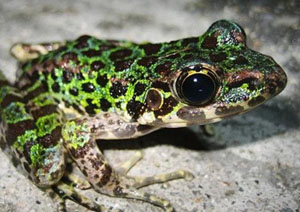
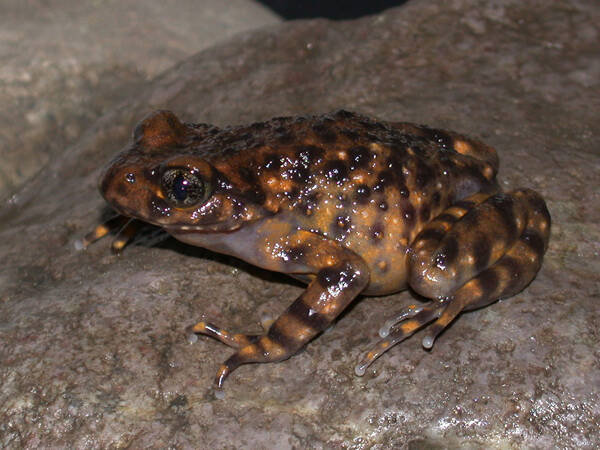
The Pouched Frog (Assa darlingtoni), also known as the hip-pocket frog, is a very small, fully terrestrial frog endemic to eastern Australia. It belongs to the family Myobatrachidae and is famous for the male’s inguinal pouches on either side of the body, in which developing tadpoles are carried until they metamorphose into tiny froglets.
Taxonomy & Names
Common names: Pouched Frog, Hip-pocket Frog, Australian Marsupial Frog;
Scientific name: Assa darlingtoni;
Family: Myobatrachidae (Australian ground frogs);
Genus: Assa – one of only two known species in this genus.
Appearance
The Pouched Frog is tiny but very distinctive:
Body size: adults are around 2.0–2.7 cm in snout–vent length;
Dorsal colour: reddish-brown, brown or grey-brown with lighter speckles and sometimes a faint reversed V-shaped marking on the back;
Lateral stripe: most individuals have a darker stripe running from the nostril through the eye along the side of the body;
Skin folds: a noticeable skin fold runs along each side from the eye towards the hip;
Belly: underside is pale, whitish to greyish, usually without strong patterns;
Limbs: hands and feet lack webbing and discs; the finger and toe tips are slightly swollen, suited to walking and crawling through leaf litter rather than long-distance jumping;
Pouches: males possess a pair of inguinal “pockets” where tadpoles are housed and complete their development.
Distribution & Habitat
The Pouched Frog is endemic to upland forests in south-eastern Queensland and northern New South Wales:
occurs in disjunct populations in mountain rainforests and adjacent wet sclerophyll forests;
typically found at higher elevations where conditions remain cool and moist.
Its habitat is characterised by:
deep leaf litter, mossy logs and rocks on the forest floor;
shaded gullies, slopes and ridges with consistently high humidity;
microhabitats under rocks, fallen timber and decomposing logs rather than open ground or ponds.
Behaviour
The Pouched Frog is a fully terrestrial, secretive species:
spends most of its time on or just beneath the forest floor, rarely seen in the open;
moves mainly by walking and short hops rather than long jumps;
hides by day under rocks, logs and deep litter and becomes more active in cool, moist conditions;
the call is a series of soft “eh-eh-eh…” notes, usually given at dawn and dusk and easily overlooked.
Diet
The diet consists mainly of very small invertebrates:
ants form a major part of the diet in many areas;
other tiny insects, springtails and small arthropods that live in leaf litter and soil;
the frog forages slowly through moist litter, snapping up any suitably sized prey.
Reproduction & Parental Care
The reproductive biology of the Pouched Frog is remarkable and highly specialised:
breeding takes place in the wetter, warmer months, often in spring and summer;
females lay small clutches of relatively large eggs in moist nests under logs, rocks or leaf litter on the forest floor;
both parents may guard the eggs, helping to keep them moist and protected from predators;
when the embryos are ready to hatch, tiny tadpoles emerge and wriggle into the male’s inguinal pouches;
all tadpole development occurs inside these pouches; tadpoles do not live freely in water and rely on yolk reserves;
after several weeks, fully formed froglets emerge from the pouches and begin life as miniature versions of the adults.
Conservation Status & Threats
Globally, on the IUCN Red List, Assa darlingtoni is currently listed asLeast Concern (LC), reflecting relatively stable populations where suitable habitat persists. However, under Australia’s Environment Protection and Biodiversity Conservation (EPBC) Act it is listed asVulnerable, recognising its restricted range and sensitivity to habitat change.
Key threats include:
loss and fragmentation of upland rainforests and wet forests through logging, clearing and infrastructure;
intense or frequent bushfires that alter forest structure and dry out the leaf-litter microhabitats;
climate change affecting rainfall patterns, cloud cover and moisture regimes in high-altitude forests;
disease risks such as chytrid fungus that impact amphibians more broadly.
Protecting rainforest and wet forest habitats within reserves and World Heritage areas, and managing fire and climate pressures, is critical for the long-term survival of the Pouched Frog.