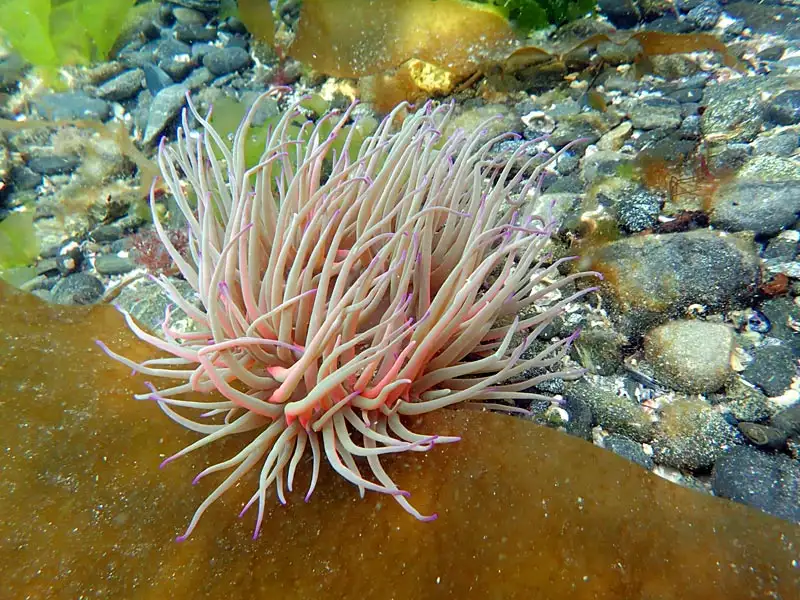
The Giant Green Anemone (Cnidopus verater), often simply called the Green Anemone, is one of the most eye-catching animals in North Pacific tidepools. Firmly attached to rock, it can resemble a bright green flower when the tide is in, with tentacles spread to intercept passing prey. When the tide goes out, it usually contracts into a smooth rounded mound, conserving moisture and protecting soft tissues from drying and intense light.
The green colour is more than decoration. Many individuals host symbiotic single-celled algae within their tissues. In good light these algae photosynthesize and provide part of the anemone’s energy, while the anemone still feeds as an active predator. Using nematocysts (stinging cells) on its tentacles, it captures small crustaceans, worms and sometimes tiny fish, then transfers prey to the mouth for digestion. Accidental contact with people typically causes mild irritation, but it is best to avoid touching intertidal animals.
Taxonomy and naming
This species is a cnidarian in the class Anthozoa and the order Actiniaria (sea anemones). The standard scientific name is Cnidopus verater. Common English names include Giant Green Anemone and Green Anemone.
Physical features
The body is a thick column topped by an oral disc with a central mouth. The disc is surrounded by many short, closely packed tentacles. Colour is typically vivid green on the disc and tentacles, with the column more olive or brown-green. At low tide the animal contracts strongly and turns the tentacles inward, which makes it look like a glossy green mound.
Range and habitat
Giant Green Anemones occur along the North Pacific coast and are especially well known from the rocky intertidal of the west coast of North America. They are most common in tidepools and moist rock features that reduce drying during low tide. They attach firmly to hard surfaces and can tolerate wave wash and rapidly changing conditions typical of intertidal life.
Behaviour and ecology
These anemones are largely sessile, feeding by extending tentacles into the water to grab prey or organic particles. They inflate and deflate by shifting water within the body: expanded when submerged, contracted when exposed. They respond quickly to touch or strong flow by withdrawing tentacles and tightening the body.
Diet
They eat small invertebrates such as crabs, amphipods, mussel larvae and worms, and may also capture small fish that wander into tidepools. Nematocysts immobilize prey, which is then moved to the mouth and digested inside the gastrovascular cavity. Photosynthetic products from symbiotic algae can supplement energy intake but do not replace feeding.
Reproduction and life history
Sea anemones can reproduce sexually and can also expand locally through asexual processes. Giant Green Anemones are long-lived, and once settled they may remain in a tidepool or crevice for many years. Early life stages are more sensitive to water quality and suitable substrate than established adults.
Relationship with people
Because of their colour and size, these anemones are popular subjects for tidepooling and nature education. The best practice is to observe without touching, avoid prying animals off rock, and step carefully to protect tidepool habitats. If skin irritation occurs after contact, rinse gently with seawater and avoid rubbing; seek medical advice if an allergic reaction develops.
Conservation status and threats
The species is generally listed as Not Evaluated on the IUCN Red List. Local threats may include coastal development, pollution, habitat disturbance, trampling and collecting. Protecting rocky intertidal and tidepool microhabitats helps maintain healthy local populations.