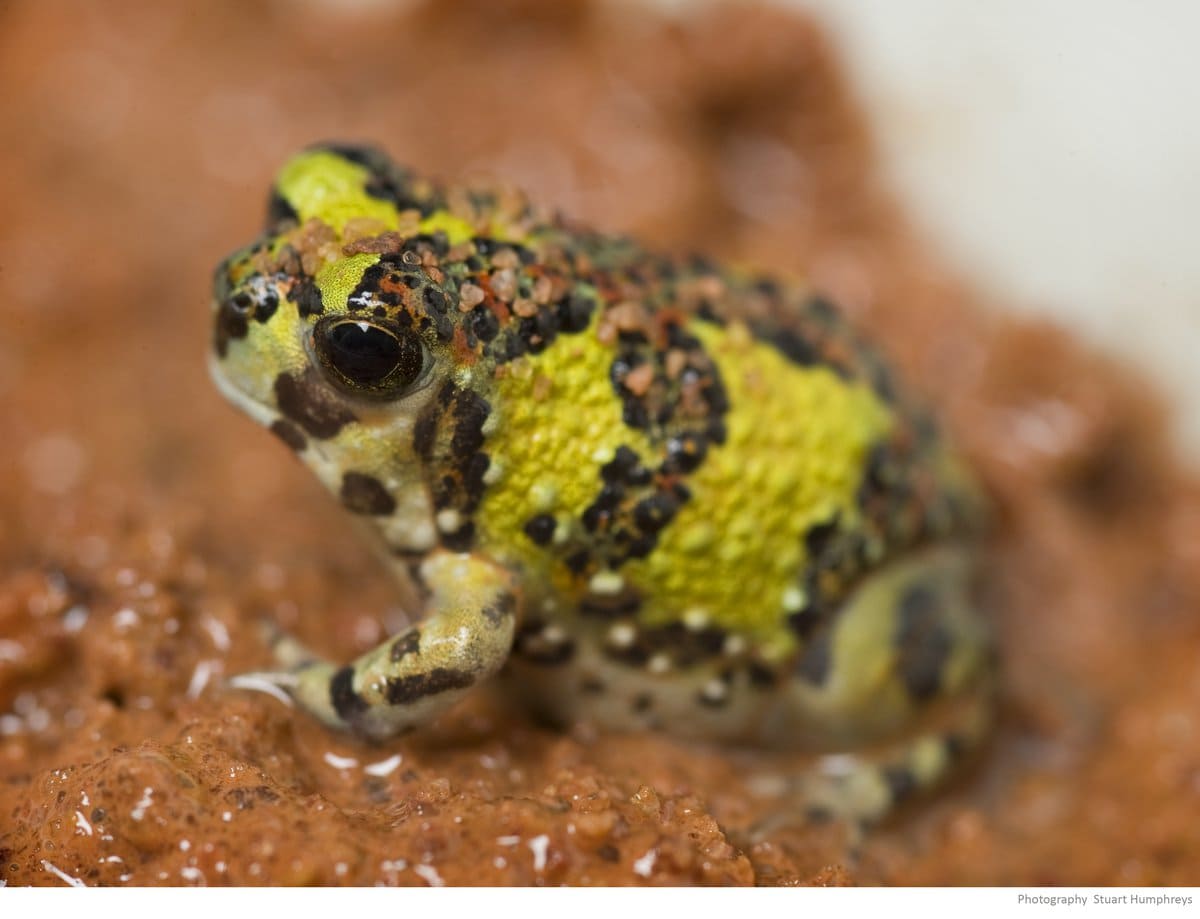
The Crucifix Frog (Notaden bennettii) is a small but strikingly colourful frog native to arid and semi-arid parts of Australia. It gets its common name from the bold cross-like pattern on its back, formed by reddish-brown patches on a bright yellow background. This unusual frog spends most of its life hidden underground and emerges mainly after heavy rain.
Taxonomy & Names
Common English names: Crucifix Frog, Crucifix Toad
Scientific name: Notaden bennettii
Genus: Notaden
Family (broad sense): Australian ground frogs related to other burrowing, water-storing species
Appearance
The Crucifix Frog is not large, but its colours make it one of the most distinctive frogs in Australia:
Body size: adults are usually around 4–6 cm in length;
Build: a short, round, almost squat body that appears plump or “ball-shaped” when fully inflated;
Dorsal colour: a bright yellow or yellow-green ground colour with bold reddish to dark brown patches, several of which combine in the centre of the back to form a cross-like pattern;
Belly: the underside is pale or whitish;
Skin texture: relatively smooth or only slightly granular on the back, with a soft, moist feel when active;
Limbs and head: the head is small and not strongly separated from the body; limbs are short but strong, well suited for digging into loose soil.
Distribution & Habitat
The Crucifix Frog is endemic to Australia, occurring in parts of the inland and eastern interior where rainfall is highly variable:
occupies arid and semi-arid grasslands, open shrublands and red-soil plains;
often associated with areas where heavy rain can create temporary pools and muddy depressions;
can also occur on lightly grazed rangelands and agricultural fringes where suitable soils remain.
For most of the year, individuals stay buried underground, only emerging to feed and breed when substantial rainfall moistens the soil and creates surface water.
Adaptations to Dry Environments
The Crucifix Frog is highly adapted to life in dry country and is a classic example of a burrowing, aestivating frog:
during prolonged dry periods it burrows down into deeper, moister soil layers;
it can form a cocoon-like layer of shed skin and mucus around its body, reducing water loss while it remains dormant;
when heavy rains arrive, the frog breaks out of this cocoon and surfaces to take advantage of the brief wet conditions.
These adaptations allow the species to survive long stretches of drought and then rapidly complete feeding and breeding during short wet “windows”.
Defence: Sticky Secretions
One of the most unusual features of the Crucifix Frog is its sticky defensive secretion:
when threatened, the frog’s skin exudes a thick, glue-like mucus that can stick to small predators or debris;
this sticky coating makes it difficult for some predators to handle or swallow the frog;
traditional knowledge suggests that Indigenous Australians have used this natural “glue” to help attach feathers and other decorations.
Together with its conspicuous colours, the sticky secretion likely serves as a strong warning and deterrent to potential predators.
Diet
The Crucifix Frog feeds mainly on small invertebrates:
small spiders and other arthropods active on the soil surface;
it forages during wet periods by moving slowly across the ground or waiting for prey to come within range of its tongue.
Breeding & Life Cycle
Breeding is closely tied to heavy rainfall events:
after substantial rain, males call from the edges of temporary pools and muddy depressions to attract females;
eggs are laid in shallow water, often in small pools that may persist only for a short time;
tadpoles must grow and metamorphose quickly before the water evaporates;
once metamorphosis is complete, the tiny froglets leave the water and seek suitable soil in which to burrow and grow.
Conservation Status & Threats
On the IUCN Red List the Crucifix Frog is currently listed as Least Concern (LC), reflecting its relatively broad distribution and lack of evidence for rapid overall decline.
Potential threats include:
habitat alteration from intensive agriculture, overgrazing and soil compaction;
pollution and pesticides affecting temporary breeding pools and tadpoles;
changes in rainfall patterns associated with climate change, which may alter the timing and reliability of breeding opportunities.
Maintaining areas of relatively undisturbed soils and protecting ephemeral wetlands and floodplains are important for the long-term conservation of this species and other arid-zone frogs.