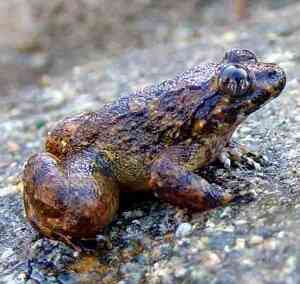
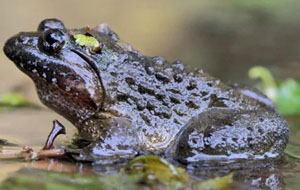
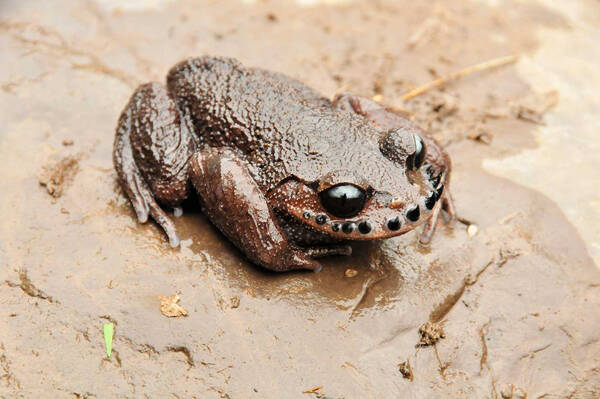
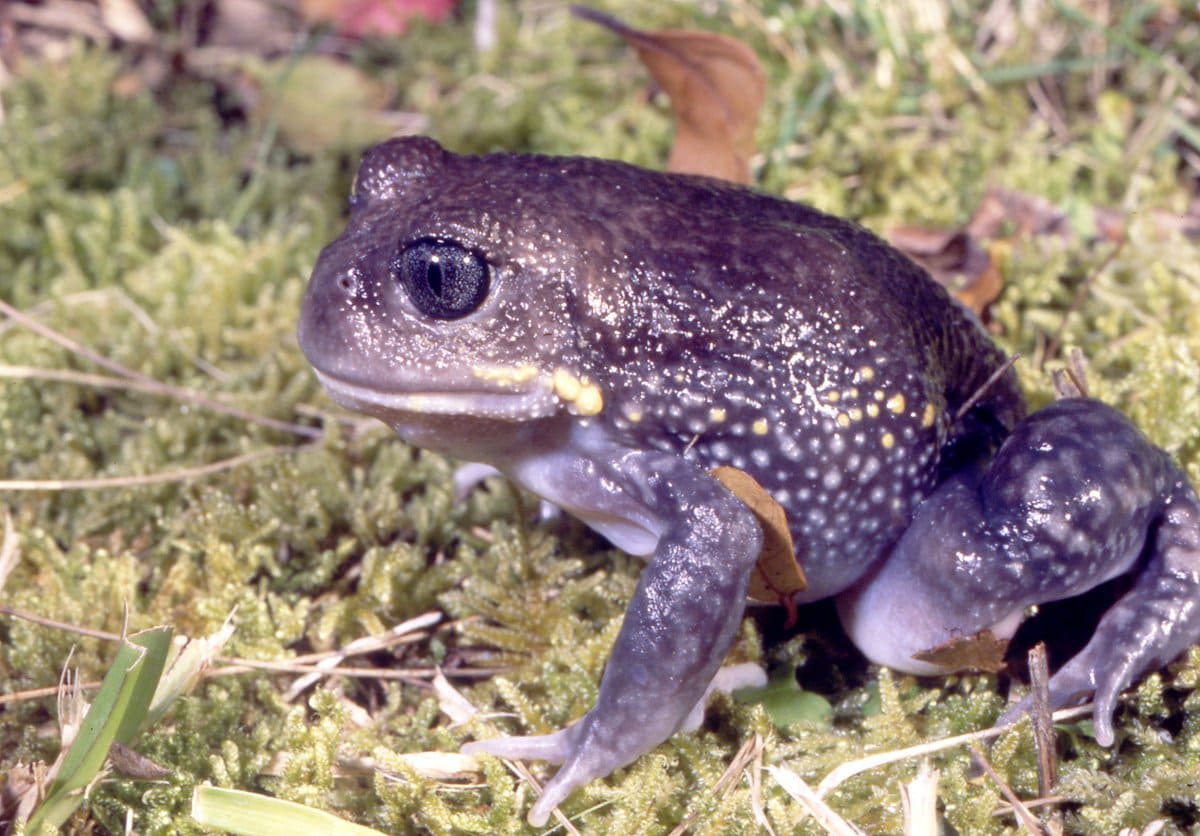
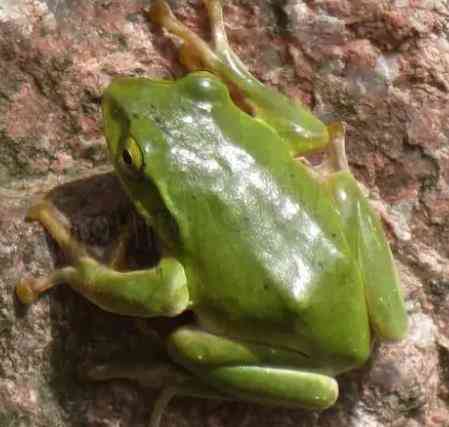
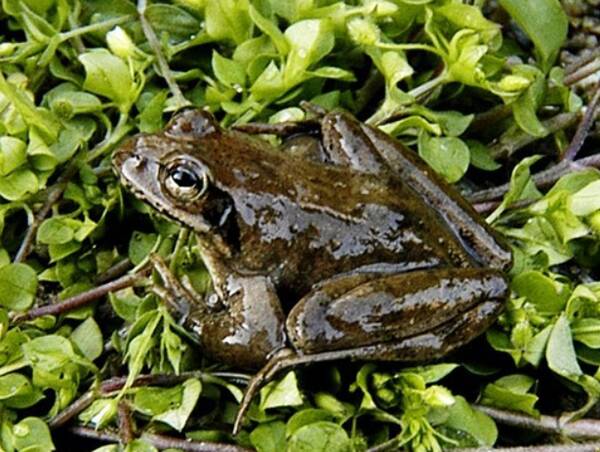
The Southern Sandhill Frog, commonly associated with the species Arenophryne rotunda, is a small, round-bodied burrowing frog specialised for life in coastal sand dunes of Western Australia. It belongs to the family Myobatrachidae and the genus Arenophryne, and is regarded as a classic example of an amphibian adapted to dry, sandy environments.
Taxonomy & Names
Common name: Southern Sandhill Frog (often referred to simply as Sandhill Frog);
Scientific name: Arenophryne rotunda;
Family: Myobatrachidae (Australian ground frogs);
Genus: Arenophryne.
Appearance
The Southern Sandhill Frog is instantly recognisable by its compact, almost spherical body shape:
Body size: adults are typically about 3–4 cm in snout–vent length, with a short, stout build;
Body shape: very rounded body with a short, blunt head, giving a “ball-like” appearance;
Dorsal colour: sandy yellow, grey-brown or brown, usually with fine speckling or diffuse mottling that closely matches the surrounding sand;
Belly: underside pale cream or light grey;
Skin texture: slightly rough or finely granular, helping the frog blend with sandy substrates;
Limbs: relatively short but powerful limbs, especially the hind legs and feet, which are adapted for burrowing and “backward digging” into loose sand;
Head & eyes: flattened head with eyes that are less protruding than in many tree frogs, suited to a fossorial lifestyle;
Overall impression: a small, round, sand-coloured frog perfectly shaped for life in deep coastal dunes.
Distribution & Habitat
The Southern Sandhill Frog is a localised endemic of coastal Western Australia:
occurs in southern parts of the coastal sand-dune belt in Western Australia;
its range is relatively narrow and closely tied to deep, loose sand near the coast.
Key habitat characteristics include:
mobile or semi-fixed coastal sand dunes and sandy coastal plains;
deep, loose, fine sand with scattered low shrubs and grasses;
overall arid to semi-arid climate with low, irregular rainfall and high evaporation.
Behaviour
The Southern Sandhill Frog is a highly specialised, nocturnal burrowing frog:
spends most of its time below the surface, using powerful hind limbs to bury itself backwards into loose sand;
emerges mainly at night, especially when temperatures are cooler and humidity is higher, or after rainfall;
when disturbed, it can rapidly disappear by digging backwards into the sand, leaving only a faint disturbance on the surface.
Call
The call of sandhill frogs is used for communication during the breeding season:
males produce a series of relatively low, somewhat nasal notes, repeated at intervals from within shallow sand burrows or among low vegetation;
calling is most common on moist nights following rainfall, when conditions are favourable for reproduction;
because the landscape is open and background noise is low, calls can carry surprisingly well across the dunes.
Diet
The Southern Sandhill Frog feeds on small invertebrates that inhabit sandy coastal ecosystems:
ants, small beetles, spiders, termites and other arthropods active on or just below the sand surface;
small insect larvae and other soft-bodied prey in the upper sand layers;
it forages at night, moving over the sand and between low plants to capture passing prey.
Reproduction & Development
Reproduction in the Southern Sandhill Frog is closely tied to rainfall and soil moisture and shows adaptation to arid conditions:
breeding tends to occur in wetter periods or after heavy rain, when the upper sand layers are moist;
males call from shallow burrows or sheltered spots among roots and vegetation in damp sand;
females lay eggs in moist underground chambers rather than in open surface water;
embryos develop within the sand, and development is thought to be largely terrestrial, with young emerging as froglets rather than free-swimming tadpoles, greatly reducing reliance on standing water.
Conservation Status & Threats
Available assessments indicate that Arenophryne rotunda is currently ofrelatively low global conservation concern (for example, listed as Least Concern in some evaluations), but its distribution is localised and dependent on intact coastal dune systems.
Key threats include:
disturbance and destruction of dune systems through coastal development, roads and tourism infrastructure;
off-road vehicle use on dunes, which can compact sand and damage microhabitats;
invasion by non-native plants that alter dune structure and moisture regimes;
climate change effects on rainfall patterns and soil moisture in already dry coastal environments.
Establishing and enforcing protected coastal areas, limiting disturbance in sensitive dune habitats and controlling invasive species are important measures for safeguarding Southern Sandhill Frogs and the unique dune ecosystems they inhabit.