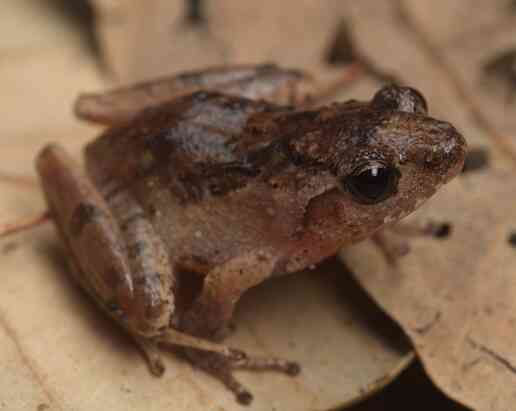
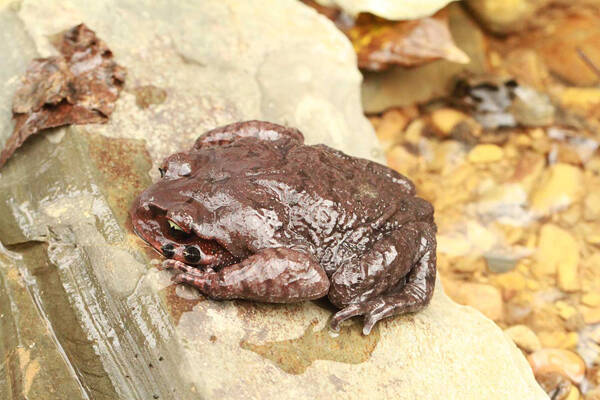
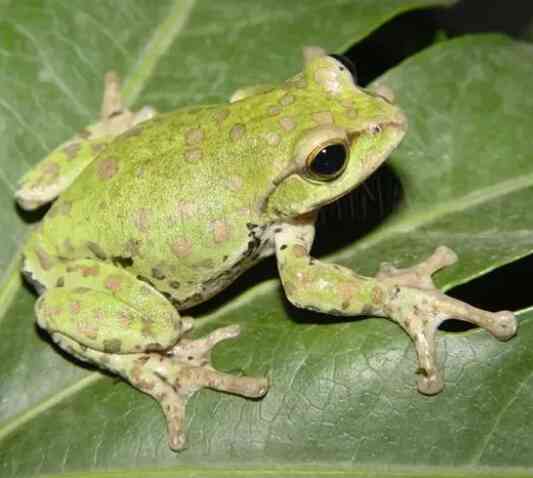
The Tapping Nursery Frog (Cophixalus infacetus) is a very small, ground-dwelling frog endemic to north-eastern Australia. It belongs to the family Microhylidae and the genus Cophixalus, a group commonly known as nursery frogs because many species complete development on land rather than in open water. The name “Tapping Nursery Frog” refers to both its reproductive strategy and its distinctive, tapping call.
Taxonomy & Names
Common name: Tapping Nursery Frog;
Scientific name: Cophixalus infacetus;
Family: Microhylidae (narrow-mouthed frogs);
Genus: Cophixalus.
Appearance
The Tapping Nursery Frog is tiny but relatively broad-headed and compact:
Body size: adults are only about 1.5–2.5 cm in snout–vent length;
Body shape: short, rounded body with a relatively wide head and short snout;
Dorsal colour: various shades of brown, grey-brown or yellow-brown, often with irregular darker markings that blend with leaf litter;
Eyes: comparatively large eyes suited to life on the dim forest floor;
Belly: underside pale grey, cream or yellowish;
Skin texture: slightly granular or finely warty on the back, but not strongly spiny or rough;
Limbs: slender limbs with slightly expanded toe tips that help the frog move across moist leaves and moss;
General impression: a tiny, leaf-coloured frog that is easily overlooked among forest debris.
Distribution & Habitat
The Tapping Nursery Frog is a localised endemic of north-eastern Queensland in Australia:
found in upland and some lowland rainforests and wet forests of north-eastern Queensland;
closely associated with moist, shaded forest floor habitats.
Typical habitat features include:
tropical rainforest and cloud forest with high humidity and relatively stable temperatures;
deep leaf litter, mossy logs, root systems and rock crevices providing many small hiding places;
consistently moist microhabitats that allow eggs and embryos to develop on land.
Behaviour
The species is a nocturnal, ground-dwelling frog with a small home range:
by day it shelters under logs, within leaf litter, under stones or among roots;
emerges at night to move slowly through leaf litter and low vegetation in search of food;
rarely strays far from the cool, moist microhabitats it requires.
Call
The Tapping Nursery Frog gets its English name from the male’s distinctive call:
the call is a series of short, sharp notes resembling the sound of tapping on wood or stone;
notes are repeated rhythmically, creating a “tock… tock… tock…” or “tup… tup…” pattern;
calls are most often heard on wet nights during the breeding season, coming from the forest floor or low cover.
Diet
Like many small microhylid frogs, the Tapping Nursery Frog feeds on tiny invertebrates:
small insects and their larvae, including ants and small beetles;
tiny arthropods inhabiting leaf litter, moss and soil surface;
prey is located and captured while the frog slowly moves through leaf litter at night.
Reproduction & “Nursery Frog” Development
A key feature of Cophixalus species is that many have terrestrial development, reducing dependence on open water. The Tapping Nursery Frog follows this general pattern:
breeding is timed to wetter periods when humidity is high and forest floors are moist;
males call from within leaf litter, under logs or near root systems to attract females;
females lay eggs in moist but non-flooded sites such as leaf litter, moss or humus-filled cavities;
embryos develop in these terrestrial nests, and development is believed to be largely direct, with hatchlings emerging as froglets rather than free-swimming tadpoles;
this strategy allows the species to exploit rainforest floor microhabitats without relying on streams or ponds.
Conservation Status & Threats
Current global assessments indicate that the Tapping Nursery Frog is ofrelatively low conservation concern (for example, listed as Least Concern in some evaluations), although its range is restricted and closely tied to intact rainforest.
Potential threats include:
loss and fragmentation of rainforest habitat through clearing and development;
disease risks affecting amphibians in general, such as chytrid fungal infections;
climate change impacts on rainfall patterns and humidity in upland rainforests.
Conserving rainforest habitats, controlling invasive species and monitoring amphibian health are important steps in maintaining healthy populations of Tapping Nursery Frogs and other nursery frogs.