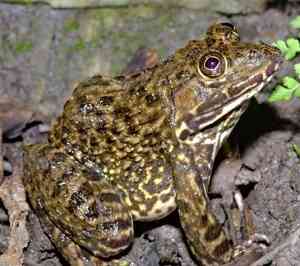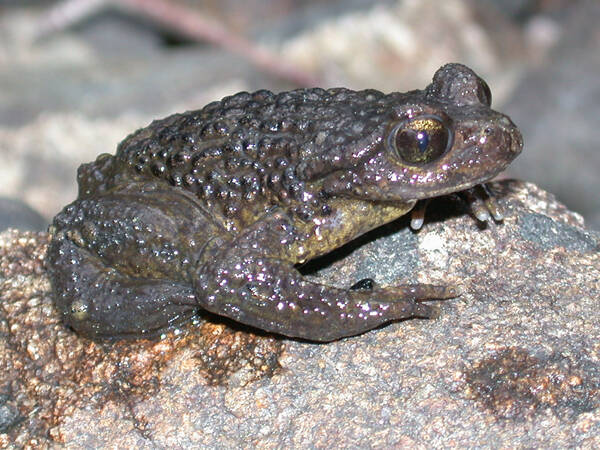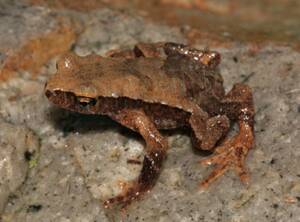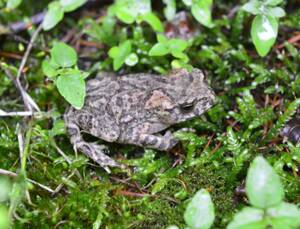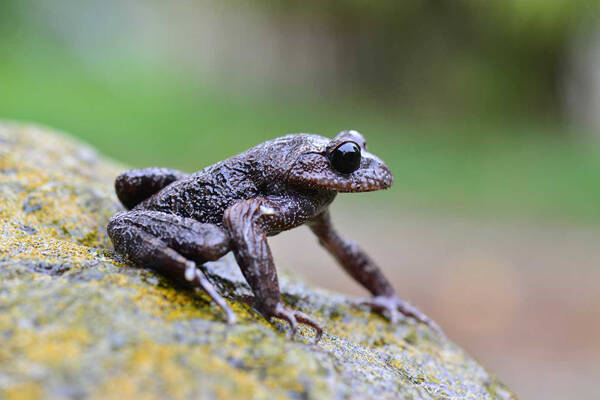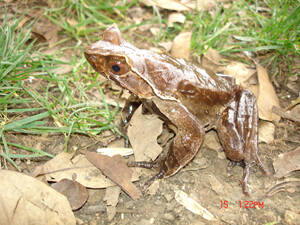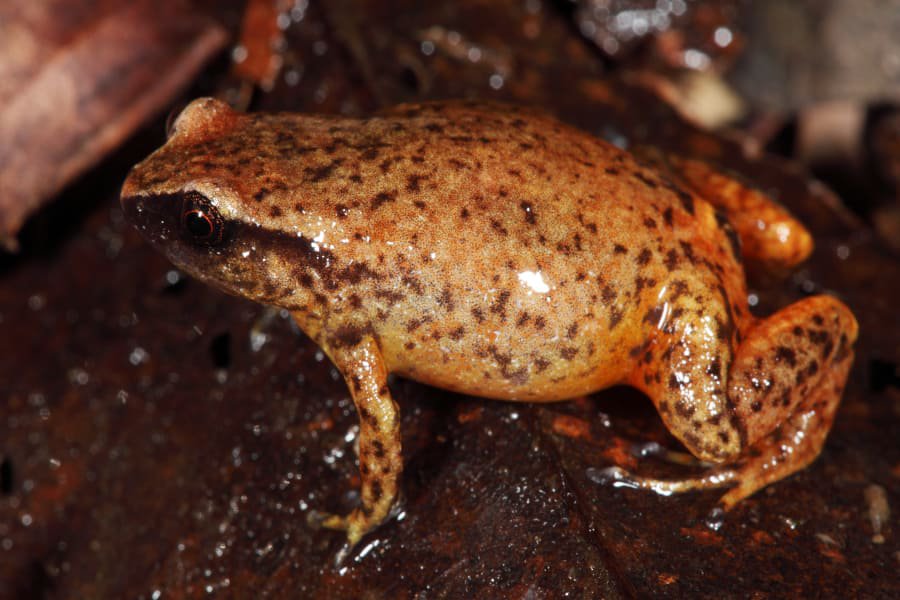
Fry’s Frog (Austrochaperina fryi), sometimes written as Fry Frog, is a small, ground-dwelling frog in the family Microhylidae. It is associated with moist forest floors in New Guinea and nearby high-rainfall regions, where it lives hidden among leaf litter and soil.
Taxonomy & Names
English name: Fry’s Frog, Fry Frog
Scientific name: Austrochaperina fryi
Family: Microhylidae (narrow-mouthed frogs)
Genus: Austrochaperina
Appearance
Fry’s Frog is inconspicuous in colour but well adapted to life on the forest floor:
Body size: adults are typically about 2–3 cm in length, making it a small frog;
Body shape: slightly spindle-shaped or rounded body with a relatively small, short head and short limbs;
Dorsal colour: brown, grey-brown or olive-brown with darker speckles or mottling, often closely matching the surrounding leaf litter and soil;
Belly: underside is paler – greyish, whitish or light yellowish – sometimes with fine spotting;
Skin texture: dorsal skin is smooth to slightly granular;
Feet: limbs are fairly short, with toe tips slightly expanded but without the large adhesive discs of tree frogs, and with little or no webbing, reflecting its mainly terrestrial habits.
Distribution & Habitat
Fry’s Frog is primarily associated with New Guinea and nearby moist montane or hill forests:
found in lowland to mid-elevation rainforests and moist hill forests;
often associated with valleys, slopes and gullies where humidity remains high.
It favours microhabitats with deep leaf litter and persistent moisture:
forest floors with thick layers of leaves, humus and decaying wood;
spaces under logs, stones and mossy roots;
areas close to small creeks, seepages or temporary forest pools, especially during wet periods.
Behaviour
Fry’s Frog is a secretive, ground-dwelling species:
by day it usually remains hidden deep in leaf litter, under logs or in small soil cavities, where humidity is higher;
it becomes more active at dusk and during the night, particularly when conditions are damp or during rainy periods;
movement is typically limited to short hops and walking on the forest floor, rather than climbing.
Because of its small size and cryptic colouration, the species is more often detected by experts during targeted surveys than by casual observers.
Diet
Like many microhylid frogs, Fry’s Frog feeds mainly on tiny invertebrates:
small insects such as ants, tiny beetles and springtails;
small spiders and other arthropods living in leaf litter;
other minute soil and litter invertebrates captured at close range.
It locates prey by sensing movement in the litter layer and rapidly flicking out its sticky tongue.
Breeding & Development
Publicly available information on the detailed breeding biology of Fry’s Frog is limited, but it likely follows patterns similar to related forest-dwelling microhylids:
breeding activity is associated with rainy periods and high humidity;
males call at night from moist ground or near temporary pools and seepages to attract females;
eggs may be laid in very small pools, shallow depressions or extremely moist ground among leaf litter;
tadpoles probably develop in small water bodies or thin films of water, or development may be relatively rapid to cope with fluctuating water availability.
Conservation Status & Threats
On the IUCN Red List, Fry’s Frog is currently assessed as Least Concern (LC), indicating that across its known range there is no strong evidence of rapid, large-scale decline.
Potential threats include:
loss and fragmentation of rainforest and moist hill forest due to logging and land conversion;
disturbance from road building and other infrastructure affecting local hydrology and humidity;
possible long-term impacts from climate change altering rainfall patterns and drying forest microhabitats.
Conserving intact forest, maintaining deep leaf litter and protecting small creeks and wet gullies are important for the continued survival of Fry’s Frog and other litter-dwelling amphibians.