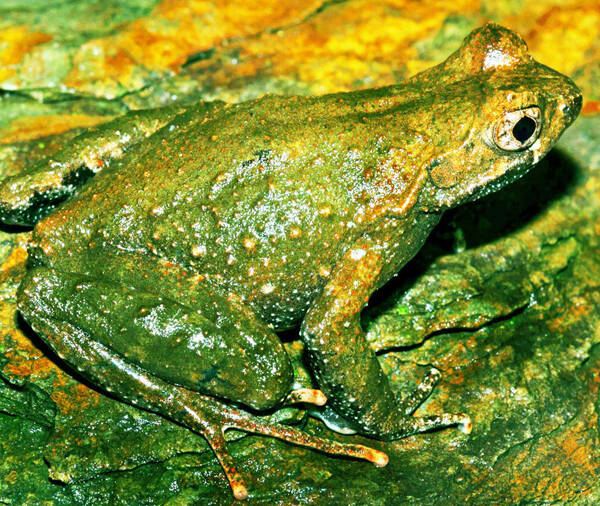
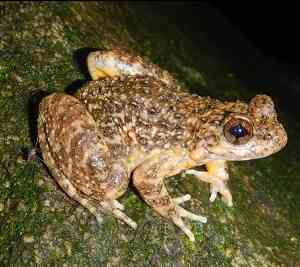
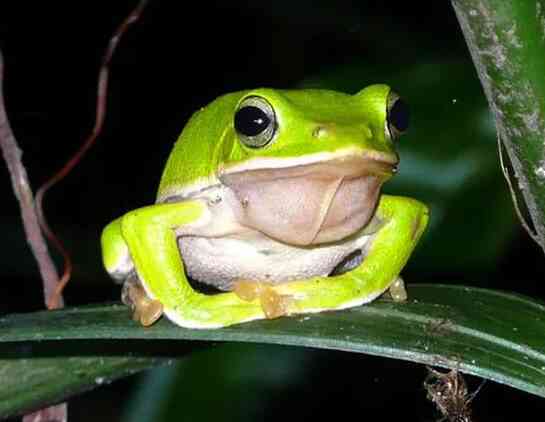
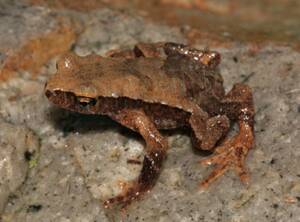
The Great Barred Frog (Mixophyes fasciolatus) is a large, robust ground-dwelling frog native to eastern Australia. It is closely associated with rainforest and wet sclerophyll forest streams, where its deep, barking calls are a familiar sound on wet nights.
Taxonomy & Names
English name: Great Barred Frog
Scientific name: Mixophyes fasciolatus
Family: Myobatrachidae (Australian ground frogs)
Genus: Mixophyes – a group of relatively large, stream-associated frogs
Appearance
The Great Barred Frog is a fairly large frog with distinctive body proportions and markings:
Body size: adults commonly reach 7–9 cm in length, with some females growing even larger;
Build: stocky, broad-bodied frog with a wide head and powerful hind limbs suited to jumping and moving along stream banks;
Dorsal colour: brown, olive-brown or golden-brown with darker mottling and cloud-like markings;
Leg bars: bold dark cross-bands on the hind limbs give the species its “barred” name;
Belly: underside is pale cream to yellowish, often with some spotting or marbling;
Head markings: a dark stripe or “mask” typically runs from the snout through the eye towards the shoulder, and the eardrum is clearly visible;
Skin texture: dorsal skin is slightly rough with small warty bumps and glandular swellings along the sides.
Distribution & Habitat
The Great Barred Frog is endemic to eastern Australia:
found mainly in south-eastern Queensland and eastern New South Wales;
occurs in high rainfall areas from coastal lowlands to upland forests and ranges.
It favours moist forest habitats associated with permanent or semi-permanent water:
rainforests, wet sclerophyll forests and moist gullies;
stream banks, waterfall plunge pools, seepages and forest ponds;
breeding often takes place in slow-flowing streams, roadside drains, temporary pools and flooded depressions in forests.
Behaviour
The Great Barred Frog is a nocturnal, ground-dwelling frog closely tied to water:
by day it usually shelters under rocks, logs, leaf litter or in burrows near streams and pools;
frogs emerge at dusk and at night to forage along stream margins and on the forest floor;
when disturbed, they often leap into water or retreat quickly into dense cover.
Call
Male Great Barred Frogs produce a loud, resonant call during the breeding season:
the call is often described as a deep “wark” or dog-like bark, repeated at intervals;
calling males are typically located near water – on stream banks, logs or vegetation overhanging pools;
on wet nights in suitable habitat, choruses of calling males can be heard echoing through gullies.
Diet
The species is carnivorous and feeds mainly on invertebrates, with occasional small vertebrate prey:
ground-dwelling insects such as beetles, crickets and cockroaches;
spiders, slugs and other arthropods and soft-bodied animals;
sometimes small frogs or other appropriately sized vertebrates.
Frogs typically hunt at night, moving slowly across damp ground and lunging at prey detected by sight and movement.
Breeding & Life Cycle
Breeding is strongly influenced by rainfall and water availability:
breeding generally occurs in warmer, wetter months, particularly after heavy rain;
males call from the edges of streams, ponds and temporary forest pools to attract females;
females deposit eggs in shallow water or in small depressions at the water’s edge, where flowing water may later reach them;
tadpoles develop in streams, drains and pools, often in relatively slow-flowing sections;
after metamorphosis, juvenile frogs leave the water and take up a terrestrial, streamside lifestyle.
Conservation Status & Threats
On the IUCN Red List the Great Barred Frog is currently classified as Least Concern (LC), reflecting its relatively broad distribution and stable populations in many areas.
Nonetheless, local populations can be impacted by:
loss and fragmentation of forest and riparian habitat through logging, agriculture and urban development;
changes to natural water flow and quality from dams, drainage works and pollution;
road traffic, trampling and predation by introduced animals such as cats and foxes;
potential disease threats and long-term changes in rainfall patterns due to climate change.
Conservation measures that protect forested catchments, maintain natural streamside vegetation and minimise pollution benefit the Great Barred Frog as well as many other stream-associated amphibians.