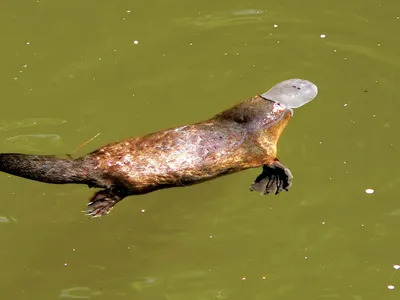
The platypus is one of Australia’s most iconic animals and one of the very few living mammals that lays eggs. It is semi‑aquatic and highly adapted to life in freshwater, where it dives to forage along the bottom and banks.
While underwater, the platypus closes its eyes, ears, and nostrils. Instead of relying on sight or hearing, it uses a remarkable combination of touch and electroreception in its bill to locate prey—making it uniquely effective in murky water and low light.
Taxonomy and naming
The platypus is a monotreme (order Monotremata), the same ancient lineage as echidnas. It is the only living species in its family (Ornithorhynchidae) and genus (Ornithorhynchus). Early European scientists were so surprised by its mix of traits that some initially suspected the first specimens were a hoax.
Physical features
Platypuses have a compact, streamlined body with exceptionally dense, insulating fur that also sheds water. The “bill” is not a hard beak but a sensitive, rubbery snout filled with mechanoreceptors and electroreceptors. These sensors detect minute electrical signals produced by muscle contractions in small aquatic animals.
The tail is broad and flat and functions as an energy store. The strongly webbed front feet provide most of the swimming power, while the hind feet and tail help with steering and stability. Adult males have a spur on each hind leg connected to venom glands; the venom is thought to be used mainly in male‑male competition rather than hunting.
Range and habitat
The species is native to eastern Australia and Tasmania, living in rivers, creeks, lakes, and some reservoirs. It favors waterways with stable flow regimes, good water quality, intact riparian vegetation, and banks suitable for digging. Individuals maintain burrows in the bank: shorter “resting burrows” and longer, more complex nesting burrows used for raising young.
Behavior and activity
Platypuses are generally solitary and are often most active from dusk through the night. During foraging, they perform repeated dives—typically lasting from tens of seconds to a few minutes—interspersed with brief surface intervals to breathe. Home ranges can overlap in productive stretches of river, but direct social interactions are limited.
Diet and hunting
Their diet is dominated by aquatic invertebrates such as insect larvae, small crustaceans, worms, and mollusks. While diving, the platypus scoops prey into cheek pouches and later chews and swallows it at the surface. Because it depends on healthy benthic (bottom‑dwelling) communities, declines in aquatic invertebrates can quickly translate into reduced food availability.
Reproduction and life cycle
Females build a nesting chamber at the end of a long nesting burrow, lining it with damp plant material. They typically lay 1–3 eggs and incubate them in the nest. After hatching, the tiny young remain in the burrow for months and are fed milk. Monotremes have no nipples; milk is secreted from mammary glands onto the skin, and the young lap it up.
Relationship with people
The platypus holds cultural importance across many First Nations communities and features in diverse local stories and traditions. Historically, platypuses were hunted for their fur, but legal protections were introduced in the late 19th and early 20th centuries. Today, conservation and long‑term river management are central to maintaining healthy populations.
Conservation status and threats
Globally, the platypus is listed as Near Threatened (NT) with an overall declining trend. Major threats include altered river flows from dams and water extraction, prolonged drought and climate change, bank and habitat degradation, sedimentation from land use, pollution, accidental drowning in nets and traps, and predation pressure from introduced or domestic animals (such as foxes, cats, and dogs). Conservation priorities often focus on protecting riparian zones, improving water quality, maintaining environmental flows, reducing bycatch in fishing gear, and monitoring populations across catchments.