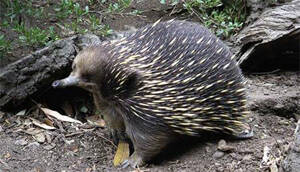
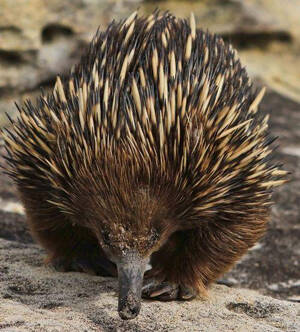
The short‑beaked echidna is one of Australia’s most iconic animals: a mammal that lays eggs, wears a coat of spines, and feeds mainly on ants and termites using a long, sticky tongue. Also known as the “spiny anteater,” it is remarkably adaptable and occurs across an enormous range of Australian environments.
Short‑beaked echidnas are mostly solitary and hard to spot. They often rest in cover during the day and become more active in the late afternoon, evening or night, especially in warm weather. When threatened, they either dig down fast—anchoring themselves in the soil—or curl into a tight spiny ball that protects the soft underside.
Taxonomy and naming
This species is a monotreme (an egg‑laying mammal) in the family Tachyglossidae. The scientific name is Tachyglossus aculeatus. The genus name reflects its “quick tongue,” and the species name refers to its spiny armour.
Physical features
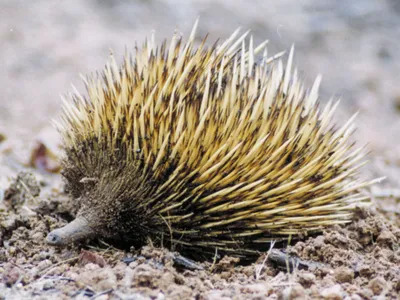
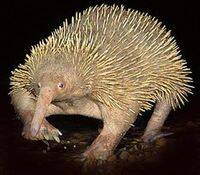
Short‑beaked echidnas have sharp keratin spines with fur between them, giving colour tones from brown to black. The body is low and robust. A firm, beak‑like snout holds the nostrils and a small mouth opening; echidnas do not chew much and instead capture prey with their tongue. Forelimbs are extremely strong with big curved claws for digging and ripping open termite mounds and rotting logs. The hind claws curve backward and help with grooming between spines.
Range and habitat
The species is widespread across Australia, including Tasmania, and extends into parts of New Guinea. It occupies many habitat types—eucalypt forests, scrub, woodland‑grassland mosaics, farmland edges, semi‑arid country and desert margins—provided there are ants or termites and suitable shelter (fallen logs, dense shrubs, rock crevices, or burrows). Because echidnas do not sweat and tolerate heat poorly, they often rest in cool refuges during hot periods.
Behavior and activity
Echidnas are typically solitary. Activity patterns shift with temperature and disturbance: in hot regions they may be mostly nocturnal, while in cooler conditions daytime foraging is more common. In colder parts of the range, individuals can enter torpor to reduce energy use. Their main defenses are their spines plus two strategies—rapid digging and curling into a ball—making them difficult for predators to handle.
Diet
They feed primarily on ants and termites, and may also eat beetle larvae, worms and other small invertebrates. A strong snout and foreclaws open nests and soil, then a long sticky tongue rapidly collects prey. The snout contains dense touch receptors and also electro‑sensing structures, which can help detect prey hidden in soil and decaying wood.
Reproduction and life cycle
Short‑beaked echidnas are egg‑laying mammals. During the breeding season, males may follow a female in a “train” until she chooses a mate. After mating, the female develops a temporary pouch and usually lays a single soft‑shelled egg, which she transfers into the pouch for incubation. The egg hatches after about 10 days. The tiny young (often called a “puggle”) has no spines at first and grows on rich milk that seeps from mammary pores (echidnas have no teats). After several weeks in the pouch, the young is left in a nursery burrow and the mother returns periodically to feed it until it is weaned and independent.
Relationship with people
Echidnas are common in many natural and semi‑urban areas, and their digging can improve soil aeration and nutrient cycling. The biggest human‑related risks are vehicle strike, dog attacks, and predation by feral cats in some landscapes. Habitat fragmentation can increase these encounters by forcing animals to cross roads and move through disturbed edges.
Conservation status and threats
Globally, the short‑beaked echidna is generally listed as Least Concern (LC) because it is widespread and flexible in habitat use. However, local populations can still be affected by roads, predation pressure from dogs and cats, loss of shelter features (such as fallen logs), and extreme heat or fire that temporarily reduces food and cover. Practical protection focuses on retaining micro‑habitats, safer road corridors, and responsible pet and predator management.