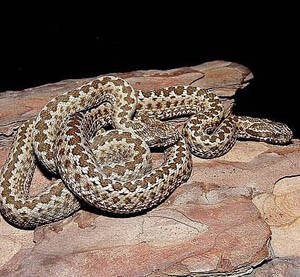
The Broad-headed Snake (Hoplocephalus bungaroides) is a small to medium-sized, highly distinctive venomous snake in the family Elapidae, and is one of Australia’s most range-restricted and threatened reptiles. Endemic to the sandstone landscapes of the Sydney Basin in New South Wales, this species is instantly recognisable by its broad, flattened, triangular head and bold black-and-yellow banded pattern. It is a specialised rock-dwelling and woodland species that moves seasonally between sandstone outcrops and adjacent forests, and its strong dependence on a very specific habitat has made it particularly vulnerable to human disturbance.
Taxonomy and naming
The Broad-headed Snake belongs to Class Reptilia, Order Squamata, Family Elapidae and Genus Hoplocephalus. The genus currently contains only three small elapid snakes, all restricted to eastern Australia. The generic name refers to the armoured or enlarged head scales, while the specific name bungaroides reflects an early, complex taxonomic history. The English common name “Broad-headed Snake” directly describes its characteristic wide, flattened head and narrow neck, one of the key features that distinguish it from many other sympatric snakes.
Physical characteristics
The Broad-headed Snake has a relatively slender body but a noticeably broad, flat, triangular head that is clearly set off from the narrow neck. Adults usually measure around 60–90 cm in total length and rarely exceed 1 m. The dorsal ground colour is dark brown to black, overlaid with a series of narrow yellow or orange-yellow bands or irregular diamond-shaped blotches, producing a striking banded pattern. From a distance, this pattern can resemble that of juvenile diamond pythons, which has led to frequent confusion by inexperienced observers. The belly is generally pale yellow to cream, sometimes with darker speckling. The scales are moderately glossy, and juveniles show a similar pattern to adults but are often brighter in colour.
Distribution and habitat
This species has an extremely limited natural range, being confined mainly to the Sydney Basin and nearby ranges within roughly 200–250 km of Sydney in New South Wales, Australia. It is strongly associated with Triassic sandstone outcrops, especially weathered rock platforms and cliff edges with thin, flat slabs that form narrow crevices. During the cooler months, both adults and juveniles shelter beneath sun-exposed sandstone slabs, using the rock as a natural “solar heater”. As temperatures rise in spring and summer, adult males and non-gravid females often move into adjacent woodlands and forests, where they occupy tree hollows, fallen logs and loose bark. Gravid females and juveniles tend to remain in rock habitats for longer, shifting between warmer and cooler crevices according to seasonal and daily temperature changes.
Behaviour and lifestyle
The Broad-headed Snake is largely nocturnal or crepuscular. By day it typically remains hidden under rocks or within tree hollows, emerging around dusk and at night to forage. Movements are generally cautious and deliberate, with snakes slowly cruising over rock platforms or along branches in search of prey. When threatened, they may flatten the head and neck, inflate the forebody and adopt a defensive S-shaped posture while hissing loudly. If the threat continues to approach, the snake may strike and deliver a venomous bite. The venom is neurotoxic and myotoxic and is potent enough to subdue small vertebrate prey; it is also medically significant to humans, although bites are uncommon and usually associated with people handling or disturbing the snakes.
Diet
Broad-headed Snakes are carnivorous predators that feed primarily on small reptiles and mammals. Field studies show that juveniles and subadults prey heavily on rock-dwelling geckos, especially Lesueur’s Velvet Gecko, which is abundant in sandstone habitats. As they grow larger, adults broaden their diet to include other lizards, small snakes and small mammals such as mice that shelter in rock crevices or tree hollows. The snake often adopts an ambush strategy, lying in wait near crevice entrances or hollow openings and striking rapidly when potential prey moves past. Venom and strong jaws quickly immobilise prey, which is then swallowed whole.
Reproduction and life cycle
The Broad-headed Snake is viviparous and gives birth to live young rather than laying eggs. Males reach sexual maturity at around five years of age, while females usually mature at about six years, and reproduction is relatively infrequent. Mating occurs from autumn through spring after snakes resume activity from the cooler months. Females typically reproduce only every second year, giving birth between about January and April. Litter sizes range from roughly 4 to 12 young. Neonates are born enclosed in thin membranes that they soon break free from, and they are fully independent from birth, equipped with functional venom glands and displaying the same characteristic pattern as adults. Growth is slow, and wild individuals are thought to live for at least 10 years, with captive snakes potentially surviving longer under good husbandry.
Relationship with humans
Historically, Broad-headed Snakes were more frequently encountered around rocky areas near Sydney, but extensive habitat modification has greatly reduced their numbers. Because their banded pattern resembles that of juvenile diamond pythons, people sometimes misidentify them as harmless pythons and attempt to catch them, increasing the risk of bites. In reality, Broad-headed Snakes are shy and secretive and do not actively seek out human contact. Most bites occur when snakes are deliberately handled or when people lift rocks and place their hands close to hidden snakes. In their natural environment, the safest and most responsible approach is to avoid disturbing rock slabs, never collect “bushrock” for gardens, and leave any wild snake undisturbed.
Conservation status and threats
The Broad-headed Snake is listed as Vulnerable on the IUCN Red List and is recognised as an endangered or threatened species under New South Wales and Australian Commonwealth legislation. Its decline is driven by a combination of factors, most notably the removal of sandstone “bushrock” for landscaping, which destroys key rock crevice shelters, as well as urbanisation, road construction, altered fire regimes and illegal collecting for the pet trade. Conservation programs focus on protecting and restoring sandstone outcrops, restricting rock removal, installing artificial rock slabs and enhancing habitat connectivity between rocky escarpments and surrounding woodlands. Public education aimed at discouraging rock removal and illegal collecting, and encouraging appreciation of native snakes, is also critical for the long-term survival of this unique species in the wild.