The Common Death Adder (Acanthophis antarcticus) is a short, stocky and highly venomous elapid, famous for its excellent camouflage and lightning-fast strike. Native to parts of eastern and southern Australia and Papua, it is among the most venomous land snakes in the world. Unlike most Australian elapids that actively forage for prey, the death adder is an ambush specialist that spends long periods coiled in leaf litter, using its tail tip as a lure to draw prey within striking range.
Taxonomy and naming
The Common Death Adder belongs to Class Reptilia, Order Squamata, Suborder Serpentes, Family Elapidae and Genus Acanthophis. Several species of death adders are currently recognised, all characterised by short, thick bodies, broad triangular heads and potent neurotoxic venom. Acanthophis antarcticus was first described in 1802 and is the most widespread member of the genus. Despite its strong resemblance to true vipers, it is an elapid, not a member of the viper family (Viperidae). The viper-like appearance, stocky build and ambush lifestyle are a striking example of convergent evolution.
Physical characteristics
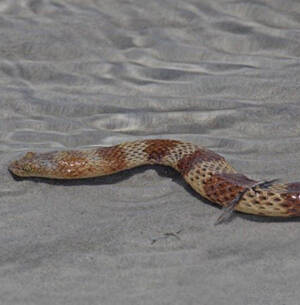
The Common Death Adder is a medium-sized snake but very stout in build, with a broad, flat, triangular head that is clearly distinct from the narrow neck. The body is thick and tapers abruptly to a very short, thin tail. The eyes are relatively small with vertically elliptical pupils, reflecting its crepuscular and nocturnal habits. Colour and pattern are highly variable: individuals may be sandy, grey-brown, reddish-brown or dark brown, usually with a series of darker crossbands or irregular bands along the body. The belly is paler, typically grey, cream or pinkish, often with fine mottling. The tail terminates in a narrow, contrasting tip that resembles a small grub or worm and is used as a caudal lure. When curled up in leaf litter, the snake closely resembles a piece of fallen wood or debris.
Distribution and habitat
This species occurs across parts of eastern and coastal southern Australia, including sections of Queensland, New South Wales and South Australia, with more scattered records from the Northern Territory and Western Australia. It has disappeared from some former parts of its range but remains widespread overall. The Common Death Adder also occurs in Papua. It occupies a variety of habitats, such as forests, woodlands, heathlands, shrublands and grasslands, especially where there is deep leaf litter or loose surface debris. Here it coils among leaves, twigs and soil, relying on its disruptive banded pattern to remain undetected.
Behaviour and lifestyle
The Common Death Adder is primarily crepuscular to nocturnal, spending much of the day hidden and becoming more active at dusk and during the night. Rather than actively roaming for prey, it usually adopts a sit-and-wait strategy, remaining in the same position for hours or even days. When threatened, it often stays still and relies on camouflage rather than fleeing, which increases the chance that people might accidentally step near or on it. If provoked or accidentally disturbed at close range, it can raise the forebody into a slightly elevated posture and deliver an extremely rapid strike.
Diet
This species is a carnivorous ambush predator. Its diet includes small mammals, birds, lizards and frogs. One of its most distinctive hunting behaviours is tail luring: the snake coils tightly with its head concealed near the body and wiggles the pale, worm-like tail tip close to the head. Inquisitive prey that approach to investigate or grab the apparent “worm” are struck with remarkable speed, injected with a dose of potent venom and then released. The adder waits for the prey to succumb before following the scent trail and swallowing it whole.
Reproduction and life cycle
Unlike many snakes that lay eggs, the Common Death Adder is viviparous in the broad sense and gives birth to live young. Breeding takes place in the warmer months, with timing varying across its range. Females retain the developing embryos for several months before giving birth to litters usually containing around 3–20 young, though litters of over 30 have been recorded. Newborn death adders measure only a few centimetres in length but already resemble miniature adults in pattern and form, and are equipped with functional venom glands and a working caudal lure. Captive individuals can live for at least nine years, and wild adults are thought to reach 10 years or more under favourable conditions.
Relationship with humans
Historically, the Common Death Adder had a fearsome reputation because many bites were fatal before effective antivenom and modern intensive care became available. Its venom is strongly neurotoxic and can cause progressive paralysis and respiratory failure if untreated. Today, with rapid first aid, prompt transport to hospital and the use of appropriate antivenom, most patients survive, but any suspected death adder bite must still be treated as a medical emergency. Because the snake relies on camouflage and often does not flee, people walking through bushland, leaf litter or long grass may inadvertently come very close, increasing the risk of accidental bites.
Conservation status and threats
At the global level, the Common Death Adder is currently assessed as Least Concern on the IUCN Red List, reflecting its broad distribution and persistence across many habitats. However, some regional populations are declining due to habitat loss, land clearing, road mortality and deliberate killing. A major emerging threat is the invasion of toxic cane toads: young death adders may be eaten by toads, while adult death adders that prey on cane toads are themselves poisoned. Long-term conservation of this species depends on protecting suitable woodland and shrubland habitats, managing invasive species such as cane toads, and improving public understanding of snake ecology and safe behaviour in snake-prone areas.