The Dugite (Pseudonaja affinis) is a slender, highly venomous elapid snake native to south-western Western Australia. It is one of the best-known “brown snakes” in the region and a significant contributor to snakebite incidents around Perth and nearby agricultural areas. At the same time, Dugites play an important ecological role as predators of rodents and other small vertebrates, helping to control pest populations in farmland and semi-urban landscapes.
Taxonomy and naming
The Dugite belongs to Class Reptilia, Order Squamata, Suborder Serpentes, Family Elapidae and Genus Pseudonaja. This genus includes several species of highly venomous brown snakes, such as the Eastern Brown Snake (Pseudonaja textilis) and the Dugite. Pseudonaja affinis itself is usually divided into a number of subspecies or regional forms based on colouration and distribution, all commonly referred to as Dugites. In Western Australia, the name “Dugite” is widely used by the public as the standard term for the local dangerous brown snake.
Physical characteristics
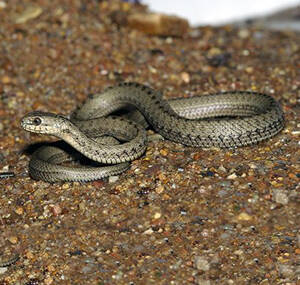
Dugites are medium to fairly large, but relatively slender snakes with narrow, coffin-shaped heads that are only slightly wider than the neck. The eyes are of moderate size with round pupils. Colouration is variable and can range from olive-brown and greyish-brown to deep chocolate brown or almost black. Some individuals, particularly certain subspecies, show fine speckling or subtle patterning formed by lighter and darker scales, while others appear almost uniform in colour. The belly is usually much paler—cream, off-white or light yellowish-brown—often with small darker flecks along the sides. The smooth scales and even, brown-toned appearance provide excellent camouflage among dry grass, leaf litter and soil.
Distribution and habitat
The Dugite is almost entirely restricted to south-western Western Australia, including the Swan Coastal Plain around Perth, adjacent hills and extending into parts of the semi-arid interior. It occupies a broad range of habitats, from native heathlands, woodlands and shrublands to farmlands, pastures, vineyards, golf courses and suburban reserves. Typical microhabitats include the bases of grass tussocks, rock and debris piles, rabbit burrows and other mammal holes, as well as gaps beneath sheds, fences and other structures. Its ability to exploit human-modified environments, together with abundant rodent populations, helps explain its success in agricultural and peri-urban landscapes.
Behaviour and lifestyle
Dugites are primarily diurnal, especially active on warm, sunny days in spring and summer, although they may also move during the late afternoon or early evening in hot weather. They travel swiftly across open ground and along fence lines or vegetation edges while hunting. The species is highly alert and will often retreat quickly into cover when it detects vibration or movement. However, if cornered, stepped on or otherwise provoked, a Dugite may raise the front of its body, flatten the neck, hiss and deliver rapid strikes. Like other brown snakes, it is capable of injecting a medically significant dose of venom in a very short time.
Diet
Dugites are carnivorous predators with a strong preference for small mammals, particularly rodents such as introduced rats and mice, as well as some native small marsupials. Around farms, grain stores and urban edges, they are drawn to areas where rodent populations are high, thereby functioning as natural rodent controllers. They also feed on lizards, other snakes (including smaller venomous and non-venomous species), birds and nestlings, and occasionally frogs and other small vertebrates. Prey is located using both vision and chemosensory cues, then seized in a rapid strike and envenomed. The potent venom quickly incapacitates the victim, which is then swallowed whole.
Reproduction and life cycle
The Dugite is oviparous. Breeding generally occurs in spring and early summer, when males roam widely in search of receptive females and may engage in combat with rival males. After mating, females lay a clutch of eggs in a sheltered, warm and relatively humid location such as under logs, within burrows or in deep debris piles. Clutch size varies with female size and condition but typically consists of around a dozen or more eggs. The eggs incubate in the substrate, and hatchlings emerge fully independent, resembling small versions of the adults and already equipped with functional venom glands and fangs. Young Dugites quickly begin to feed on small lizards and juvenile rodents.
Relationship with humans
In south-western Western Australia, Dugites are among the snakes most frequently involved in medically significant bites. Their occurrence in farmland, outer suburbs and even some urban green spaces brings them into regular contact with people and domestic animals. Most bites, however, result from accidental encounters—such as stepping on a snake—or attempts to capture or kill it. Dugites do not actively seek out humans and prefer to avoid confrontation when possible. Any suspected Dugite bite must be treated as a medical emergency: the recommended first aid is pressure immobilisation of the affected limb and immediate transport to hospital for observation, investigation of coagulation status and administration of antivenom if indicated.
Conservation status and threats
Despite their fearsome reputation, Dugites are currently considered secure across most of their range and are generally listed as Least Concern on conservation assessments. Their ability to utilise disturbed habitats and exploit rodent-rich environments has likely helped maintain their populations. Local threats include road mortality, habitat loss and fragmentation, deliberate killing due to fear, and potential impacts of pesticides and other contaminants on both snakes and their prey. Long-term conservation of Dugites depends on maintaining mosaics of native and semi-natural habitat, promoting responsible rodent control methods that minimise non-target poisoning, reducing unnecessary persecution and improving public understanding of how to live safely alongside venomous snakes.