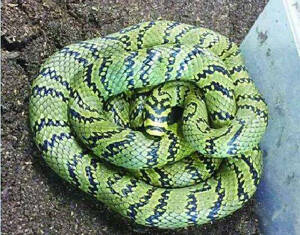
The Golden-crowned Snake (Cacophis squamulosus) is a small, secretive elapid snake native to eastern Australia. Belonging to the family Elapidae and the genus Cacophis, it is best known for the distinctive golden or pale yellow crown-shaped marking on the top of its head, which gives the species its common name. Golden-crowned Snakes are primarily nocturnal and spend much of the day hidden under rocks, logs and leaf litter, emerging at night to hunt small reptiles and amphibians.
Taxonomy and naming
This species is classified within Class Reptilia, Order Squamata, Suborder Serpentes, Family Elapidae and Genus Cacophis. Species in Cacophis are small elapid snakes characterised by a contrasting pale “crown” or head marking. The specific name squamulosus refers to the fine scaling of the body. The English common name “Golden-crowned Snake” describes the golden-coloured marking across the top of the head and behind the eyes, which is a key field mark for identification.
Physical characteristics
The Golden-crowned Snake is a slender, small-bodied snake, with adults typically reaching total lengths of about 50–75 cm. Dorsal colouration is usually dark brown, grey-brown or olive-brown, while the belly is much paler, often creamy or orange-tinged. The most striking feature is the pale golden or yellow crown-shaped marking on the head, extending from the snout over the top of the head and forming curved pale bands behind the eyes that contrast with the darker surrounding scales. The head is slightly flattened, the eyes are moderate in size with round pupils, and the body is covered in small, smooth, glossy scales that facilitate movement through soil, leaf litter and tight crevices.
Distribution and habitat
The Golden-crowned Snake occurs along parts of the eastern seaboard and adjacent inland regions of Australia, from south-eastern Queensland through much of eastern New South Wales and into some southern areas. It inhabits moist to semi-moist forests, eucalypt woodlands, rainforest margins, creek gullies and dense shrublands, especially where there is abundant ground cover such as leaf litter, fallen timber, rocks and other debris. In suburban and urban areas it may persist in gardens, parks and vegetated reserves that provide suitable shelter and humidity. By day it typically hides under logs, stones, bark and dense litter, becoming active after dark.
Behaviour and lifestyle
The species is mainly nocturnal and highly secretive. During the day, Golden-crowned Snakes remain concealed, avoiding heat and predators. At dusk and during the night they emerge to forage, moving slowly and carefully through leaf litter and low vegetation. When disturbed, individuals may coil tightly, raise the front part of the body and display a defensive posture, sometimes striking or mock-striking to deter perceived threats. Despite these displays, they generally prefer to retreat rather than engage in prolonged confrontation.
Diet
Golden-crowned Snakes are carnivorous and feed chiefly on small reptiles and amphibians. They commonly prey on skinks and other small lizards, reptile eggs, frogs and frog eggs, and occasionally other small vertebrates and invertebrates encountered on the forest floor. Using a combination of chemical and tactile cues, they search through leaf litter, around logs and in soil crevices for suitable prey, then seize it with a quick strike and subdue it with venom. Their slender bodies allow them to access tight spaces where lizards and eggs are concealed.
Reproduction and life cycle
The Golden-crowned Snake is oviparous. Breeding takes place in the warmer months, and females lay clutches of several to around a dozen eggs in moist, sheltered sites such as within deep leaf litter, under logs or among tree roots and rocks. Incubation is entirely dependent on ambient temperature and humidity. When development is complete, hatchlings emerge as miniature replicas of the adults, already capable of hunting very small prey. As with many small snakes, juvenile mortality can be high due to predation and environmental stresses, and only a fraction of hatchlings survive to reproductive age.
Relationship with humans
Although Golden-crowned Snakes are venomous, they are generally considered to pose a low risk to healthy adult humans. Their venom is effective on small prey but bites to people typically cause local pain, swelling and discomfort rather than severe systemic effects. Nevertheless, any bite from a venomous snake should be treated seriously: the victim should keep calm, immobilise the affected limb and seek prompt medical assessment. Around homes and gardens, Golden-crowned Snakes tend to avoid direct contact and rarely bite unless handled or provoked.
Conservation status and threats
On a global scale, the Golden-crowned Snake is usually assessed as Least Concern, with populations considered relatively stable across much of its range. However, local declines may occur where native forest and woodland are cleared or fragmented for urban development, agriculture and roads. Additional pressures include road mortality, predation by domestic cats and other introduced predators, and persecution due to fear of snakes in general. Conservation-friendly actions include retaining ground cover and woody debris in gardens and reserves, reducing unnecessary killing of snakes, keeping cats indoors or supervised, and promoting public education about the ecological role and modest risk profile of small native snakes such as the Golden-crowned Snake.
References
Cogger, H.G. 1992. Reptiles and Amphibians of Australia. Reed Books.
Glasby, C.J., Ross, G.J.B. & Beesley, P.L. (eds) 1993. Fauna of Australia. Vol. 2A Amphibia & Reptilia. AGPS, Canberra.
Griffiths, K. 1997. Frogs and Reptiles of the Sydney Region. UNSW Press, Sydney.
Swan, G. 1990. A Field Guide to Snakes and Lizards of New South Wales. Three Sister Productions, Winmalee.