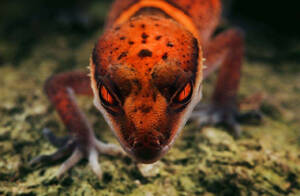
The Southern Leaf-tailed Gecko (Phyllurus platurus) is a medium-sized, highly camouflaged gecko of the family Carphodactylidae, endemic to the Sydney Basin of New South Wales, Australia. It has a flattened body, a broad leaf-shaped tail and rough, spiny scales that closely resemble sandstone rock and tree bark, allowing it to blend almost perfectly into its surroundings.
Taxonomy and naming
The Southern Leaf-tailed Gecko belongs to Class Reptilia, Order Squamata, Suborder Sauria, Family Carphodactylidae and Genus Phyllurus. Species of Phyllurus are leaf-tailed geckos native to eastern Australia, characterised by flattened bodies and leaf-shaped tails. Phyllurus platurus is also widely known as the broad-tailed gecko or Sydney leaf-tailed gecko, names that refer to its broad tail and typical occurrence in the Sydney region.
Physical characteristics
Southern Leaf-tailed Geckos are moderate in size, reaching up to about 15 cm in total length from snout to tail tip. The body is flattened and covered in rough, tubercular scales and small spines. Colouration is typically mottled brown or grey with darker and lighter blotches and patches that mimic lichen-covered sandstone and bark. The tail is broad, flattened and leaf-like, often with irregular edges and notches that help break up the outline and enhance camouflage. Unlike many other geckos, this species has well-developed claws rather than large adhesive toe pads, an adaptation for clinging to rough rock and bark. The head is broad with large eyes, lacking eyelids, and has vertical pupils typical of nocturnal geckos.
Distribution and habitat
Phyllurus platurus is endemic to Australia and is common in the Sydney Basin and adjacent areas of New South Wales, from around Newcastle south to the Illawarra. It is strongly associated with coastal sandstone landscapes, including cliffs, boulder fields, rock faces and crevices, but also occurs in nearby forests and rainforest gullies. The species has adapted well to urban and suburban environments, where it may be found on house walls, retaining walls, fences, garages and building foundations that provide suitable cracks and refuges.
Behaviour and lifestyle
The Southern Leaf-tailed Gecko is strictly nocturnal. By day it usually hides in rock crevices, under stones, in tree hollows or beneath building structures, resting tightly pressed against the substrate. After dark it emerges to forage, moving slowly over rock surfaces, tree trunks and man-made structures in search of prey. When threatened, individuals often rely on camouflage, remaining motionless against rock or bark. If further provoked, they may open the mouth, hiss and adopt a defensive posture. Like many geckos, they can shed the tail as a last resort to distract predators; the tail later regenerates, although the replacement tail may differ in shape and pattern from the original.
Diet
Southern Leaf-tailed Geckos are primarily insectivorous. They feed on a variety of invertebrates, including spiders, moths, beetles, cockroaches and other nocturnal insects, and will opportunistically take other suitably sized arthropods. In urban areas they often hunt around lights and walls where insects congregate at night, effectively acting as natural pest controllers around houses and gardens.
Reproduction and life cycle
The species is oviparous. Breeding generally takes place in late spring and summer. Females usually lay one or two soft-shelled eggs in a sheltered, humid site such as a rock crevice or beneath leaf litter, where the eggs are protected from desiccation. Incubation in the wild takes roughly two to three months, after which the hatchlings emerge fully independent and able to feed on small insects within a few days. Young geckos take up to about two years to reach full adult size. Longevity in the wild is not well documented, but individuals are thought to live for around 8–10 years or more, with captive animals potentially surviving even longer under good care.
Relationship with humans
In the Sydney region the Southern Leaf-tailed Gecko is one of the more frequently encountered native reptiles around rock gardens, retaining walls and houses built on sandstone. It is harmless to people, lacking venom glands, and plays a useful role by consuming cockroaches, moths and other insects. When handled roughly it may bite in self-defence, but bites are superficial and pose little risk beyond minor skin damage and possible infection. As with all native reptiles in Australia, collection and keeping are regulated by law, and wild geckos should not be captured without appropriate licences.
Conservation status and threats
On a global scale the Southern Leaf-tailed Gecko has not yet been individually assessed by the IUCN Red List (Not Evaluated), and within the Sydney Basin it remains relatively common where suitable sandstone habitat persists. However, local populations can be affected by habitat loss and fragmentation due to urban expansion, removal or modification of sandstone outcrops, road construction and quarrying. Additional threats include predation by introduced animals such as cats and foxes and incidental mortality from domestic pets and vehicles. Conservation of the species is supported by retaining natural sandstone outcrops and native vegetation, designing wildlife-friendly gardens and green spaces, managing feral predators and promoting public appreciation of native geckos.