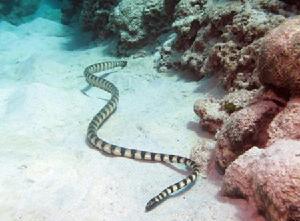
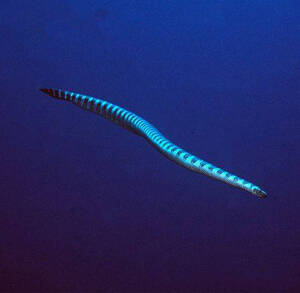
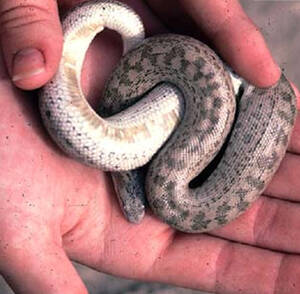
The Tiger Snake (Notechis scutatus) is a large, highly venomous elapid native to southern Australia, including Tasmania and many coastal islands. It is well known for its often striking banded pattern—dark and light crossbands reminiscent of a tiger’s stripes—although colour and pattern can vary greatly between regions and even between individuals. Tiger Snakes are among the most medically important snakes in Australia and are strongly associated with wetlands, estuaries and other habitats close to water.
Taxonomy and naming
The Tiger Snake belongs to Class Reptilia, Order Squamata, Suborder Serpentes, Family Elapidae and Genus Notechis. Most modern authorities treat all regional forms, including island populations, as a single, highly variable species, Notechis scutatus. Earlier classifications recognised additional species or subspecies within the complex, but these are now usually regarded as geographic variants. The specific name scutatus refers to shields or scales, reflecting the heavily scaled body.
Physical characteristics
Tiger Snakes are robust, medium- to large-sized snakes. Adults commonly reach about 1–1.5 m in total length, with particularly large individuals approaching or exceeding 2 m. Dorsal colouration is extremely variable: individuals may be olive, yellow-brown, orange-brown or jet black, with many showing contrasting pale and dark bands or crossbands that give the classic “tiger” appearance, while others are more uniformly coloured with indistinct or absent banding. The belly is usually paler, cream, yellowish or orange. The head is somewhat broader than the neck, with medium-sized eyes and round pupils, and the species has fixed front fangs typical of elapid snakes. When threatened, Tiger Snakes flatten the body and raise the forepart in a classic pre-strike posture.
Distribution and habitat
Notechis scutatus is endemic to Australia and occurs across much of the southern coastal fringe, from south-western Western Australia through South Australia and Victoria to south-eastern New South Wales, as well as on Tasmania and numerous offshore islands. Tiger Snakes are strongly associated with wetlands and other moist habitats, including river floodplains, creeks, swamps, lagoons, farm dams, irrigation channels and coastal marshes. They are excellent swimmers and are frequently encountered close to permanent or seasonal water, using rock piles, logs, burrows and dense vegetation for shelter.
Behaviour and lifestyle
Tiger Snakes are tolerant of cooler temperatures and may be active by day or during warm evenings and nights, depending on local climate. In cooler regions they bask to raise body temperature, retreating to burrows or dense cover during the hottest or coldest parts of the day. When disturbed they often attempt to escape, but if cornered they will flatten the neck and body, hiss loudly and may strike repeatedly. In addition to being strong swimmers, Tiger Snakes can climb low shrubs, logs and even man-made structures when searching for basking sites or prey.
Diet
Tiger Snakes are carnivorous predators that feed mainly on vertebrates. On the mainland, adult snakes primarily consume frogs and small mammals such as rodents and also take fish, birds and bird eggs. On some offshore islands, seabird chicks form an important part of the diet. Tiger Snakes usually hunt around water and in moist grasslands, using vision and chemosensory cues to locate prey before striking and injecting highly potent venom. The prey may be held or released and followed until it succumbs, after which it is swallowed whole. Juveniles often specialise more on small frogs, lizards and fish.
Reproduction and life cycle
Like many Australian elapids, the Tiger Snake is viviparous, giving birth to live young rather than laying eggs. Mating typically occurs in spring and early summer, and males may engage in ritualised combat. After mating, embryos develop inside the female’s body for several months. Females give birth in summer to litters that often number 20–30 neonates, with exceptional records of more than 60 young from a single female. Newborn Tiger Snakes are small but fully equipped with venom glands and fangs and are capable of independent hunting soon after birth. The species can live for roughly 10–15 years in the wild, and captive individuals may survive even longer.
Relationship with humans
Because Tiger Snakes favour wetlands, farm dams and watercourses near human settlement, encounters with people are not uncommon in parts of southern Australia. Historically they have been responsible for a significant proportion of serious and fatal snakebites in the country. Their venom contains potent neurotoxins, myotoxins and coagulants that can cause paralysis, muscle breakdown, kidney damage and death without prompt treatment. Any suspected Tiger Snake bite is a medical emergency requiring immediate application of a pressure immobilisation bandage and rapid transport to hospital for antivenom and supportive care. In most Australian jurisdictions, Tiger Snakes are legally protected, and killing or harming them can attract substantial fines and other penalties.
Conservation status and threats
On the IUCN Red List, the Tiger Snake is currently assessed as Least Concern, reflecting its wide distribution and overall stable global population. Nevertheless, some local and island populations are vulnerable to habitat loss and degradation, wetland drainage, road mortality, persecution and predation by introduced animals such as foxes and cats. Conservation of Tiger Snakes is closely tied to the protection and restoration of wetland and riparian habitats, the retention of refuges such as rock piles and logs and public education that reduces fear-driven killing of native snakes while emphasising safe coexistence and appropriate bite management.